
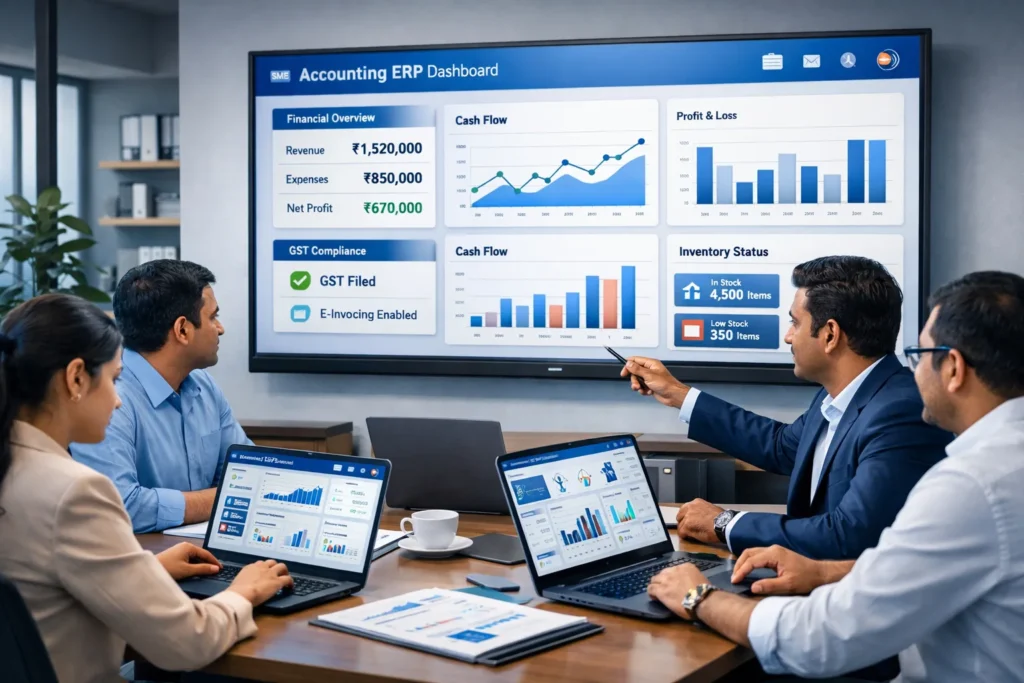
Managing finances is no longer just about bookkeeping for small and mid-sized businesses. As SMEs grow, they face challenges like complex taxation, inventory mismatches, delayed reporting, and poor cash flow visibility. This is why more businesses are searching for the best accounting ERP software to gain control, accuracy, and scalability.
Unlike standalone accounting tools, accounting ERP software integrates finance, inventory, compliance, and reporting into a single platform. In this guide, we’ll explain what accounting ERP software is, its pricing, key modules, ROI, and how SMEs can choose the right solution.
What Is Accounting ERP Software?
Accounting ERP software is an integrated business management system that centralizes accounting, finance, taxation, inventory, and reporting into one unified platform. It helps SMEs automate financial operations and make data-driven decisions.
Accounting Software vs Accounting ERP Software
Traditional accounting software focuses mainly on:
- Bookkeeping
- Invoicing
- Basic financial reports
Accounting ERP software goes further by offering:
- Integrated inventory and costing
- Compliance automation (GST, VAT, TDS)
- Real-time financial dashboards
- Workflow automation and audit trails
For growing SMEs, ERP eliminates data silos and manual reconciliation between systems.
Who Should Use Accounting ERP Software?
The best accounting ERP software is ideal for:
- Small and mid-sized businesses (SMEs)
- Manufacturing and production units
- Trading and distribution companies
- Service-based businesses with multi-branch operations
- Businesses managing GST, e-invoicing, or job costing
Key Features of the Best Accounting ERP Software for SMEs
Core Accounting & Finance Modules
A robust accounting ERP includes:
- General Ledger (GL)
- Accounts Payable & Accounts Receivable
- Chart of Accounts management
- Automated journal entries
- Profit & Loss, Balance Sheet, and Cash Flow reports
These features ensure accuracy, compliance, and faster financial closing.
Taxation & Compliance Management
Modern SMEs need ERP systems that support:
- GST, VAT, and TDS compliance
- E-invoicing and e-way bill integration
- Automated tax calculations
- Regulatory-ready reports
The best accounting ERP software reduces compliance risks and penalties.
Inventory & Cost Management
Accounting ERP connects inventory with finance to provide:
- Real-time stock valuation
- Batch, serial, FIFO/LIFO tracking
- Job costing and cost centres
- Reduced stock mismatches and wastage
Automation & Workflow Controls
ERP software improves efficiency with:
- Approval workflows
- Role-based access control
- Complete audit trails
- Automated reconciliation
Reporting, Dashboards & Analytics
Decision-makers benefit from:
- Real-time financial dashboards
- MIS and custom reports
- Exportable reports for audits and management reviews
- Accurate forecasting and budgeting tools
Pricing Models of Accounting ERP Software for SMEs
Understanding pricing is crucial when selecting the best accounting ERP software.
Subscription-Based (Cloud ERP) Pricing
Cloud ERP pricing typically includes:
- Monthly or annual subscription
- Per-user or per-module pricing
- Lower upfront investment
Cloud accounting ERP is ideal for SMEs due to flexibility, scalability, and remote access.
One-Time Licence (On-Premise ERP) Costs
On-premise ERP pricing involves:
- One-time licence fee
- Server and infrastructure costs
- Annual maintenance and upgrade charges
This model suits businesses with strict data residency needs.
Hidden Costs to Watch Out For
SMEs should consider:
- Implementation and customisation fees
- Data migration costs
- Training and ongoing support expenses
ROI of Using the Best Accounting ERP Software
Cost Savings Through Automation
ERP reduces:
- Manual accounting work
- Data entry errors
- Compliance penalties
- Dependency on multiple software tools
Improved Cash Flow & Financial Visibility
With real-time insights, SMEs can:
- Track receivables and payables accurately.
- Improve working capital management
- Close books faster
Scalability & Long-Term Growth
Accounting ERP supports:
- Multi-branch and multi-location growth
- Increased transaction volumes
- New regulatory requirements
This makes ERP a long-term investment rather than just a software expense.
How to Choose the Best Accounting ERP Software for Your SME
Business Size & Industry Fit
Choose ERP based on:
- Industry-specific needs (manufacturing, trading, services)
- Transaction volume
- Compliance requirements
Must-Have vs Nice-to-Have Features
Avoid overcomplicated systems. Prioritise:
- Core accounting
- Inventory integration
- Compliance automation
- Reporting and dashboards
Ease of Use & Implementation
The best accounting ERP software should offer:
- User-friendly interface
- Fast implementation
- Local support and training
Data Security & Compliance Readiness
Ensure the ERP provides:
- Secure cloud infrastructure
- Regular backups
- Compliance-ready updates
Cloud vs On-Premise Accounting ERP – Which Is Better for SMEs?
Benefits of Cloud Accounting ERP Software
- Lower upfront costs
- Anywhere, anytime access
- Automatic updates and compliance changes
- Faster deployment
When On-Premise ERP Makes Sense
- Highly customised workflows
- Strict internal data policies
- Limited internet connectivity
Common Mistakes SMEs Make While Selecting Accounting ERP Software
- Choosing based only on price
- Ignoring future scalability
- Underestimating implementation effort
- Not involving finance and operations teams
Avoiding these mistakes ensures better ROI and smoother adoption.
FAQs About the Best Accounting ERP Software
The best accounting ERP software depends on business size, industry, compliance needs, and scalability requirements.
Costs range from affordable monthly subscriptions to higher one-time licences, depending on deployment and features.
Yes, ERP offers deeper integration, automation, inventory control, and scalability compared to standalone accounting tools.
Implementation typically takes a few weeks to a few months, depending on customisation and data migration.
Yes, modern accounting ERP software supports GST compliance, e-invoicing, and statutory reporting.
Why SMEs Should Invest in the Best Accounting ERP Software
Choosing the best accounting ERP software empowers SMEs with financial clarity, operational efficiency, and scalable growth. With integrated modules, real-time insights, and strong compliance support, accounting ERP is no longer optional—it’s essential for competitive businesses.
Ready to simplify accounting and gain real-time financial control?
Book a free demo of the best accounting ERP software designed for SMEs.
Great post! Thanks for sharing this valuable information. Keep up the excellent work.