
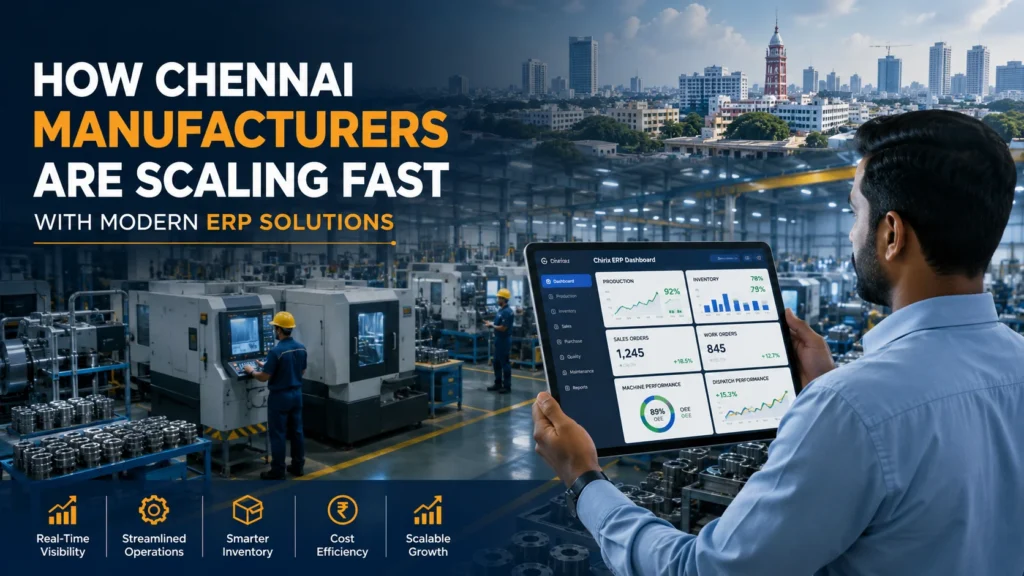
Chennai has earned its reputation as the “Detroit of India” for good reason. From the automotive and auto-component belts of Oragadam and Sriperumbudur to the engineering and electronics manufacturing clusters around Ambattur and Guindy, the city’s factories are running at a pace few other Indian manufacturing hubs can match. Global OEMs, Tier-1 suppliers, and hundreds of ancillary units call Chennai home, and orders keep growing.
But growth exposes cracks fast. A factory that ran fine on spreadsheets and WhatsApp groups at 50 orders a month starts breaking down at 500. Bills of material get outdated. Job work orders sent to subcontractors go untracked. GST filings slip because nobody has real-time visibility into invoices. This is exactly where ERP solutions for Chennai manufacturers are becoming less of a nice-to-have and more of a survival requirement.
In this post, we’ll look at why Chennai’s manufacturing sector is under pressure to scale, what modern ERP actually delivers on the shop floor, and how manufacturers across the city are using it to grow without the operational chaos that usually comes with scaling up.
Why Chennai’s Manufacturing Sector Is Under Pressure to Scale
The Automotive and Auto-Ancillary Boom in Oragadam & Sriperumbudur
Chennai’s automotive corridor – anchored by major OEM plants in Oragadam and Sriperumbudur – has pulled in hundreds of component suppliers, forging units, and precision engineering shops. As OEM production volumes rise, every Tier-2 and Tier-3 supplier downstream feels the pressure to match delivery schedules, quality certifications, and cost targets. Manual production planning simply can’t keep pace with the just-in-time delivery expectations that automotive supply chains demand.
Rising Competition from Coimbatore, Pune, and Gujarat Clusters
Chennai manufacturers aren’t just competing with each other. Coimbatore’s engineering and pump manufacturing base, Pune’s automotive cluster, and Gujarat’s fast-scaling industrial belt are all vying for the same OEM contracts and export orders. Factories that can quote faster, deliver on time, and prove compliance digitally have a real edge, and that edge increasingly comes down to whether a factory runs on connected systems or disconnected spreadsheets.
Common Bottlenecks – Manual BOM Tracking, Delayed WIP Visibility, and GST Filing Errors
Ask any Chennai plant manager where time gets lost, and the answers repeat: bills of material (BOM) maintained in Excel that go stale the moment a design changes; work-in-progress (WIP) that’s invisible until a floor supervisor manually walks the shop; and GST returns and e-way bills reconciled at month-end instead of in real time. These aren’t small inefficiencies; they’re the difference between winning a repeat order and losing it to a faster competitor.
What “Modern ERP” Actually Means for a Manufacturing SME
Beyond Accounting Software – MRP, BOM, and Shop-Floor Integration
A lot of SMEs still think of ERP as glorified accounting software. Modern manufacturing ERP goes much further; it ties material requirements planning (MRP), multi-level BOMs, and shop-floor data capture into one system. When a sales order comes in, the system automatically checks material availability, triggers purchase requisitions, and updates production schedules; no manual cross-checking is required.
Cloud-Based vs. On-Premise ERP for Chennai Factories
Chennai manufacturers are increasingly choosing cloud-based ERP over traditional on-premise servers. Cloud ERP means a plant owner can check production status from a phone while travelling for a client meeting in Bangalore, and IT overhead drops significantly since there’s no server hardware to maintain. On-premise still has a place for units with strict data residency requirements, but for most SMEs, the cloud has become the default.
Real-Time OEE and Production Dashboards
Overall Equipment Effectiveness (OEE) dashboards give plant managers a live read on machine utilisation, downtime causes, and throughput – replacing the end-of-shift paper logs that used to take a day to compile into anything useful. For a Chennai factory running multiple shifts, this real-time visibility is often the single biggest unlock for identifying where capacity is quietly being lost.
Key Ways Chennai Manufacturers Are Using ERP to Scale
Automating Job Work Orders for Subcontracted Auto-Component Units
Auto-component manufacturers frequently send semi-finished parts out for processes like plating, heat treatment, or machining. Tracking these job work orders manually – what left the factory, what’s due back, and what’s overdue – is a common source of delays. ERP systems automate job work order issuance, track subcontractor turnaround times, and flag delays before they cascade into missed OEM deliveries.
Streamlining GST, E-Invoicing, and E-Way Bill Compliance
GST compliance, e-invoicing, and e-way bill generation are non-negotiable for any Chennai manufacturer moving goods across state lines to OEM plants or export ports. Modern ERP platforms generate these documents automatically as part of the sales and dispatch workflow, cutting the manual reconciliation work that used to eat up finance teams’ time at month-end.
Reducing Inventory Holding Costs with Real-Time Stock Visibility
Overstocking raw materials to avoid production stoppages ties up working capital — often unnecessarily. Real-time stock visibility across multiple warehouses or shop-floor stores lets manufacturers hold leaner inventory without risking a production halt, freeing up capital that can be redeployed into growth.
Faster Quote-to-Cash Cycles for Export-Orientated Units
For Chennai’s export-orientated manufacturers, the time between quoting a buyer and receiving payment directly affects cash flow. ERP-driven quote-to-cash workflows from costing and quotation through production, dispatch, and invoicing compress this cycle significantly, which matters even more when dealing with international payment terms.
Chirix ERP vs. Traditional Systems: What Changes on the Ground?
Many legacy ERP systems used by Chennai manufacturers were built for generic businesses, not manufacturing-specific workflows like multi-level BOM management or job work tracking, leading to heavy customisation costs and long implementation timelines.
How Chirix ERP Is Built Specifically for Manufacturing Workflows
Chirix ERP is designed around the realities of Indian manufacturing SMEs from day one – native MRP and BOM handling, job work order tracking, GST and e-invoicing built in, and OEE dashboards that don’t require a separate add-on module. For Chennai manufacturers, that means faster go-live and fewer workarounds.
How to Choose the Right ERP for Your Chennai Manufacturing Unit
Questions to Ask Before You Sign a Contract
- Does the ERP support multi-level BOM and job work order tracking out of the box?
- Is GST, e-invoicing, and e-way bill generation built in, or does it require a third-party add-on?
- What’s the realistic implementation timeline for a plant of our size?
- Can the vendor show manufacturing-specific case studies, not just generic ones?
Implementation Timeline – What to Expect in the First 90 Days
Most SME ERP rollouts follow a similar arc: weeks 1–3 for requirements mapping and data migration, weeks 4–8 for configuration and shop-floor pilot testing, and weeks 9–12 for full rollout and team training. Factories that phase this properly see far fewer disruptions than those trying to go live all at once.
Frequently Asked Questions
The best ERP for a Chennai manufacturer is one built specifically for manufacturing workflows — with native support for BOM, MRP, job work orders, and GST/e-invoicing compliance — rather than a generic business ERP adapted after the fact.
Costs vary based on the number of users, modules required, and customisation needs. Most Chennai SMEs can expect a phased implementation that scales cost with rollout stage rather than a single large upfront payment.
Yes. Modern manufacturing ERP platforms generate GST-compliant invoices, e-invoices, and e-way bills automatically as part of the sales and dispatch process, reducing manual reconciliation.
A typical mid-sized manufacturing unit in Chennai can expect a 90-day implementation timeline, covering requirements mapping, configuration, pilot testing, and full rollout.
Scaling Chennai’s Manufacturing Future with the Right ERP Partner
Chennai’s manufacturers aren’t short on ambition or order volume, what’s often missing is the operational backbone to scale without breaking. Modern ERP closes that gap, turning manual BOM tracking, disconnected job work orders, and last-minute GST scrambles into a single, real-time system built for how manufacturing actually works.
Ready to see how Chirix ERP fits your factory’s workflow? Book a demo with Shenin Singh,