
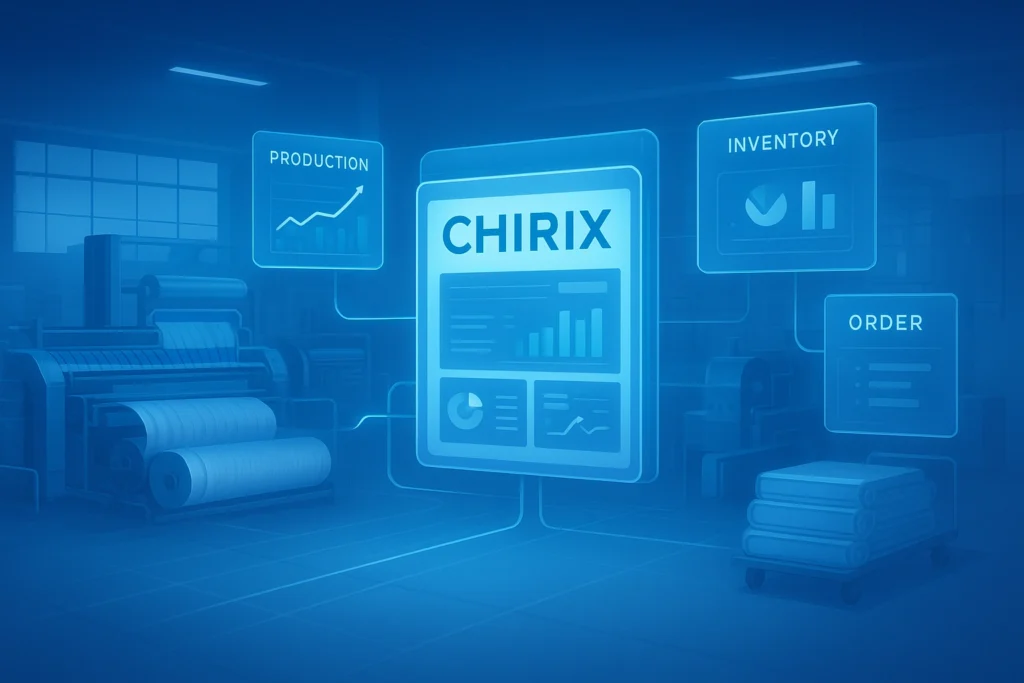
The textile industry is undergoing a rapid digital transformation. Global competition, rising customer expectations, increasing production costs, and shrinking delivery timelines are pushing manufacturers to modernise faster than ever before.
To stay competitive in 2026, textile factories must rely on technology that delivers real-time insights, improves operational control, and ensures agility. This is exactly where ERP software for textile industry plays a transformative role.
Among various solutions in the market, Chirix ERP stands out as a textile-focused platform designed to support complex production workflows, ensure accuracy, and streamline factory operations end-to-end.
The Evolving Landscape of the Textile Industry in 2026
Increased Global Competition and Customer Expectations
Brands expect faster turnaround times, higher product quality, accurate order tracking, and transparent production updates. Without digital tools, achieving this consistently becomes nearly impossible.
Rising Production Costs and Operational Challenges
- Labour shortages
- Fluctuating raw material prices
- Energy efficiency concerns
- Heavy compliance requirements
Textile manufacturers need integrated systems to reduce wastage, optimise resources, and increase productivity.
Pressure to Adopt Digital Manufacturing
Industry 4.0 technologies—IoT machines, automation, and data analytics—are becoming standard. Factories that lag behind risk losing future business opportunities.
What Is ERP Software for Textile Industry?
Definition and Purpose
ERP is a centralised system that integrates all core operations of a textile factory, including production, inventory, sales, finance, and quality. It offers complete visibility and real-time control over every process.
Industry-Specific Modules
- Yarn and fabric management
- Dyeing & finishing workflows
- Inventory, WIP tracking, and warehouse management
- Costing, budgeting & finance
- Order, dispatch & shipment tracking
Chirix ERP includes all these modules and adapts easily to multi-stage textile operations.
Why Textile Factories Need ERP Software to Stay Competitive in 2026
1. Real-Time Production Monitoring & Control
ERP enables factories to track every stage—spinning, weaving, knitting, dyeing, finishing, cutting, and packing.
Chirix ERP offers IoT-enabled dashboards for machine status, output, and resource utilisation.
2. Improved Inventory & Raw Material Management
Managing yarn, fabric rolls, chemicals, trims, and accessories becomes effortless.
ERP prevents stockouts, minimises excess purchases, and reduces wastage.
3. Higher Productivity Through Process Automation
- Automated BOM creation
- Accurate MRP planning
- Streamlined work orders
Chirix ERP helps cut down manual errors and increases operational speed.
4. End-to-End Supply Chain Visibility
From supplier purchase orders to customer dispatch, everything is interconnected.
Factories can commit to accurate delivery dates and improve customer trust.
5. Quality Control & Compliance Management
ERP standardises inspections at every stage, ensuring fewer rejections.
Chirix ERP includes digital QC forms, defect tracking, and audit-ready documentation.
6. Accurate Costing & Profitability Insights
Track cost per batch, per lot, per product, or per customer.
ERP provides precise financial visibility needed for competitive pricing.
7. Streamlined Order-to-Dispatch Cycle
ERP enables faster approvals, automated documentation, and real-time tracking to prevent delays and improve on-time delivery performance.
Key Features to Look for in ERP Software for Textile Industry
Production Planning & Scheduling
Optimises machine loads and labour allocation.
Material Requirement Planning (MRP)
Ensures the right materials are available at the right time.
Batch/Lot Tracking
Tracks every lot’s journey from raw material to finished goods.
Quality Management System
Automated QC checkpoints for consistent quality output.
Inventory & Warehouse Automation
Barcode/RFID support, stock valuation, and warehouse mapping.
Integrated Finance & Accounting
Real-time financial insights integrated with production data.
Sales, CRM & Order Management
Manages order confirmations, pricing, customer follow-ups, and delivery commitments.
Reporting & Analytics Dashboard
Chirix ERP offers advanced, customisable dashboards for decision-making.
Benefits of Implementing ERP Software in Textile Factories
Improved Operational Efficiency
Automation reduces dependency on manual work.
Reduced Costs & Wastage
Optimised resource planning saves significant operational expenses.
Better Decision-Making
Real-time dashboards help managers quickly identify issues and act proactively.
Higher Customer Satisfaction
Faster deliveries, better quality, and transparent communication.
Scalability for Growth
ERP grows with the business — ideal for expanding factories.
Case Examples: How ERP Transforms Textile Manufacturing
Example 1: Reducing Production Delays by 30%
Factories using ERP reduce downtime through improved scheduling.
Example 2: Saving Costs Through Raw Material Optimisation
Accurate tracking of yarn and fabrics reduces purchase excess by 10–15%.
Example 3: Improving Quality with Automation
Digitised QC leads to fewer defects and consistent product quality.
Why 2026 Is the Right Time for ERP Adoption
Digital Manufacturing Is No Longer Optional
Competitive pressure forces factories to modernise quickly.
Customers Prefer Digitally Enabled Suppliers
Brands want real-time status updates and transparent workflows.
Government Push Toward Smart Manufacturing
Subsidies and initiatives encourage technology adoption across industries.
Choosing the Right ERP Software for Your Textile Factory
Factors to Consider
- Industry-specific textile modules
- Customisation flexibility
- Cloud or on-premise deployment
- Mobile access
- Scalability
- After-sales support
Questions to Ask ERP Providers
- Does your ERP handle multi-stage textile production?
- Is real-time machine monitoring available?
- Can the system reduce material wastage?
- What are integration options with machines and external apps?
Why Chirix ERP Is the Right Choice for Textile Manufacturers
Chirix ERP is designed specifically for textile factories, supporting weaving, knitting, dyeing, finishing, and garmenting workflows.
With real-time dashboards, advanced automation, customisable modules, and strong industry experience, Chirix ERP helps manufacturers achieve:
- 20–30% faster production cycles
- Accurate real-time inventory tracking
- Higher quality and fewer defects
- Improved visibility from order to dispatch
For textile factories aiming to stay competitive in 2026, Chirix ERP offers the technology backbone needed to scale profitably and efficiently.
Conclusion
Modern textile factories cannot rely on manual processes to survive in 2026. Adopting erp software for textile industry is essential for speed, accuracy, quality, and cost control.
With its textile-focused capabilities, automation, and real-time insights, Chirix ERP empowers manufacturers to stay ahead in a competitive global market.
What are the biggest challenges when implementing ERP in a textile factory is it employee adaptation, machine integration, or initial investment costs?
All three factors—employee adaptation, machine integration, and initial investment—are major challenges, but the impact depends on the factory’s digital maturity. In most textile factories, the biggest challenge is employee adaptation, because teams are used to manual processes and resist switching to a data-driven workflow. Machine integration comes next, especially when older machines need IoT sensors or custom connectors. Initial investment is also a concern, but factories that understand long-term ROI usually accept it once they see the efficiency gains. A well-planned ERP rollout with proper training, phased implementation, and strong vendor support can reduce all three challenges significantly. try Chirix