
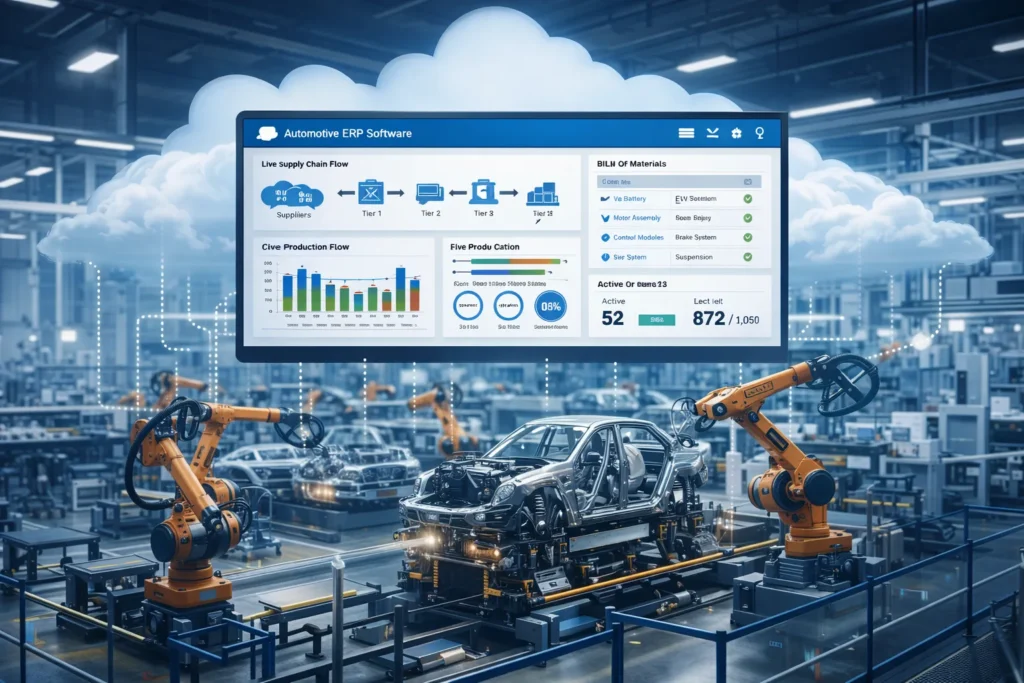
The Automotive Industry Is Changing Faster Than Ever
The automotive manufacturing industry is under intense pressure. Rising raw material costs, frequent supply chain disruptions, electric vehicle (EV) adoption, and strict quality standards have made traditional manufacturing models outdated.
Many automotive manufacturers still rely on legacy, on-premise ERP systems that were never designed for today’s complex, multi-plant, data-driven operations. These systems often lack real-time visibility, are expensive to maintain, and struggle to scale.
This is why OEMs and Tier suppliers worldwide are rapidly switching to cloud-based Automotive ERP software—a smarter, more agile solution built for modern automotive manufacturing.
In this blog, we’ll explore why cloud ERP is becoming the industry standard, how it improves efficiency, and what manufacturers should look for when choosing the right Automotive ERP Software.
What Is Cloud-Based Automotive ERP Software?
Cloud-based Automotive ERP Software is an enterprise resource planning system hosted on secure cloud infrastructure rather than on local servers. It centralises all core automotive operations—production, inventory, quality, finance, and supply chain—into one unified platform accessible anytime, anywhere.
Unlike generic ERP systems, Automotive ERP Software is designed to handle:
- Complex Bills of Materials (BOMs)
- Vendor and jobwork processes
- OEM compliance requirements
- Multi-location production planning
Key Modules in Automotive ERP Software
A modern cloud-based Automotive ERP Software typically includes:
- Production Planning & Scheduling
- Inventory & Warehouse Management
- Material Requirement Planning (MRP)
- BOM & Engineering Change Management
- Quality Management & Traceability
- Jobwork & Subcontracting Management
- Finance, Costing & MIS Reporting
- Vendor & Supply Chain Management
Why Traditional ERP Systems Are Failing Automotive Manufacturers
Lack of Real-Time Visibility
Legacy ERP systems often operate in silos. Production, inventory, and finance data are updated manually or with delays, leading to:
- Stock mismatches
- Production downtime
- Missed delivery deadlines
In contrast, cloud-based Automotive ERP Software provides real-time dashboards that enable faster, data-driven decisions.
High Infrastructure and Maintenance Costs
On-premise ERP systems require:
- Expensive servers and hardware
- Dedicated IT teams
- Costly upgrades and maintenance
Cloud ERP eliminates these costs by offering a subscription-based model with automatic updates.
Limited Scalability
As automotive manufacturers expand into:
- New plants
- EV components
- New OEM partnerships
traditional ERP systems struggle to keep up.
Cloud-based Automotive ERP Software scales effortlessly as the business grows.
Key Reasons Automotive Manufacturers Are Switching to Cloud-Based ERP Software
Real-Time Production and Supply Chain Visibility
Cloud-based Automotive ERP Software offers:
- Live production tracking
- Real-time inventory status
- Vendor and job work visibility
This helps manufacturers respond quickly to delays and supply disruptions.
Faster Implementation and Lower Total Cost of Ownership
Cloud ERP systems:
- Deploy faster than on-premise ERP
- Require no physical infrastructure
- Reduce long-term operational costs
This makes Automotive ERP Software accessible even for small and mid-sized manufacturers.
Scalability Across Plants and Locations
Whether managing:
- Multiple factories
- OEM and aftermarket orders
- Domestic and export operations
cloud-based ERP adapts without system reconfiguration.
Anywhere Access for Modern Teams
With cloud-based Automotive ERP Software, managers and teams can access data:
- From factory floors
- Remote offices
- On the move
This is crucial for multi-plant automotive operations.
How Cloud-Based Automotive ERP Software Improves Manufacturing Efficiency
Smarter Production Planning and Scheduling
Advanced planning tools help:
- Optimise machine utilisation
- Reduce bottlenecks
- Align production with demand
Accurate Inventory and MRP Management
Cloud-based Automotive ERP Software ensures:
- Optimal stock levels
- Reduced excess inventory
- Timely raw material procurement
Enhanced Quality Control and Traceability
Automotive manufacturers must comply with strict quality standards. Cloud ERP enables:
- Batch and serial traceability
- Quality checkpoints
- Audit-ready documentation
Cloud ERP Software and the Future of Automotive Manufacturing
Supporting EV and Smart Manufacturing
EV production involves complex BOMs and new compliance requirements. Automotive ERP Software supports:
- EV-specific workflows
- Smart factory integration
- IoT-enabled data collection
Advanced Analytics and Data-Driven Decisions
Cloud-based ERP provides:
- Real-time MIS dashboards
- Cost analysis
- Predictive insights for planning and procurement
Seamless Integration with OEM Systems
Modern Automotive ERP Software integrates easily with:
- OEM portals
- Third-party logistics
- Accounting and CRM tools
Security, Compliance, and Reliability of Cloud-Based Automotive ERP Software
Data Security and Access Control
Cloud ERP platforms offer:
- Encrypted data storage
- Role-based access
- Secure authentication
Industry and Regulatory Compliance
Automotive ERP Software supports:
- IATF 16949 quality standards
- GST, e-Invoicing, and E-Way Bill compliance
- Audit and reporting requirements
Business Continuity and Disaster Recovery
Cloud-based systems ensure:
- Automatic backups
- High system uptime
- Quick recovery during disruptions
How to Choose the Right Cloud-Based Automotive ERP Software
Automotive-Specific Capabilities Matter
Choose ERP software built specifically for automotive manufacturers, not generic ERP. Look for:
- Job work and subcontracting management
- OEM-specific workflows
- Part traceability and BOM control
Cloud ERP vs Generic ERP
Generic ERP systems require heavy customisation and often fail to meet automotive needs. Purpose-built Automotive ERP Software delivers:
- Faster ROI
- Lower implementation risk
- Better user adoption
Questions to Ask ERP Vendors
- Does the ERP support automotive job work?
- How fast is implementation?
- Is support available locally?
- Can it scale as the business grows?
Business Benefits of Switching to Cloud-Based Automotive ERP Software
Reduced Operational Costs
Lower IT expenses, reduced wastage, and improved resource utilisation.
Faster Decision-Making
Real-time insights help management act quickly and confidently.
Improved OEM and Customer Satisfaction
Better quality control, on-time delivery, and transparency strengthen OEM relationships.
Cloud-Based Automotive ERP Software Is the New Standard
For automotive manufacturers, cloud-based Automotive ERP Software is no longer optional—it’s essential. Companies that continue using outdated ERP systems risk falling behind competitors who operate with greater speed, accuracy, and agility.
By adopting modern cloud-based Automotive ERP Software, manufacturers gain real-time visibility, scalability, and the tools needed to thrive in a rapidly evolving automotive landscape.
Automotive ERP Software is a specialised ERP system designed to manage production, inventory, quality, finance, and supply chain operations for automotive manufacturers.
They are switching for real-time visibility, lower costs, scalability, and better support for modern manufacturing needs like EV production.
Yes. Cloud ERP systems use encryption, access controls, and regular backups to ensure data security and reliability.
Absolutely. Cloud-based Automotive ERP Software is cost-effective and scalable, making it ideal for MSMEs and growing manufacturers.
Yes. Automotive-specific ERP solutions are designed to manage job work, vendor tracking, and cost visibility efficiently.