
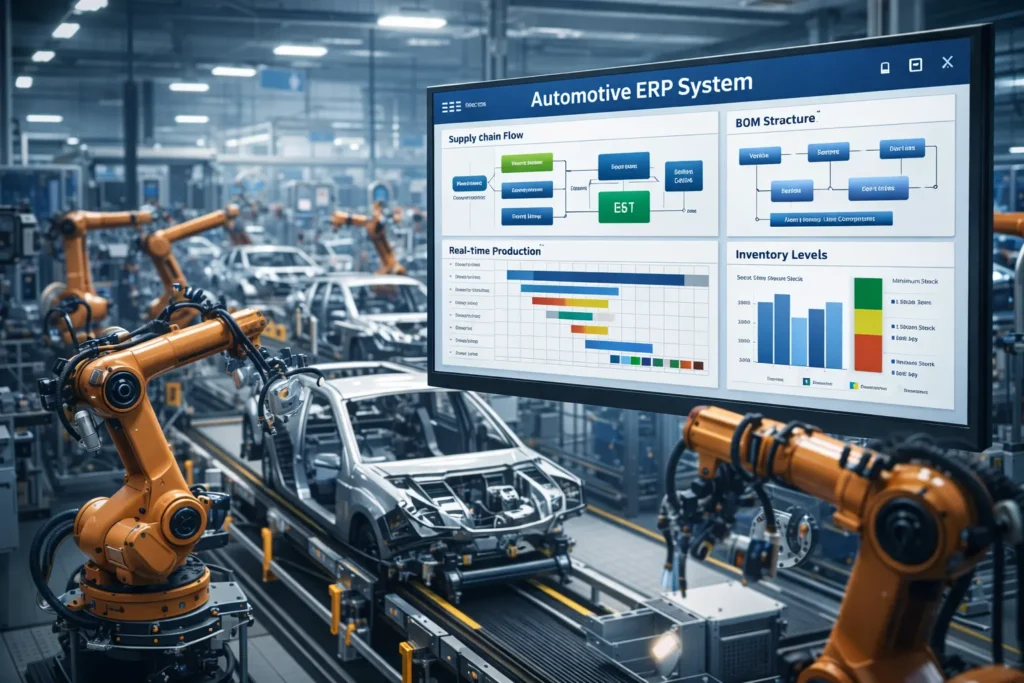
Why the Automotive Industry Needs Smarter ERP Systems
The automotive industry operates under extreme pressure—tight delivery schedules, complex supply chains, strict quality standards, and constant cost control. From raw material sourcing to final vehicle or component delivery, even a small delay or data mismatch can lead to major losses.
This is where automotive ERP software plays a critical role. Designed specifically for automotive manufacturers, suppliers, and distributors, it helps businesses streamline operations, improve visibility, ensure compliance, and scale efficiently.
In this guide, we’ll explain what automotive ERP software is, its key features, benefits, real-world use cases, and how to choose the right solution for your business.
What Is Automotive ERP Software?
Automotive ERP software is an enterprise resource planning system tailored to the unique needs of the automotive industry. It integrates core business functions—production, inventory, supply chain, finance, quality, and sales—into a single, centralised platform.
Unlike generic ERP systems, automotive ERP software supports:
- Complex Bills of Materials (BOMs)
- Multi-level supplier networks
- Just-in-Time (JIT) manufacturing
- Quality compliance and traceability
- Costing at component and batch level
It is widely used by:
- Automotive OEMs
- Tier 1, Tier 2, and Tier 3 suppliers
- Auto parts manufacturers
- Automotive distributors and aftermarket businesses
How Automotive ERP Software Works
Automotive ERP software collects real-time data from all departments and stores it in a unified database. This enables:
- Seamless coordination between production, procurement, inventory, and finance
- Automated workflows and approvals
- Accurate forecasting and reporting
- Faster, data-driven decision-making
Key Features of Automotive ERP Software
Production Planning and Manufacturing Management
- Bill of Materials (BOM) and routing management
- Production scheduling and capacity planning
- Work order and shop floor tracking
- Scrap, rejection, and rework management
Inventory and Supply Chain Management
- Raw material, WIP, and finished goods tracking
- Supplier and vendor management
- Just-in-Time (JIT) inventory optimisation
- Batch and serial number tracking
Quality Management and Compliance
- In-process and final quality inspections
- Compliance with ISO, IATF, and industry standards
- End-to-end traceability
- Recall and audit management
Sales, Distribution, and Dealer Management
- Sales order processing and fulfilment
- Customer pricing and contract management
- Dealer and distributor performance tracking
- Logistics and delivery scheduling
Financial Accounting and Cost Control
- Product-wise and batch-wise costing
- Profit and margin analysis
- GST, tax, and statutory compliance
- Real-time financial reporting
Analytics and Reporting Dashboard
- Centralised dashboards with KPIs
- Production, inventory, and sales analytics
- Custom and automated reports
- Forecasting and trend analysis
Benefits of Automotive ERP Software
Improved Operational Efficiency
Automation reduces manual work, errors, and delays, helping teams focus on productivity rather than firefighting.
Better Supply Chain Visibility
End-to-end tracking ensures materials arrive on time, production runs smoothly, and inventory levels stay optimal.
Enhanced Quality Control and Compliance
Built-in quality processes help maintain consistency, reduce defects, and meet regulatory requirements.
Cost Reduction and Higher Profitability
Accurate costing and waste reduction directly improve margins and financial control.
Scalability for Business Growth
Automotive ERP software supports multi-plant operations, new product lines, and business expansion without operational chaos.
Common Use Cases of Automotive ERP Software
Automotive Parts Manufacturing
- Managing complex multi-level BOMs
- Batch-wise production and traceability
- Cost control for high-volume manufacturing
OEM and Tier Supplier Operations
- Demand forecasting and supplier coordination
- Vendor performance tracking
- Compliance and audit readiness
Automotive Aftermarket and Distribution
- Inventory turnover optimisation
- Order processing and logistics management
- Customer and dealer management
Multi-Plant Automotive Enterprises
- Centralised ERP with plant-wise control
- Standardised processes across locations
- Consolidated financial and operational reporting
Cloud-Based vs On-Premise Automotive ERP Software
Cloud Automotive ERP Software
- Lower upfront investment
- Faster deployment
- Remote access and scalability
- Automatic updates and maintenance
On-Premise Automotive ERP Software
- Greater control over data
- High customisation options
- Requires IT infrastructure and ongoing maintenance
How to Choose the Right Automotive ERP Software
Industry-Specific Functionality
Ensure the ERP is designed for automotive manufacturing and supply chains—not generic workflows.
Integration Capabilities
The system should integrate with CRM, SCM, IoT devices, and third-party tools.
Customisation and Scalability
Your ERP should grow with your business and adapt to changing requirements.
Implementation Support and Training
Choose a vendor with strong domain expertise, onboarding support, and long-term service.
Future Trends in Automotive ERP Software
- AI-driven production planning
- IoT-enabled smart factories
- Predictive analytics for maintenance and demand
- ERP systems aligned with EV and sustainable manufacturing
Why Automotive ERP Software Is a Competitive Advantage
In today’s fast-paced automotive industry, efficiency, accuracy, and visibility are non-negotiable. Automotive ERP software empowers businesses to streamline operations, maintain quality, control costs, and scale confidently.
Choosing the right ERP solution isn’t just an IT decision—it’s a strategic investment in long-term growth and competitiveness.
Automotive ERP software is a specialized system that helps automotive businesses manage production, inventory, supply chain, finance, and quality in one integrated platform.
Automotive ERP software is ideal for OEMs, auto component manufacturers, tier suppliers, and automotive distributors.
Yes, modern cloud-based automotive ERP software is scalable and cost-effective for small and mid-sized manufacturers.
The main benefits include improved efficiency, better inventory control, enhanced quality compliance, cost reduction, and scalability.
Implementation typically takes between 3 to 6 months, depending on business size and customization needs.