
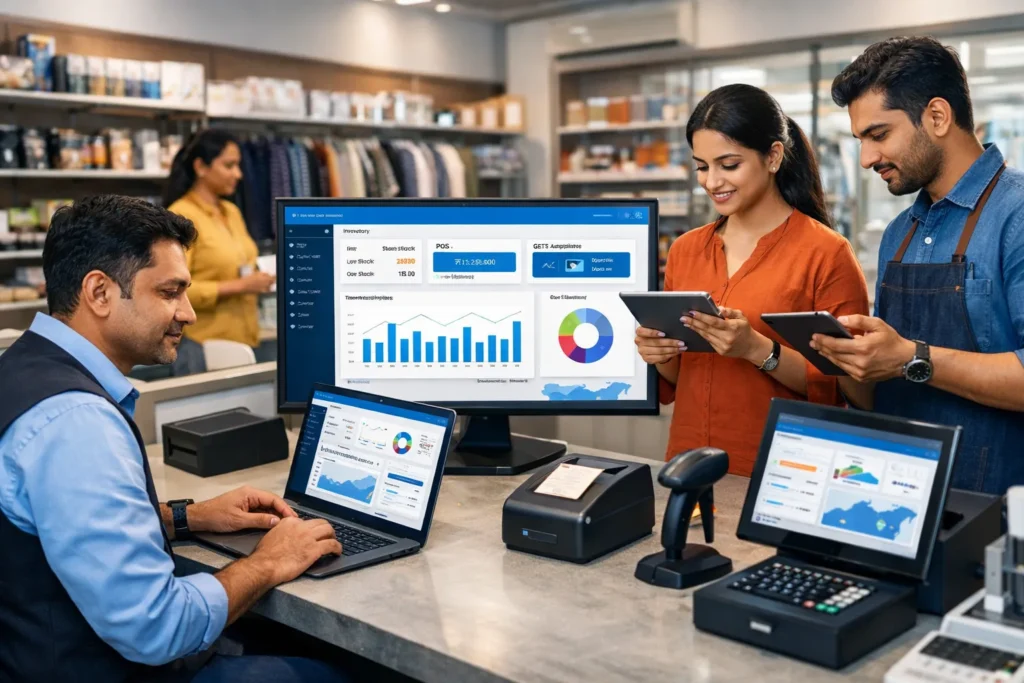
The Digital Backbone Modern Retailers Can’t Ignore
Retail in India is evolving at breakneck speed. Customers expect seamless experiences across physical stores, online marketplaces, and mobile apps. At the same time, retailers must manage GST compliance, volatile demand, complex supply chains, and razor-thin margins.
Many small and mid-sized retailers still rely on disconnected tools — POS software, spreadsheets, standalone accounting systems, and manual processes. This fragmentation leads to stockouts, excess inventory, billing errors, and poor visibility into business performance.
Retail ERP software solves these challenges by bringing your entire retail operation onto one unified platform.
In this comprehensive guide, you’ll discover:
- What retail ERP software is and why it matters
- Key features and benefits for Indian SMB retailers
- How to choose the right solution
- Implementation best practices
- Future trends shaping retail technology
What Is Retail ERP Software?
Retail ERP software is an integrated system that connects all core retail operations, including:
- Point of Sale (POS)
- Inventory and warehouse management
- Procurement
- Finance and accounting
- Customer relationship management
- Reporting and analytics
Instead of juggling multiple systems, retailers get a single source of truth for their entire business.
How Retail ERP Differs from Generic ERP
Generic ERP systems often struggle with retail-specific demands such as:
- High transaction volumes
- SKU-level inventory tracking
- Promotions and discount management
- Multi-store operations
- Omnichannel fulfilment
Retail ERP solutions are purpose-built for these workflows.
Why Indian Retailers Need Specialised ERP
India’s retail environment adds unique complexities:
- GST compliance and e-invoicing
- Regional tax variations
- Diverse payment methods (UPI, wallets, COD)
- Marketplace integration with platforms like Amazon and Flipkart
- Rapid expansion into Tier-2 and Tier-3 cities
A localised retail ERP ensures compliance and operational efficiency.
Key Benefits of Retail ERP Software for SMB Retailers
1. Real-Time Inventory Visibility
Inventory mismanagement is one of the biggest profit killers in retail.
Retail ERP software enables:
- Live stock tracking across stores and warehouses
- Automatic low-stock alerts
- Faster replenishment planning
- Identification of fast-moving vs. slow-moving products
Result: fewer stockouts and less dead inventory.
2. Seamless Omnichannel Management
Customers shop everywhere — in-store, online, and on marketplaces.
Retail ERP unifies:
- Physical store sales
- E-commerce orders
- Marketplace fulfilment
- Returns and exchanges
This ensures consistent inventory and pricing across all channels.
3. Strong Financial Control
Manual accounting leads to costly errors and compliance risks.
ERP automates:
- GST calculations and reporting
- Accounts receivable/payable
- Cash flow tracking
- Profitability analysis
- Financial statements
Finance teams gain real-time visibility into business health.
4. Faster Billing and Better Customer Experience
Modern consumers value speed and convenience.
Retail ERP enables:
- Quick POS billing
- Barcode scanning
- Digital receipts
- Loyalty programmes
- Customer purchase history
This improves satisfaction and repeat business.
5. Data-Driven Decision Making
Gut-based decisions are risky in today’s competitive market.
ERP dashboards provide:
- Sales trends by product/store
- Demand forecasting
- Margin analysis
- Employee performance metrics
- Seasonal insights
Retailers can optimise pricing, promotions, and inventory scientifically.
Essential Features to Look for in Retail ERP Software
Choosing the right system requires evaluating core capabilities.
Inventory & Warehouse Management
Look for:
- Multi-location tracking
- Batch and serial number control
- Automated reorder points
- Inter-warehouse transfers
- Stock ageing reports
POS Integration
A robust POS module should support:
- Offline billing (critical for connectivity issues)
- Barcode scanning
- Multiple payment modes
- Returns and exchanges
- Discount management
Multi-Store Management
Growing retailers need centralised control with local flexibility.
Key capabilities:
- Store-wise performance analytics
- Centralised pricing and promotions
- Stock transfers between outlets
- Role-based access control
GST & Compliance Tools
Indian retailers must comply with complex tax regulations.
Essential features include the following:
- Automated GST calculations
- E-invoicing support
- Filing-ready reports
- Audit trails
Procurement & Vendor Management
ERP streamlines purchasing by enabling:
- Demand-based purchase planning
- Supplier comparison
- Purchase order automation
- Vendor performance tracking
Reporting & Analytics
Real-time insights are a major ERP advantage.
Look for dashboards showing:
- Revenue and margins
- Inventory turnover
- Category performance
- Customer analytics
- Forecasts
Common Challenges Faced by SMB Retailers — And How ERP Solves Them
| Challenge | ERP Solution |
|---|---|
| Inventory inaccuracies | Real-time stock tracking |
| Manual errors | Automated workflows |
| Poor visibility | Unified dashboards |
| Difficulty scaling | Multi-store support |
| Data silos | Centralized database |
ERP transforms reactive operations into proactive management.
How to Choose the Right Retail ERP Software
Not all ERP systems are created equal. Follow this framework:
1. Assess Your Business Needs
Consider:
- Number of stores
- Product categories
- Sales channels
- Transaction volume
- Growth plans
2. Identify Must-Have Features
Separate essentials from nice-to-have features to avoid overspending.
3. Evaluate Total Cost of Ownership
Look beyond licence fees:
- Implementation costs
- Customisation
- Training
- Maintenance
- Upgrade expenses
Cloud ERP typically offers lower upfront costs.
4. Check Integration Capabilities
Your ERP should integrate with:
- POS hardware
- E-commerce platforms
- Payment gateways
- Logistics partners
- Accounting tools
5. Assess Vendor Support
Reliable support is crucial during and after implementation.
Look for:
- Local presence
- Training resources
- Response times
- Industry experience
Cloud vs On-Premise Retail ERP: Which Is Better?
Cloud ERP Advantages
Most SMB retailers now prefer cloud solutions because they offer the following:
- Lower initial investment
- Anywhere access
- Automatic updates
- Scalability as business grows
- Reduced IT maintenance
When On-Premise May Make Sense
On-premise systems may suit businesses that require:
- Heavy customisation
- Strict data control
- Existing IT infrastructure
However, for most small- and mid-sized retailers, cloud ERP delivers faster ROI.
Implementation Tips for Success
Even the best ERP can fail without proper rollout.
Prepare Clean Data
Garbage in, garbage out. Clean your inventory and customer data before migration.
Train Employees Early
User adoption determines success. Provide role-based training.
Start with Core Modules
Begin with inventory, POS, and finance before adding advanced features.
Monitor Performance
Track KPIs, such as:
- Sales growth
- Inventory turnover
- Billing speed
- Order fulfilment time
Future Trends in Retail ERP Software
Retail technology continues to evolve rapidly.
AI-Driven Forecasting
Predict demand with high accuracy using machine learning.
Mobile-First Management
Owners can monitor operations from smartphones in real time.
Automation of Routine Tasks
Purchase orders, replenishment, and reporting increasingly run automatically.
Unified Commerce Platforms
ERP systems are becoming the central hub connecting stores, e-commerce, logistics, and marketing.
Frequently Asked Questions
Costs vary widely based on features, deployment type, and number of users. Cloud solutions typically operate on subscription pricing, making them affordable for SMBs.
Yes. Even single-store retailers benefit from improved inventory control, accounting automation, and reporting.
Small deployments can go live in weeks, while complex multi-store implementations may take several months.
Most modern retail ERP platforms offer POS integration or built-in POS functionality.
Reputable providers use enterprise-grade security, encryption, and backups — often stronger than in-house systems.
The Smart Investment That Powers Retail Growth
For small and mid-sized retailers in India, adopting retail ERP software is no longer optional — it’s a strategic necessity.
A well-chosen system delivers:
✅ Real-time visibility across operations
✅ Better inventory control
✅ Strong financial management
✅ Seamless omnichannel capabilities
✅ Scalability for future growth
Retailers that continue relying on fragmented tools risk falling behind competitors who operate with data, automation, and agility.
The right retail ERP doesn’t just manage your business — it transforms it.
Great post! Thanks for sharing this valuable information. Keep up the excellent work!
Grate Post! Thanks for sharing this valuable information. Keep up the excellent work.