
Manufacturing today is more complex than ever. Rising raw material costs, supply chain disruptions, tighter compliance requirements, and increasing customer expectations have made operational efficiency a competitive necessity—not a luxury.
Yet many manufacturing businesses still rely on spreadsheets, disconnected software, and manual processes to manage production, inventory, finance, and procurement. While this might work in the early stages, it quickly becomes a bottleneck as operations grow.
If your systems are struggling to keep up, it may be time to consider an ERP System. Below are the key signs your manufacturing business has outgrown its current tools—and why upgrading could be the smartest decision you make this year.
What Is an ERP System in Manufacturing?
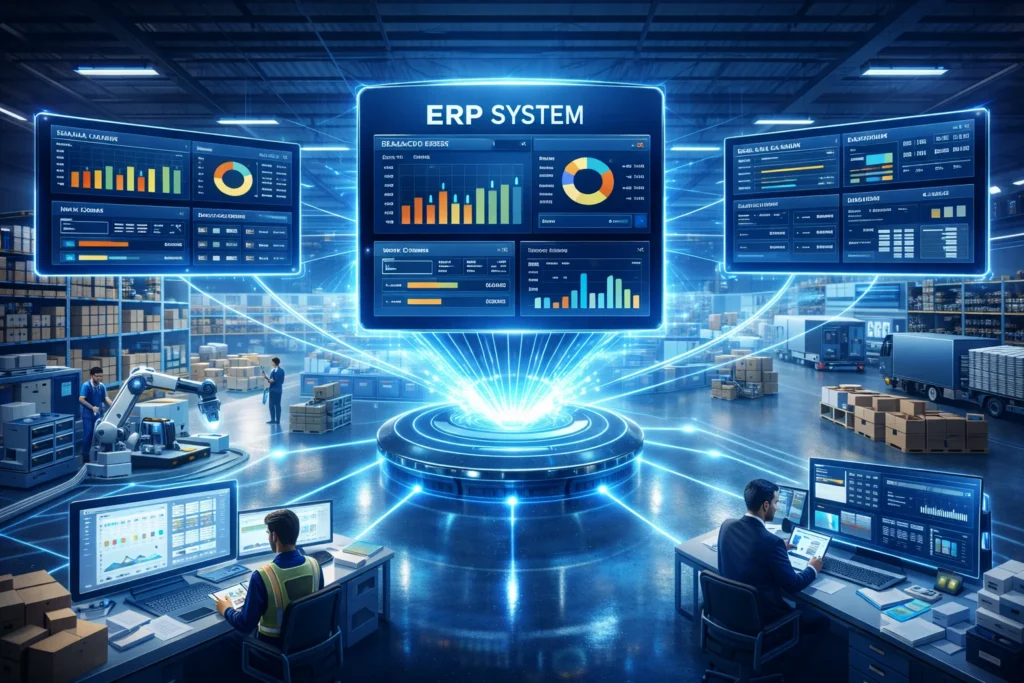
An ERP System (Enterprise Resource Planning System) is integrated software that connects and manages all core business processes in one centralised platform.
For manufacturing companies, this typically includes:
- Production planning and control
- Inventory management
- Procurement and vendor management
- Finance and accounting
- Quality control
- Sales and order management
- Supply chain tracking
Instead of operating in silos, departments share real-time data through a single system. This eliminates duplication, reduces errors, and improves visibility across the organisation.
1. Your Systems Don’t Talk to Each Other
Multiple Software Tools Running Separately
Are you using:
- One tool for accounting
- Another for inventory
- Excel for production planning
- Manual methods for procurement
Disconnected systems mean constant data re-entry and higher risk of mistakes.
Conflicting Data Between Departments
If finance reports one inventory number while the warehouse reports another, you don’t have a single source of truth.
How an ERP System Fixes This
An ERP System centralizes data in one database. When inventory updates, finance sees it instantly. When production completes a job, sales and accounts are updated automatically.
Result: Accuracy, transparency, and efficiency.
2. Production Delays Are Becoming Frequent
Poor Production Planning
Without real-time capacity visibility, planning becomes reactive instead of strategic.
Common symptoms:
- Missed deadlines
- Machine downtime surprises
- Overloaded production schedules
Lack of Shop Floor Visibility
If managers only discover delays after they happen, your system lacks real-time monitoring.
How an ERP System Helps
An ERP System provides:
- Advanced production scheduling
- Capacity planning
- Real-time shop floor tracking
- Work order management
You gain control over operations instead of constantly firefighting issues.
3. Inventory Problems Are Draining Profits
Overstocking That Locks Up Capital
Excess raw materials and finished goods increase storage costs and reduce cash flow.
Stockouts That Stop Production
Running out of critical components leads to the following:
- Emergency purchases
- Higher costs
- Missed delivery deadlines
ERP System Inventory Optimisation
A modern ERP System offers:
- Demand forecasting
- Automated reorder points
- Batch and lot tracking
- Real-time stock visibility
You maintain optimal inventory levels without guesswork.
4. You’re Still Relying on Spreadsheets and Paper
Manual Data Entry Is Time-Consuming
If your team spends hours updating spreadsheets or filing paperwork, productivity suffers.
Human Errors Are Increasing
Manual processes lead to the following:
- Duplicate entries
- Calculation errors
- Lost documents
ERP System Automation
An ERP System automates:
- Purchase orders
- Sales invoices
- Work orders
- Inventory updates
- Financial postings
Automation reduces errors and frees your team to focus on strategic tasks.
5. You Don’t Have Clear Cost and Profit Visibility
Difficulty Calculating True Production Costs
Without integrated costing, it’s hard to know the following:
- Material costs
- Labour expenses
- Overhead allocation
- Actual product margins
Pricing Decisions Based on Assumptions
Inaccurate costing leads to underpricing or overpricing your products.
ERP System Financial Insights
An ERP System integrates finance with operations, enabling the following:
- Real-time cost tracking
- Product-level profitability analysis
- Accurate budgeting and forecasting
- Detailed financial reporting
Better data leads to better decisions.
6. Quality Issues and Compliance Risks Are Increasing
Inconsistent Quality Control
Manual quality checks and separate tracking systems increase defect rates.
Poor Traceability
In regulated industries, lack of traceability can lead to compliance penalties.
ERP System Quality Management
An ERP System enables:
- Standardised quality procedures
- Inspection tracking
- Audit trails
- Batch traceability
- Regulatory reporting
This reduces risk and builds customer trust.
7. Decision-Making Is Slow
Waiting for Reports
If managers wait days for reports from different departments, decisions are delayed.
Limited Analytics
Spreadsheets cannot provide predictive insights or real-time dashboards.
ERP System Dashboards and BI
Modern ERP Systems include:
- Live dashboards
- KPI tracking
- Custom reporting
- Business intelligence tools
You can identify trends, forecast demand, and respond quickly to market changes.
8. Rapid Growth Is Stressing Your Current Systems
Increased Orders and Product Lines
As you grow:
- SKUs increase
- Suppliers multiply
- Production complexity rises
Your current tools may not scale.
Multi-Location Challenges
Managing multiple warehouses or factories with spreadsheets is nearly impossible.
ERP System Scalability
An ERP System grows with your business by supporting the following:
- Multi-location operations
- Multi-currency transactions
- Advanced supply chain management
- Integration with other software
Growth should be exciting—not chaotic.
9. Customer Complaints Are Increasing
Missed Delivery Dates
Poor coordination between sales and production results in unrealistic commitments.
Lack of Order Visibility
If customers constantly ask for updates, your systems lack transparency.
ERP System Improves Customer Service
With ERP, you get:
- End-to-end order tracking
- Accurate delivery schedules
- Real-time order status
- Faster response times
Satisfied customers lead to repeat business and stronger brand reputation.
How to Evaluate If You Need an ERP System
Ask yourself:
- Are manual processes slowing down operations?
- Do departments struggle to share accurate data?
- Are production delays and inventory issues frequent?
- Is management lacking real-time visibility?
- Is growth creating operational chaos?
If you answered “yes” to several of these, your manufacturing business likely needs an ERP System.
Benefits of Implementing an ERP System in Manufacturing
Beyond solving current issues, ERP provides:
- Improved operational efficiency
- Reduced costs
- Better cash flow management
- Stronger compliance
- Data-driven decision-making
- Scalable growth infrastructure
Most manufacturers see long-term ROI through improved productivity and reduced waste.
Don’t Wait for a Crisis
Many manufacturing businesses delay ERP implementation until inefficiencies become severe. By then, losses may already be significant.
Recognising the early signs allows you to act proactively.
An ERP System is not just software—it’s a foundation for sustainable growth, operational excellence, and competitive advantage.
If your manufacturing operations feel increasingly complex, disconnected, or inefficient, it may be time to explore the right ERP solution for your business.