
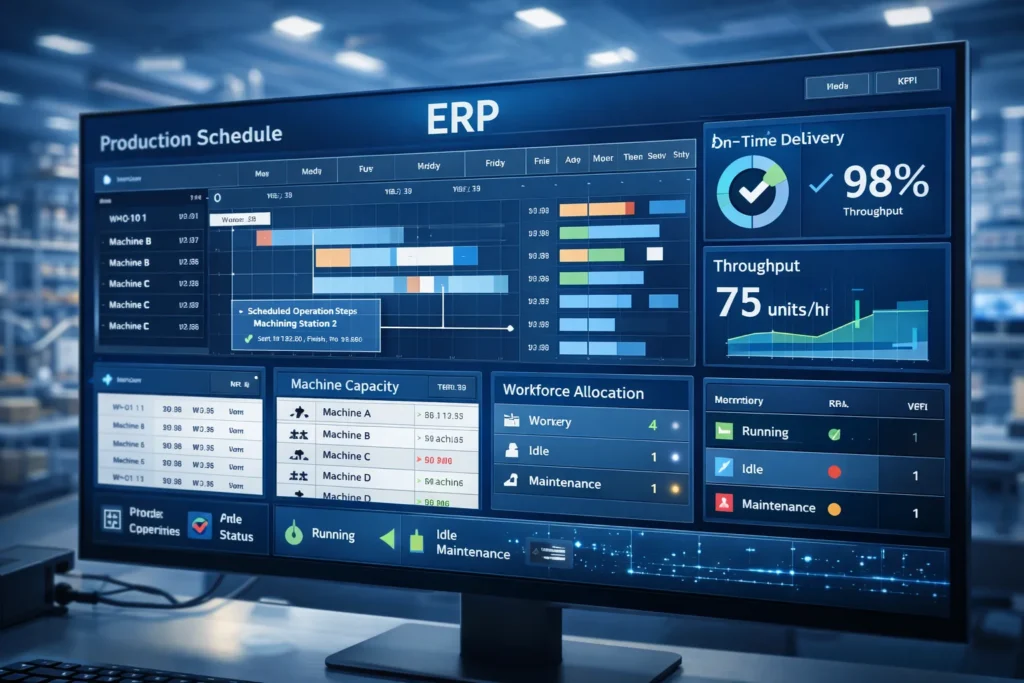
In today’s competitive manufacturing landscape, poor production planning is expensive. Missed delivery deadlines, excess inventory, machine downtime, and last-minute overtime can silently drain profits. Many manufacturers still rely on spreadsheets, disconnected systems, or manual coordination between departments — and that’s where the real problem begins.
As product lines expand and supply chains become more complex, traditional planning methods simply can’t keep up. This is where ERP software for manufacturers becomes a game-changer.
In this guide, we’ll explore how ERP transforms production planning and scheduling — from reactive and manual to automated, intelligent, and data-driven.
What Is Production Planning and Scheduling?
Before diving into how ERP helps, let’s clarify the basics.
Production Planning
Production planning determines:
- What to produce
- How much to produce
- When to produce it
- What resources are required
It aligns demand forecasts, sales orders, and inventory levels with manufacturing capacity.
Production Scheduling
Scheduling focuses on the following:
- Assigning tasks to machines and workers
- Determining job sequences
- Setting timelines for each production stage
Planning defines the strategy. Scheduling executes it.
When these processes are disconnected or poorly managed, manufacturers face delays, inefficiencies, and rising costs.
Why Traditional Planning Methods Fail
Many manufacturers still rely on spreadsheets or separate software systems for inventory, procurement, sales, and production. This creates several problems:
1. Data Silos
Each department works with its own data. Sales forecasts may not match inventory levels. Procurement may not know production priorities.
2. Lack of Real-Time Visibility
By the time reports are compiled, the information is outdated.
3. Manual Errors
Incorrect formulas, duplicate entries, or miscommunication can disrupt entire schedules.
4. Poor Response to Disruptions
Supplier delays, machine breakdowns, or sudden order changes require quick adjustments — something spreadsheets simply can’t handle efficiently.
This is exactly where ERP software for manufacturers makes a measurable difference.
How ERP Improves Production Planning
Centralised Data Across Departments
An ERP system integrates the following:
- Sales
- Inventory
- Procurement
- Production
- Finance
This creates a single source of truth. When sales enters a new order, production instantly sees it. Inventory levels update in real time. Procurement can automatically plan purchases based on production needs.
No more guesswork.
Demand Forecasting and Sales Integration
ERP systems analyse:
- Historical sales data
- Seasonal trends
- Customer demand patterns
This allows manufacturers to forecast more accurately and align production with real demand. As a result:
- Overproduction decreases
- Stockouts are reduced
- Customer satisfaction improves
Material Requirements Planning (MRP)
A powerful feature of ERP is automated Material Requirements Planning (MRP).
MRP calculates:
- Raw materials required
- Components needed
- Purchase timelines
- Production quantities
Instead of manually estimating materials, ERP generates accurate requirements based on active orders and forecasts. This prevents both shortages and excess inventory.
How ERP Enhances Production Scheduling
Planning is only half the battle. Execution matters just as much.
Real-Time Capacity Planning
ERP provides visibility into:
- Machine availability
- Work center capacity
- Workforce allocation
Manufacturers can avoid overloading one production line while another sits idle.
Finite Scheduling for Realistic Timelines
Unlike basic planning tools, ERP supports finite scheduling—meaning it considers actual constraints such as
- Machine capacity
- Labour availability
- Maintenance schedules
This ensures production timelines are realistic and achievable.
Automated Schedule Adjustments
When disruptions occur, such as the following:
- Supplier delays
- Machine breakdowns
- Urgent customer orders
ERP systems can automatically reschedule tasks, minimising downtime and maintaining delivery commitments.
Instead of spending hours reworking spreadsheets, managers can adjust plans in minutes.
Real-Time Shop Floor Visibility
One of the biggest advantages of ERP software for manufacturers is live production tracking.
Work-in-Progress (WIP) Monitoring
Managers can track:
- Production stages
- Job status
- Output quantities
- Bottlenecks
Performance Dashboards
Real-time dashboards display key performance indicators (KPIs) such as:
- On-time delivery rates
- Machine utilisation
- Production efficiency
- Scrap and rework levels
This enables proactive decision-making instead of reactive firefighting.
Better Inventory Coordination
Production planning fails when materials are unavailable.
ERP systems synchronise production and inventory by:
- Automatically reserving materials for production orders
- Alerting teams about low stock
- Triggering purchase orders when needed
This coordination supports lean manufacturing and just-in-time (JIT) strategies, reducing carrying costs and waste.
Improved Resource Utilisation
Manufacturing profitability depends on how efficiently resources are used.
Machine Optimisation
ERP helps:
- Reduce idle time
- Balance workloads
- Maximise throughput
Workforce Efficiency
Managers can:
- Assign tasks based on skill levels
- Plan shifts effectively
- Reduce overtime costs
This leads to better productivity without increasing overhead.
Faster Response to Disruptions
Manufacturing environments are dynamic. ERP systems support:
Scenario Planning
Managers can run “what-if” analyses to evaluate the following:
- Demand spikes
- Raw material shortages
- Production delays
Rapid Rescheduling
When unexpected issues arise, ERP recalculates schedules quickly – helping maintain delivery commitments and customer trust.
Measurable Benefits of ERP-Driven Planning
Manufacturers implementing ERP for planning and scheduling often experience:
Operational Improvements
- Higher on-time delivery rates
- Shorter production cycles
- Improved shop floor efficiency
Financial Gains
- Lower inventory carrying costs
- Reduced waste and scrap
- Better cash flow management
Strategic Advantages
- Stronger customer relationships
- Increased competitiveness
- Scalable growth support
Is ERP Worth It for Small and Mid-Sized Manufacturers?
Many small and mid-sized manufacturers assume ERP is only for large enterprises. That’s no longer true.
Modern ERP systems offer the following:
- Cloud-based deployment
- Modular implementation
- Faster ROI
- Scalable pricing
Even growing manufacturers can benefit from structured planning and scheduling tools without massive upfront investments.
From Reactive to Predictive Manufacturing
Production planning and scheduling are at the heart of manufacturing success. When managed manually, they create inefficiencies, delays, and unnecessary costs.
With ERP software for manufacturers, businesses gain:
- Real-time visibility
- Automated planning
- Accurate scheduling
- Better inventory control
- Data-driven decision-making
Instead of reacting to problems, manufacturers can predict, optimise, and grow confidently.
If your production team is still relying on spreadsheets and disconnected systems, it may be time to evaluate how ERP can transform your operations — and turn planning into a competitive advantage.