
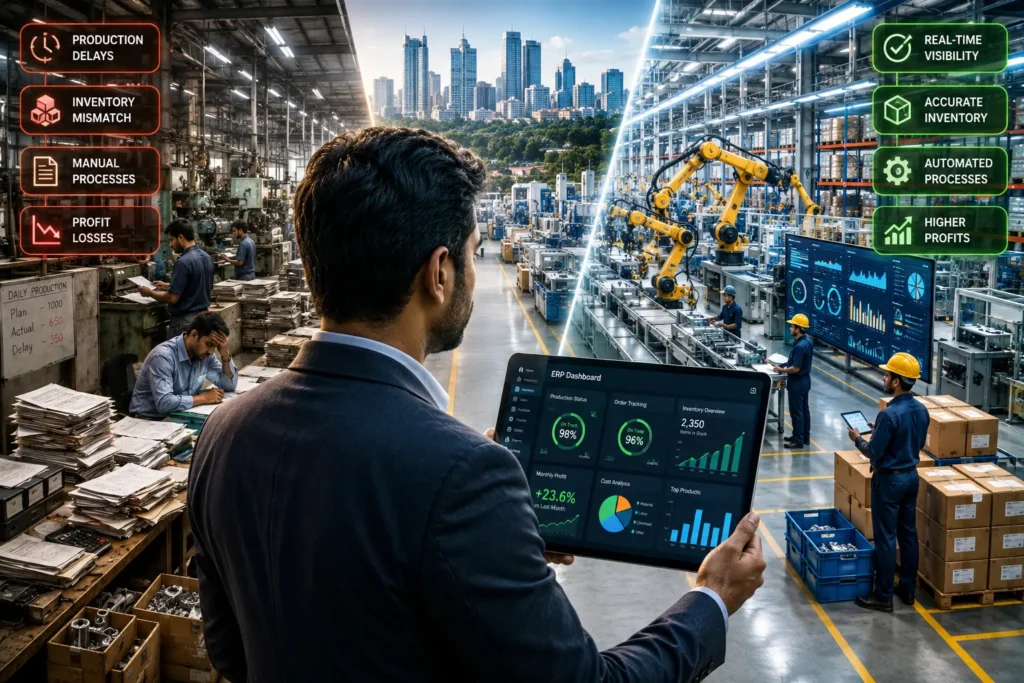
Running a manufacturing business in Bangalore is more competitive than ever. Rising raw material costs, increasing customer expectations, labor management challenges, and supply chain disruptions can quickly impact profitability. Yet many factory owners continue to rely on spreadsheets, manual processes, and disconnected software systems to manage critical operations.
The result? Hidden losses that accumulate every day.
Production delays, inventory mismatches, missed orders, inefficient resource utilization, and inaccurate financial reporting can silently drain your profits. While these issues may seem minor individually, together they can cost manufacturers lakhs of rupees annually.
An ERP System offers a proven solution by bringing all business operations into one centralized platform. From production planning and inventory management to procurement and finance, an ERP System helps factory owners gain complete visibility and control over their operations.
If you’re a manufacturer in Bangalore looking to improve efficiency and profitability, it’s time to understand how an ERP System can transform your business.
Why Bangalore Manufacturers Are Losing Money Without Realizing It
Production Delays That Impact Customer Satisfaction
Many factories struggle with poor production planning. Without real-time visibility into machine availability, workforce allocation, and material requirements, production schedules often become unpredictable.
When orders are delayed, customer trust decreases, leading to lost business opportunities and reduced revenue.
Inventory Errors and Excess Stock
Inventory is one of the biggest expenses for manufacturers. Without an effective ERP System, businesses often experience:
- Overstocking of slow-moving items
- Stock shortages of critical materials
- Inaccurate inventory records
- Increased warehouse costs
These inventory challenges directly affect cash flow and profitability.
Manual Processes Increase Operational Costs
Many manufacturing businesses still rely heavily on spreadsheets and paperwork. Manual processes often lead to:
- Data duplication
- Human errors
- Delayed reporting
- Reduced employee productivity
The time spent correcting mistakes and gathering information translates into higher operational costs.
Lack of Real-Time Visibility
When departments work in isolation, management struggles to make informed decisions. Production, inventory, procurement, sales, and finance teams may all be working with different information.
Without accurate real-time data, factory owners often react to problems instead of preventing them.
What Is an ERP System and How Does It Work?
An ERP System (Enterprise Resource Planning System) is an integrated software platform that connects all business processes into a single centralized database.
Instead of using multiple disconnected applications, manufacturers can manage everything from one system.
Core Functions of an ERP System
A manufacturing ERP System typically includes:
- Production Planning
- Inventory Management
- Procurement Management
- Sales and Customer Management
- Finance and Accounting
- Quality Control
- Reporting and Analytics
How ERP Connects Every Department
An ERP System enables seamless communication between departments.
For example:
- Sales orders automatically trigger production requirements.
- Inventory levels update in real time.
- Purchase requests are generated automatically.
- Financial records remain synchronized.
This eliminates data silos and improves operational efficiency.
Top Signs Your Factory Needs an ERP System
If your manufacturing business experiences any of the following issues, implementing an ERP System should become a priority.
Frequent Production Bottlenecks
Unexpected delays and scheduling conflicts indicate poor production visibility.
Inventory Mismatches
If physical stock does not match system records, inventory control needs improvement.
Rising Operational Costs
Increasing expenses without corresponding business growth often points to process inefficiencies.
Difficulty Tracking Orders
When customers frequently ask for order updates and your team struggles to provide answers, visibility is lacking.
Inconsistent Financial Reporting
If generating accurate financial reports takes days or weeks, your systems may not be integrated.
Limited Growth Capacity
When business expansion feels difficult because existing processes cannot handle increased demand, an ERP System becomes essential.
Major Ways an ERP System Saves Money for Bangalore Factory Owners
Reduces Inventory Holding Costs
An ERP System provides accurate inventory visibility, helping manufacturers maintain optimal stock levels.
Benefits include:
- Reduced excess inventory
- Lower storage costs
- Improved cash flow
- Better inventory turnover
Improves Production Efficiency
Production planning tools help manufacturers:
- Schedule jobs efficiently
- Minimize downtime
- Optimize machine utilization
- Improve workforce productivity
As a result, factories produce more with the same resources.
Minimizes Human Errors
Automation reduces dependence on manual data entry and paperwork.
This helps eliminate costly mistakes in:
- Inventory management
- Purchase orders
- Production schedules
- Financial transactions
Cuts Procurement Costs
ERP software improves purchasing efficiency by:
- Tracking supplier performance
- Automating procurement processes
- Preventing duplicate purchases
- Supporting better vendor negotiations
Prevents Revenue Leakage
Missed invoices, inaccurate pricing, and delayed deliveries can all impact revenue.
An ERP System ensures every order is tracked from quotation to payment, reducing financial leakage.
How an ERP System Helps Bangalore Manufacturers Stay Competitive
Faster Response to Customer Demands
Modern customers expect faster delivery and accurate order tracking.
ERP software enables manufacturers to respond quickly and confidently.
Improved Product Quality
Quality management modules help maintain consistent manufacturing standards.
Manufacturers can:
- Track quality inspections
- Identify defects early
- Reduce rework costs
- Improve customer satisfaction
Better Compliance and Traceability
Many industries require strict compliance and documentation.
An ERP System helps maintain complete records for audits and regulatory requirements.
Enhanced Supply Chain Management
Real-time supply chain visibility improves planning and reduces disruptions.
Data-Driven Decision Making
With accurate dashboards and reports, business leaders can make informed strategic decisions based on real-time information.
Real-Life Example: Before and After ERP Implementation
Before ERP
A mid-sized manufacturing company in Bangalore faced several operational challenges:
- Frequent inventory shortages
- Production delays
- Manual reporting
- Lack of cost visibility
These issues affected profitability and customer satisfaction.
After ERP
Following ERP implementation, the company achieved the following:
- Better inventory accuracy
- Reduced production downtime
- Faster reporting
- Improved order fulfillment
- Increased operational efficiency
Within months, management gained complete visibility into factory operations and improved decision-making capabilities.
Key Features to Look for in an ERP System for Manufacturing
Not all ERP solutions are designed for manufacturers.
When evaluating options, look for features such as the following:
Production Planning and Scheduling
Efficient scheduling helps maximize production capacity.
Inventory and Warehouse Management
Real-time inventory tracking improves stock accuracy.
Quality Management
Integrated quality controls help reduce defects.
Financial Management
Automated accounting improves financial accuracy and compliance.
Business Intelligence and Analytics
Advanced dashboards provide actionable insights.
Mobile Accessibility
Mobile access allows managers to monitor operations from anywhere.
Scalability
Choose an ERP System that can grow with your business.
Why Local Bangalore Manufacturers Prefer Industry-Specific ERP Solutions
Manufacturing businesses have unique operational requirements that generic software often cannot address.
Industry-specific ERP solutions offer:
- Manufacturing-focused workflows
- Faster implementation
- Better user adoption
- Industry best practices
- Local compliance support
This allows manufacturers to achieve faster ROI and greater operational improvements.
ERP System Implementation: What Factory Owners Should Expect
Business Process Assessment
The implementation begins with understanding existing workflows and identifying improvement opportunities.
Data Migration
Existing business data is securely transferred into the ERP platform.
Employee Training
Proper training ensures successful adoption across departments.
Go-Live and Optimization
Once deployed, the ERP System is continuously optimized to maximize performance.
Measuring ROI
Manufacturers should track key metrics such as the following:
- Inventory reduction
- Production efficiency
- On-time deliveries
- Operational cost savings
Calculating the Cost of Not Having an ERP System
Many factory owners focus on the cost of ERP implementation but overlook the cost of doing nothing.
Without an ERP System, manufacturers often experience the following:
- Excess inventory costs
- Production downtime
- Lost sales opportunities
- Higher labor expenses
- Poor customer retention
Over time, these hidden losses can significantly exceed the investment required for ERP implementation.
Future-Proof Your Factory with an ERP System
The manufacturing industry is rapidly moving toward Industry 4.0, automation, and data-driven operations.
An ERP System provides the foundation for:
Smart Manufacturing
Connect machines, people, and processes in one ecosystem.
AI-Powered Analytics
Gain deeper insights through predictive reporting and forecasting.
Better Scalability
Expand operations without increasing complexity.
Sustainable Growth
Improve efficiency while maintaining profitability.
Conclusion
If you’re a factory owner in Bangalore, the biggest threat to your profitability may not be market competition—it could be the inefficiencies hidden within your own operations.
Production delays, inventory errors, disconnected systems, and manual processes quietly drain profits every day. An ERP System helps eliminate these challenges by providing complete visibility, automation, and control across your manufacturing operations.
The sooner you identify and address operational inefficiencies, the sooner your factory can improve productivity, reduce costs, and achieve sustainable growth.
Don’t wait until hidden losses become major business problems. Investing in the right ERP System today can help your manufacturing business become more efficient, competitive, and profitable tomorrow.
Frequently Asked Questions
An ERP System integrates production, inventory, finance, procurement, and other business processes into a single platform for better management and visibility.
It reduces inventory waste, minimizes manual errors, improves production efficiency, and streamlines operations.
Yes. Modern ERP solutions are scalable and designed for businesses of all sizes.
Implementation timelines vary based on business size and complexity but typically range from a few weeks to several months.
Manufacturers often experience improvements in inventory accuracy, operational efficiency, customer satisfaction, and overall profitability.