
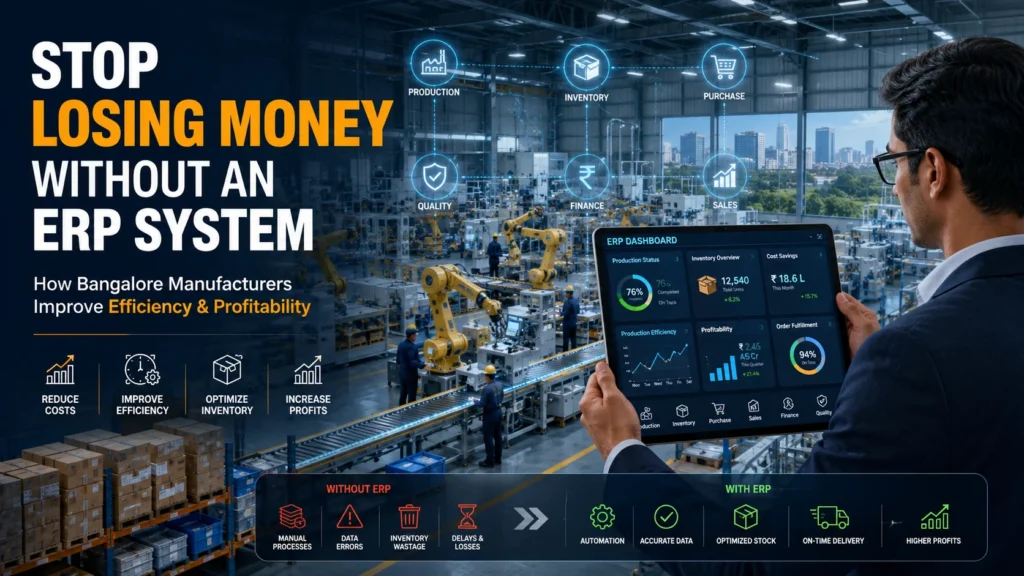
Bangalore is one of India’s leading manufacturing hubs, home to thousands of factories producing everything from automotive components and engineering products to electronics, packaging materials, and consumer goods. While many factory owners focus on increasing sales, they often overlook the hidden operational inefficiencies that silently drain profits every day.
Production delays, inventory wastage, manual processes, inaccurate reporting, and poor visibility into operations can cost manufacturers lakhs of rupees each month. The worst part? Many business owners don’t even realize where the money is being lost.
If your factory still relies on spreadsheets, disconnected software, or manual processes, it’s time to consider a Bangalore ERP System. An ERP (Enterprise Resource Planning) system helps manufacturers streamline operations, reduce costs, improve productivity, and make smarter business decisions.
In this article, we’ll explore how a Bangalore ERP System can help factory owners stop losing money and achieve sustainable growth.
Why Bangalore Factories Are Losing Money Every Day
Inventory Mismanagement and Stock Wastage
Inventory is one of the biggest investments for any manufacturing company. Yet many factories struggle with inventory inaccuracies due to manual tracking methods.
Common inventory problems include:
- Overstocking materials that remain unused
- Understocking critical components
- Excessive inventory carrying costs
- Stock obsolescence and wastage
Without real-time inventory visibility, businesses often tie up valuable capital in unnecessary stock.
Production Delays and Downtime
Production delays directly impact profitability. Delayed orders lead to customer dissatisfaction and missed revenue opportunities.
Major causes include:
- Material shortages
- Poor production planning
- Machine downtime
- Inefficient scheduling
When production schedules are not synchronised with inventory and procurement, delays become inevitable.
Manual Processes Create Costly Errors
Many factories still depend heavily on Excel sheets and paper-based processes.
This often results in:
- Data duplication
- Calculation errors
- Lost documents
- Delayed reporting
Even small mistakes can create significant operational and financial losses.
Lack of Real-Time Visibility
Business decisions are only as good as the information available.
Without centralised data, factory owners struggle to answer important questions:
- What is the current production status?
- Which products are most profitable?
- How much inventory is available?
- What are the actual manufacturing costs?
Delayed information leads to delayed decisions.
What Is a Bangalore ERP System?
An ERP System is an integrated software solution that connects all business processes into a single platform.
Instead of managing multiple disconnected systems, ERP provides one centralised source of truth for the entire organisation.
A manufacturing ERP system typically manages:
- Production
- Inventory
- Procurement
- Finance
- Sales
- Quality Control
- Human Resources
This allows departments to work together efficiently while sharing real-time information.
How ERP Connects Every Department
ERP eliminates information silos by ensuring that every department accesses the same data.
For example:
When a sales order is created:
- Inventory levels are updated automatically.
- Production receives manufacturing requirements.
- Procurement gets material purchase alerts.
- Finance records the transaction.
This automation reduces manual effort and improves accuracy.
Key Signs Your Factory Needs a Bangalore ERP System
You Depend Heavily on Excel Sheets
If critical business operations are managed through spreadsheets, errors and inefficiencies are unavoidable.
Inventory Levels Are Frequently Incorrect
Unexpected stock shortages or excess inventory are clear indicators of poor inventory management.
Production Schedules Are Frequently Missed
Missed delivery commitments often signal a lack of production planning capabilities.
Financial Reports Take Too Long
If your finance team requires days to generate reports, your business lacks real-time financial visibility.
Management Lacks Accurate Business Data
Decision-making becomes difficult when information is scattered across departments.
Customer Complaints Are Increasing
Order delays, incorrect shipments, and communication gaps can negatively impact customer satisfaction.
How a Bangalore ERP System Helps Stop Revenue Leakage
Real-Time Inventory Management
ERP software provides complete inventory visibility.
Benefits include:
- Accurate stock tracking
- Batch and serial number management
- Automated stock alerts
- Reduced carrying costs
Manufacturers can optimise inventory levels and reduce wastage.
Better Production Planning
ERP systems improve production efficiency through:
- Production scheduling
- Material requirement planning (MRP)
- Capacity planning
- Work order management
This ensures resources are utilised effectively and deadlines are met consistently.
Automated Procurement Processes
ERP streamlines purchasing activities by:
- Tracking vendor performance
- Automating purchase requests
- Monitoring material requirements
- Reducing procurement delays
The result is lower purchasing costs and improved supplier relationships.
Financial Control and Cost Monitoring
Manufacturers gain better financial visibility through:
- Cost center tracking
- Budget management
- Profitability analysis
- Automated accounting
Factory owners can identify cost leakages and take corrective action quickly.
Improved Order Management
ERP ensures smooth order processing from quotation to delivery.
Benefits include:
- Faster order fulfillment
- Better customer communication
- Reduced errors
- Improved customer satisfaction
Major Benefits of Implementing a Bangalore ERP System
Increased Operational Efficiency
ERP automates repetitive tasks, allowing employees to focus on higher-value activities.
Reduced Manufacturing Costs
Businesses can lower expenses through:
- Better resource planning
- Reduced inventory wastage
- Lower production downtime
- Efficient procurement
Higher Productivity
Employees spend less time searching for information and more time completing productive work.
Better Decision-Making
Real-time dashboards and reports provide valuable insights into business performance.
Improved Customer Satisfaction
Faster deliveries and accurate order processing improve customer experiences.
Regulatory Compliance
ERP simplifies compliance by maintaining accurate records and generating audit-ready reports.
Industry-Specific Applications of ERP in Bangalore Factories
Engineering Manufacturing
ERP helps manage:
- Bill of Materials (BOM)
- Production schedules
- Project costing
Automotive Component Manufacturing
Manufacturers can improve the following:
- Quality control
- Traceability
- Vendor management
Food and Beverage Processing
ERP supports:
- Batch tracking
- Expiry management
- Regulatory compliance
Textile and Garment Manufacturing
Factories can optimise:
- Material planning
- Production scheduling
- Inventory control
Packaging Industry
ERP helps improve:
- Raw material tracking
- Production efficiency
- Cost management
Electronics Manufacturing
Manufacturers gain better control over:
- Component inventory
- Assembly operations
- Quality assurance
Essential Features to Look for in a Bangalore ERP System
Before selecting ERP software, ensure it includes:
Production Management
Track and manage production activities in real time.
Inventory Management
Maintain accurate stock records and optimise inventory levels.
Procurement Management
Automate purchasing and vendor management processes.
Financial Accounting
Manage accounts, expenses, and profitability.
Quality Control
Monitor product quality throughout production.
Business Intelligence
Generate dashboards and performance reports instantly.
Mobile Accessibility
Access business information from anywhere.
Cloud Deployment
Enable secure access with lower infrastructure costs.
ROI: How Much Money Can a Factory Save with ERP?
Consider a mid-sized manufacturing company in Bangalore generating ₹10 crore annually.
Without ERP, they may experience:
- 10% inventory wastage
- 5% production downtime
- Delayed reporting
- Procurement inefficiencies
After ERP implementation:
- Inventory costs may reduce by 15–30%
- Production efficiency may improve by 20–40%
- Order fulfillment accuracy can exceed 95%
- Decision-making becomes significantly faster
The savings often recover ERP investment within a short period while delivering long-term benefits.
Choosing the Right Bangalore ERP System
Understand Your Business Requirements
Identify the challenges your factory faces and prioritise ERP features accordingly.
Evaluate Industry Experience
Choose a provider with proven experience in manufacturing ERP implementations.
Check Customization Capabilities
Your ERP should adapt to your processes rather than forcing process changes.
Assess Implementation Support
Successful ERP implementation requires strong training and support services.
Consider Future Growth
Select a scalable ERP solution capable of supporting future expansion.
Compare Total Cost of Ownership
Evaluate:
- Software costs
- Implementation charges
- Training expenses
- Maintenance fees
Look beyond initial pricing and focus on long-term value.
Why Bangalore Manufacturers Are Rapidly Adopting ERP Solutions
Manufacturing is becoming increasingly competitive.
To remain profitable, factories need:
- Digital transformation
- Real-time operational visibility
- Faster decision-making
- Improved productivity
- Better customer service
ERP systems provide the technology foundation required to achieve these goals.
Businesses that embrace ERP gain a competitive advantage, while those relying on outdated processes risk falling behind.
Conclusion
Many Bangalore factory owners unknowingly lose significant amounts of money due to inefficient processes, inventory issues, production delays, and lack of visibility.
A Bangalore ERP System helps eliminate these challenges by integrating all business functions into a single platform. From inventory management and production planning to finance and procurement, ERP enables manufacturers to operate more efficiently, reduce costs, and increase profitability.
If your factory is still relying on spreadsheets and disconnected systems, now is the time to invest in ERP. The sooner you digitise your operations, the sooner you can stop losing money and start maximising growth.
Ready to Transform Your Factory Operations?
Discover how the right ERP solution can help your manufacturing business reduce costs, improve efficiency, and achieve sustainable growth. Schedule a consultation today and take the first step toward a smarter, more profitable factory.