
If you run a manufacturing or packaging business, you already know the feeling: it’s the end of the month, and someone on your team is stitching together numbers from three different spreadsheets, a few WhatsApp messages from the production floor, and whatever the last GST filing said. By the time the report lands on your desk, the data are already a week old, and the decision you needed to make yesterday is still waiting.
This is the hidden cost of slow reporting. Late insights mean missed production deadlines, inventory mismatches that turn into stockouts or overstock, and pricing decisions made on gut feel instead of facts. In an industry where margins are tight and timelines are tighter, that delay adds up fast.
This is exactly the gap that good ERP reporting software is built to close. Instead of waiting on manual compilation, your team gets real-time, accurate data the moment it’s needed, not days later. In this blog, we’ll walk through what ERP reporting software actually does, the key features inside Chirix ERP’s reporting module, and how faster reports translate into faster, smarter decisions on the floor and in the boardroom.
What Is ERP Reporting Software and Why It Matters
ERP reporting software pulls data from every connected part of your business’s production, inventory, sales and finance and turns it into reports and dashboards you can actually act on. Instead of separate teams maintaining separate spreadsheets that never quite match up, everyone is working off the same live data.
The Shift from Manual Reports to Automated Insights
Manual reporting usually looks like this: someone exports data from multiple systems, copies it into Excel, manually checks for errors, and formats it for whoever asked for it. It’s slow, it’s repetitive, and it’s prone to human error a single typo in a formula can throw off an entire production forecast. Automated reporting removes this bottleneck entirely. Reports are generated directly from live operational data, so what you’re looking at reflects what’s actually happening on the floor right now, not what happened last week.
Why Manufacturers and Packaging Businesses Need Real-Time Data
Manufacturing and packaging operations run on tight, interconnected processes. A delay in raw material delivery affects your Bill of Materials (BOM) accuracy. A miscalculated Material Requirements Planning (MRP) cycle can stall an entire production line. And with GST compliance and e-waybill generation tied directly to your shipments, even small reporting delays can create compliance headaches. Real-time reporting means you catch these issues while they’re still small before they become missed deadlines or compliance penalties.
Key Features of Chirix ERP’s Reporting Module
Chirix ERP’s reporting module is built specifically with manufacturing and packaging businesses in mind. Here’s what’s inside.
Real-Time Dashboards for Production and Sales
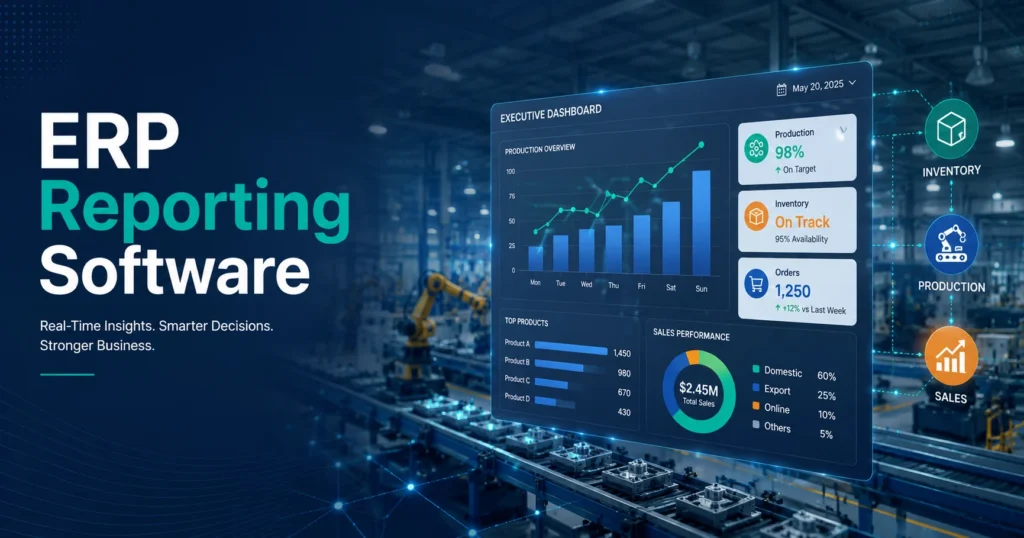
Instead of pulling reports on demand, your team gets live dashboards showing production status, order fulfilment, and sales performance as it happens. A plant manager can see exactly how many units have been completed today versus the daily target, while a sales lead can track order pipeline value without sending a single follow-up email.
Customisable Reports for Different Departments
Not every team needs the same data. Chirix ERP lets you build role-specific reports: finance gets cash flow and receivables tracking; inventory teams get stock movement and reorder alerts; production gets machine utilisation and downtime reports; and sales gets order and customer performance data. Everyone sees what’s relevant to their job, without digging through irrelevant numbers.
Drill-Down Analytics for Root-Cause Identification
A summary number rarely tells the whole story. If output drops on a particular day, Chirix ERP lets you drill down from the high-level dashboard straight into the specific order, machine, or shift responsible so you’re solving the actual problem instead of guessing at it.
Automated Report Scheduling and Sharing
Reports can be scheduled to generate and land in the right inboxes automatically: daily production summaries each morning, weekly sales reports every Monday, or monthly financial statements without anyone needing to remember to run them manually.
How Faster Reporting Translates to Faster Decisions
Good data is only useful if it actually changes how fast and how well you act on it. Here’s where that shows up.
Reducing Decision Lag in Production Planning
When production data is delayed, planning decisions get delayed with it. With real-time reporting, a production manager can adjust schedules the moment a bottleneck appears, rather than discovering it in next week’s report.
Identifying Inventory Bottlenecks Before They Escalate
Stockouts and overstocking both eat into profitability. Real-time inventory reporting flags low-stock items before they halt production and highlights slow-moving stock before it ties up working capital unnecessarily.
Supporting Data-Backed Pricing and Procurement Decisions
When you can see real costs, order volumes, and margins clearly and immediately, pricing and procurement decisions stop being estimates. You’re negotiating with suppliers and quoting clients based on actual numbers, not last quarter’s averages.
Industry Use Cases: ERP Reporting Software in Action
Manufacturing Floor Efficiency Tracking
Consider a mid-sized manufacturing unit running multiple production lines. Without real-time reporting, a slowdown on one line might go unnoticed for days, quietly eating into monthly output targets. With live dashboards tracking machine utilisation and downtime by line, the same issue gets flagged within hours, giving floor managers time to reassign resources or troubleshoot before the month-end numbers take the hit.
Packaging Industry Demand Forecasting
For a packaging business juggling seasonal demand swings, reporting that’s even a week behind can mean over-ordering raw materials for a slow month or under-preparing for a sudden order spike. Real-time sales and order trend reports help these businesses align production and procurement much closer to actual demand, reducing waste and missed deliveries.
Chirix ERP vs. Traditional Reporting Methods
Factor Manual / Spreadsheet Reporting Chirix ERP Reporting Module Time to generate a report. Hours to days Real-time / instant Error rate Higher (manual entry, formula errors) Low (automated, single data source) Accessibility Limited to whoever built the file Role-based access for relevant teams Update frequency: Periodic (weekly/monthly) Continuous, live updates Compliance tracking (GST, e-waybill) Manual cross-checking Integrated and automated
How to Get Started with Chirix ERP’s Reporting Tools
Implementation Overview
Getting started typically begins with mapping your existing reporting needs, which departments need which reports, and what data sources they currently pull from. Chirix ERP’s team then configures dashboards and report templates around your specific production and sales workflows, rather than forcing your business into a generic template.
Training and Support for Your Team
Rolling out new reporting tools only works if your team actually uses them. Chirix ERP includes onboarding support and training so department heads and floor staff alike are comfortable navigating dashboards and pulling the reports they need, with ongoing support available as your reporting needs evolve.
Frequently Asked Questions
Chirix ERP generates production reports, inventory and stock movement reports, sales and order reports, financial statements, and compliance-related reports such as GST summaries — all customisable by department.
Yes. Chirix ERP allows role-based report configuration, so finance, production, inventory, and sales teams each see dashboards relevant to their responsibilities.
Yes. The reporting module scales to business size, making it useful for small and mid-sized manufacturers as well as larger operations with multiple production lines.
Chirix ERP integrates GST and e-waybill data directly into its reporting system, reducing the manual cross-checking typically needed to stay compliant during shipments and filings.
Conclusion
Faster reporting isn’t just about convenience; it’s about catching problems while they’re still small, making pricing and procurement decisions based on real numbers, and keeping production running smoothly instead of reactively. Chirix ERP’s reporting module is built to give manufacturing and packaging businesses exactly that: real-time, role-specific, accurate data that turns into faster, more confident decisions.
Want to see how Chirix ERP’s reporting tools would work for your specific operation? Reach out to our sales team for a personalised walkthrough.