
Bangalore has earned a reputation as one of India’s leading manufacturing hubs. From precision engineering and automotive components to electronics, packaging, food processing, and industrial machinery, thousands of small and mid-size manufacturers power the city’s industrial growth. While these businesses have immense potential, many still rely on spreadsheets, paper-based records, or disconnected software to manage daily operations.
As production volumes increase and customer expectations rise, manual processes become a major obstacle. Inventory discrepancies, production delays, inaccurate cost calculations, and limited visibility into operations can reduce profitability and make it difficult to compete.
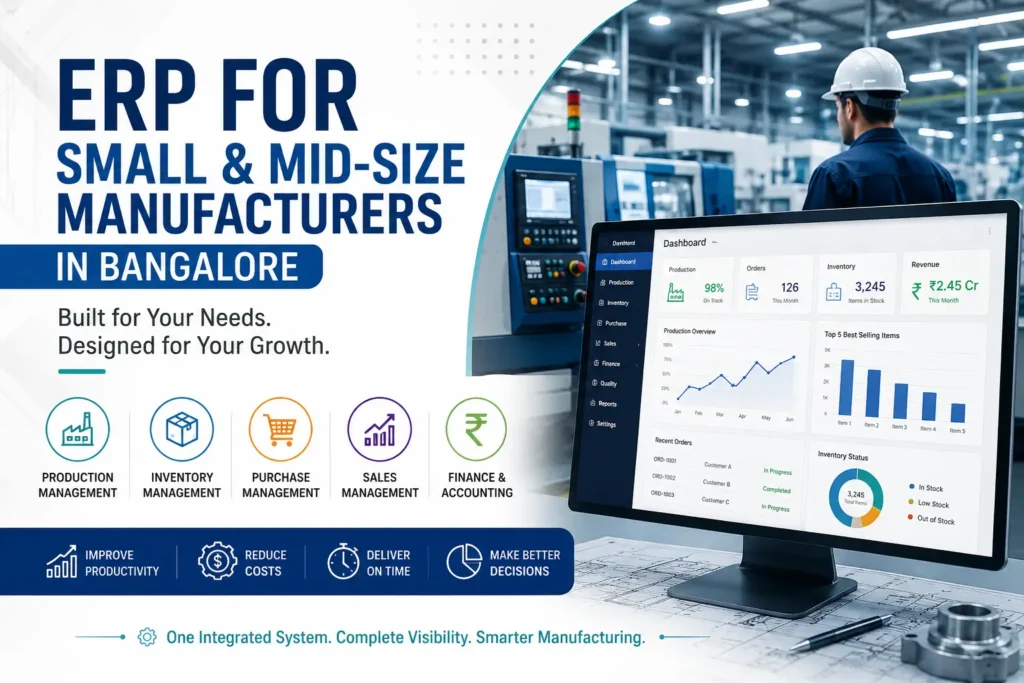
This is where ERP for Small & Mid-Size Manufacturers in Bangalore becomes a game changer. Unlike traditional business software that handles only one function, an Enterprise Resource Planning (ERP) system integrates production, inventory, purchasing, sales, finance, quality control, and reporting into a single platform. It enables business owners to make faster decisions based on real-time data while improving efficiency across every department.
Whether you’re managing a growing factory with 20 employees or a mid-sized manufacturing unit with multiple production lines, the right ERP solution helps streamline operations, reduce waste, and prepare your business for sustainable growth.
Why Small & Mid-Size Manufacturers in Bangalore Need ERP More Than Ever
Manufacturing in Bangalore has become increasingly competitive. Customers expect shorter lead times, consistent product quality, and transparent communication throughout the production process. At the same time, manufacturers are dealing with rising raw material costs, labour shortages, fluctuating demand, and tighter profit margins.
Without an integrated system, managing these challenges becomes difficult.
Increasing Competition Demands Better Efficiency
Today’s manufacturers are not just competing with local businesses but also with companies across India and global suppliers. To remain competitive, businesses must improve productivity while controlling operational costs.
An ERP system helps manufacturers by:
- Automating repetitive tasks
- Eliminating duplicate data entry
- Improving production planning
- Optimising inventory levels
- Providing real-time operational insights
- Reducing manual errors
Instead of spending hours gathering information from different departments, decision-makers can access accurate business data from a centralised dashboard.
The Challenges of Manual Operations
Many small manufacturers continue to rely on Excel sheets or standalone software for different functions. While these tools may work during the early stages of business growth, they become difficult to manage as operations expand.
Common issues include:
- Inaccurate inventory records
- Delayed purchase approvals
- Production scheduling conflicts
- Duplicate data entry
- Lack of visibility across departments
- Difficulty tracking work orders
- Delayed customer deliveries
- Manual financial reporting
These inefficiencies often result in increased costs and missed business opportunities.
Digital Transformation Is No Longer Optional
Customers increasingly expect faster deliveries, higher product quality, and better service. Businesses that continue using manual systems may struggle to meet these expectations.
ERP software supports digital transformation by connecting every department through a single source of truth. Teams can collaborate more effectively, managers gain real-time visibility into operations, and business owners can make informed decisions based on accurate data rather than assumptions.
What Is ERP for Small & Mid-Size Manufacturers?
Enterprise Resource Planning (ERP) is a business management system that integrates all core manufacturing operations into one centralised platform. Instead of maintaining separate software for accounting, inventory, production, purchasing, and sales, ERP brings every process together.
For manufacturing businesses, this means that information entered in one department is instantly available to other departments.
For example:
- A confirmed sales order automatically creates production requirements.
- Production consumes raw materials from inventory.
- Inventory updates stock levels in real time.
- Purchasing receives alerts when materials fall below reorder levels.
- Finance can track production costs and profitability without manual calculations.
This seamless flow of information reduces delays, minimises errors, and improves operational efficiency.
ERP vs. Traditional Accounting Software
Many small businesses assume accounting software is sufficient to manage manufacturing operations. While accounting software handles invoicing and financial records, it does not provide complete visibility into production and supply chain activities.
An ERP solution goes far beyond accounting by offering the following:
- Production planning
- Material Requirement Planning (MRP)
- Inventory management
- Purchase management
- Sales order management
- Warehouse management
- Quality control
- Machine maintenance
- Cost tracking
- Business analytics
This integrated approach enables manufacturers to optimise operations from raw material procurement to final product delivery.
Common Challenges Faced by Small Manufacturers in Bangalore
Every manufacturing business encounters operational challenges, but small and mid-sized companies often face additional resource constraints that make efficient management even more important.
Poor Inventory Management
Inventory is one of the largest investments for any manufacturing business. Without accurate stock tracking, manufacturers often experience the following:
- Overstocking that increases carrying costs
- Stock shortages that delay production
- Material wastage due to poor storage
- Difficulty locating materials in the warehouse
- Inaccurate inventory valuation
An ERP system provides real-time inventory visibility, helping businesses maintain optimal stock levels while reducing waste.
Production Planning Issues
Production delays frequently occur because of poor planning and limited visibility into available resources.
Common challenges include:
- Machine downtime
- Inefficient scheduling
- Labour allocation problems
- Raw material shortages
- Delayed work orders
- Missed production deadlines
ERP software helps manufacturers create realistic production schedules based on machine capacity, labour availability, and material readiness.
Purchase Management Challenges
Procurement directly impacts production efficiency. Manual purchasing processes often result in the following:
- Delayed purchase orders
- Vendor communication gaps
- Higher procurement costs
- Duplicate purchases
- Emergency buying at premium prices
ERP automates purchase requests, approval workflows, supplier management, and reorder planning to improve procurement efficiency.
Limited Financial Visibility
Many manufacturers struggle to understand their actual production costs and profitability because financial information is spread across multiple systems.
Without accurate cost analysis, businesses find it difficult to
- Set competitive pricing
- Control expenses
- Monitor cash flow
- Improve profitability
- Plan future investments
An ERP system consolidates financial and operational data, providing real-time reports that support informed decision-making.