
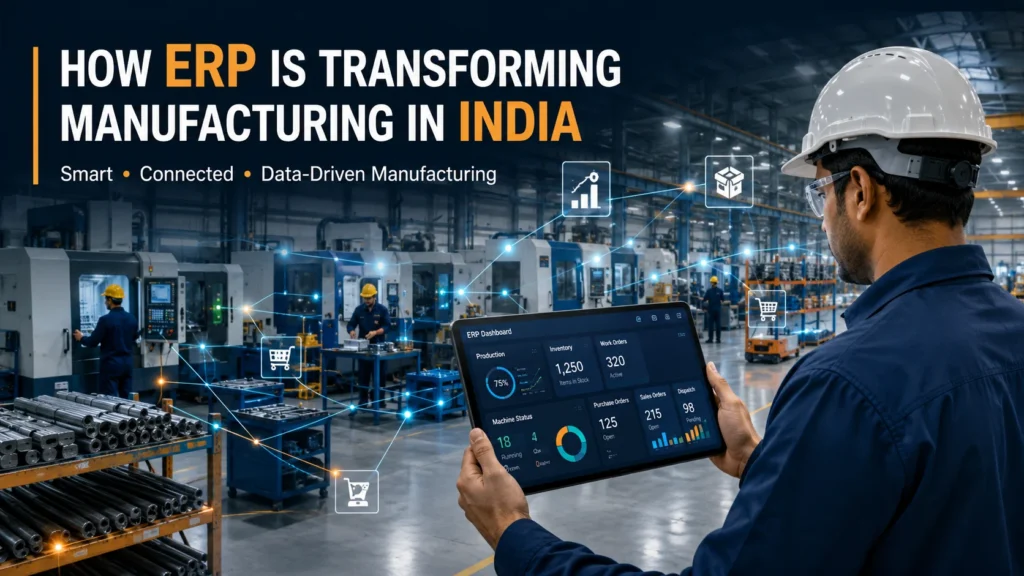
Why ERP Is Becoming Essential for Indian Manufacturers
India’s manufacturing sector is undergoing a major transformation. Engineering manufacturers, in particular, are dealing with increasing customer expectations, rising raw material costs, tighter delivery schedules, growing product complexity, and the need to maintain consistent quality.
For many small and medium-sized engineering manufacturers, however, day-to-day operations are still managed through a combination of spreadsheets, paper records, standalone accounting software, WhatsApp messages, and disconnected systems.
This creates a familiar set of problems:
- Stock mismatches
- Production delays
- Difficulty tracking work orders
- Limited machine-wise production visibility
- Manual purchase processes
- Material wastage
- Difficult job-work tracking
- Delayed reports
- Billing and dispatch errors
- Poor coordination between departments
This is where ERP for the manufacturing industry in India is becoming increasingly important.
A modern manufacturing ERP brings production, inventory, procurement, sales, finance, quality, logistics, and other business processes together on a single platform. Instead of relying on disconnected information, manufacturers can access centralised and real-time business data.
For SME engineering manufacturers, the goal isn’t simply to “digitise” existing processes. The real objective is to reduce operational inefficiencies, improve visibility, control costs, and create a scalable foundation for growth.
What Is ERP for the Manufacturing Industry?
ERP stands for Enterprise Resource Planning. Manufacturing ERP is software designed to connect the different functions involved in running a manufacturing business.
For an engineering manufacturer, this can include:
- Sales and quotations
- Customer orders
- Bill of Materials (BOM)
- Production planning
- Work orders
- Machine-wise production
- Raw material inventory
- Purchase management
- Job work and subcontracting
- Quality control
- Finished goods
- Dispatch and logistics
- Billing
- Finance and accounting
- Management dashboards
Instead of each department maintaining its own records, ERP creates a connected flow of information.
How Does Manufacturing ERP Work?
Consider a typical engineering manufacturing process:
Customer Order → Production Planning → Material Requirement → Purchase → Raw Material Receipt → Production → Quality Check → Finished Goods → Dispatch → Billing → Finance
Without ERP, each stage may be tracked using separate files or systems.
With an integrated ERP system, information can flow from one process to another, reducing repetitive data entry and improving visibility across the organisation.
Why Indian SME Manufacturers Need ERP
Large enterprises have traditionally been early adopters of ERP systems. Today, ERP is becoming increasingly relevant for small and medium-sized manufacturers as well.
Growing Operational Complexity
An engineering manufacturing company may handle hundreds of components, multiple machines, different raw materials, several suppliers, subcontractors, customer-specific specifications, and multiple production stages.
As the business grows, manually coordinating all these activities becomes increasingly difficult.
Rising Customer Expectations
Customers increasingly expect the following:
- Faster delivery
- Accurate quotations
- Consistent quality
- Order visibility
- Reliable documentation
- Competitive pricing
Manufacturers need better internal coordination to meet these expectations.
Increasing Cost Pressure
Raw materials, labour, energy, transportation, and operating costs can significantly affect manufacturing margins.
ERP helps manufacturers understand where resources are being consumed and where operational inefficiencies may exist.
Need for Faster Decisions
Management cannot afford to wait several days for reports showing production status or inventory levels.
With ERP dashboards, decision-makers can access business information more quickly and make decisions based on current operational data.
How ERP Is Transforming Manufacturing in India
ERP is changing manufacturing operations by connecting traditionally disconnected processes.
For SME engineering manufacturers, some of the most important transformations include the following.
1. Real-Time Production Tracking
Production visibility is one of the biggest challenges for engineering manufacturers.
When production information is maintained manually, management may struggle to answer basic questions:
- Which work orders are currently running?
- How much has been produced?
- Which machines are available?
- Which orders are delayed?
- How much production remains?
- What is the planned versus actual output?
A manufacturing ERP can provide centralised production tracking.
Managers can monitor work orders, production quantities, production stages, and machine-related information from a single system.
Machine-Wise Production Tracking
For engineering manufacturers operating CNC machines, lathes, milling machines, presses, fabrication equipment, or other machinery, machine-wise production visibility can be particularly valuable.
ERP can help track:
- Machine allocation
- Production quantities
- Work-order status
- Machine utilisation
- Planned production
- Actual production
- Production delays
This gives management a clearer picture of shop-floor performance.
2. Better Inventory Management
Inventory is one of the largest operational concerns for manufacturing SMEs.
Too little stock can stop production.
Too much stock can lock up working capital.
Inaccurate stock information can create both problems simultaneously.
Manufacturing ERP helps connect purchasing, inventory, production, and sales so that businesses can maintain better visibility over material movement.
A manufacturing ERP can help track:
- Raw materials
- Work-in-progress
- Finished goods
- Consumables
- Spare parts
- Stock locations
- Stock ageing
- Material receipts
- Material issues
- Stock transfers
FIFO-Based Inventory Control
For manufacturers managing large quantities of raw materials, FIFO-based inventory management can help maintain better material rotation and reconciliation.
ERP can automate stock movement according to defined inventory rules rather than relying entirely on manual records.
Barcode-Based Inventory Tracking
Barcode-based inventory processes can further improve accuracy by allowing teams to identify and track materials digitally.
This can reduce dependence on handwritten records and improve stock visibility.
3. Smarter Production Planning and Scheduling
Production planning becomes increasingly complicated as manufacturing businesses grow.
A production manager needs to consider the following:
- Customer orders
- Material availability
- Machine capacity
- Existing work orders
- Delivery deadlines
- Workforce availability
- Production priorities
ERP can bring these factors together in a structured production planning process.
Instead of relying on multiple spreadsheets, production teams can manage work orders and production schedules through a centralised system.
Planned vs Actual Production
One of the biggest advantages of digital production management is the ability to compare planned production with actual output.
This helps managers identify:
- Delays
- Bottlenecks
- Capacity issues
- Production inefficiencies
- Resource constraints
Over time, this information can help manufacturers improve production planning.
4. Improved Procurement and Purchase Management
Engineering manufacturers frequently purchase different grades, sizes, and specifications of raw materials.
Managing these purchases manually can result in:
- Duplicate orders
- Emergency purchases
- Missed requirements
- Supplier communication gaps
- Excess inventory
- Material shortages
ERP connects production requirements with procurement activities.
A typical workflow can be:
Material Requirement → Purchase Requisition → Approval → Purchase Order → Goods Receipt → Quality Check → Inventory
This creates better visibility throughout the purchasing cycle.
Supplier Management
ERP can also help manufacturers maintain supplier information, purchase history, pricing information, and procurement records.
This gives management better information when evaluating suppliers and purchasing decisions.
5. Efficient Job Work and Subcontracting Management
Many Indian engineering manufacturers depend on external vendors for processes such as:
- Heat treatment
- Plating
- Powder coating
- Welding
- Machining
- Surface treatment
- Fabrication
- Specialised finishing
Managing subcontracted work through spreadsheets can make material tracking difficult.
Manufacturing ERP can help track:
- Material sent to subcontractors
- Job-work orders
- Material consumption
- Pending quantities
- Finished quantities received
- Vendor-wise job work
- Job-work costs
This creates better accountability and reduces the risk of losing track of materials outside the factory.
6. Automated Billing and GST Processes
Manufacturing involves a large volume of commercial transactions.
Manual billing can increase the risk of:
- Data-entry mistakes
- Incorrect tax calculations
- Duplicate entries
- Delayed invoices
- Documentation issues
ERP can integrate sales and billing processes with operational data.
Depending on the ERP and its integrations, manufacturers can manage processes such as:
- GST invoicing
- E-invoicing
- E-way bills
- Sales invoices
- Credit notes
- Debit notes
- Receivables
This can reduce repetitive work and improve the consistency of billing processes.
7. Better Financial and Cost Visibility
For an engineering manufacturer, revenue alone does not tell the full story.
Management needs to understand:
How much does it cost to manufacture a product?
ERP can connect operational transactions with financial information.
Manufacturers can gain better visibility into:
- Material costs
- Purchase expenses
- Production costs
- Job-work costs
- Sales revenue
- Receivables
- Payables
- Product profitability
This can help management identify areas where costs are increasing and where margins may be under pressure.
8. Improved Quality Management and Traceability
Quality is critical for engineering manufacturers supplying industrial customers.
A manufacturing ERP can support quality processes throughout the production cycle.
This may include:
Incoming Quality Checks
Materials received from suppliers can be inspected before being released into production.
In-Process Quality Checks
Quality checks can be performed at specific production stages.
Finished Goods Inspection
Completed products can be checked against predefined requirements before dispatch.
Rejection Tracking
ERP can help record rejected quantities and analyse rejection patterns.
This creates a more structured quality-management process and improves traceability.
9. Better Supply Chain and Dispatch Management
Manufacturing does not end when production is completed.
Finished products need to be packed, documented, dispatched, and delivered.
ERP can connect:
Sales → Production → Inventory → Dispatch → Billing → Logistics
This helps different departments work with the same information.
Manufacturers can improve visibility into:
- Pending orders
- Ready-to-dispatch products
- Dispatch schedules
- Delivery documentation
- Customer orders
- Finished goods availability
The result is a more connected order-to-delivery process.
10. Data-Driven Decision Making
One of the biggest advantages of ERP is the ability to convert operational data into management information.
Instead of manually preparing reports, management can use dashboards to monitor important KPIs.
For example:
- Production output
- Pending work orders
- Inventory levels
- Purchase orders
- Sales orders
- Receivables
- Machine performance
- Production status
- Stock ageing
From Manual Reports to Real-Time Insights
The transformation can be represented as:
Manual Records → Digital Data → Automated Reports → Live Dashboards → Better Decisions
For SME manufacturers, this visibility can make a significant difference as the organisation grows.
The Role of Cloud ERP in India’s Manufacturing Sector
Traditional ERP implementations often required significant investments in servers, infrastructure, and IT resources.
Cloud ERP has changed this model.
With cloud ERP, software and data can be accessed through secure internet-connected devices, depending on the system architecture and access controls.
Benefits of Cloud ERP for Manufacturers
Cloud ERP can offer:
- Lower infrastructure requirements
- Remote accessibility
- Centralised data
- Easier scalability
- Automatic software updates
- Data backup capabilities
- Multi-location accessibility
- Faster deployment
Why Cloud ERP Works Well for SMEs
For an SME manufacturer, maintaining a large internal IT infrastructure may not be practical.
Cloud ERP can provide access to integrated business software without requiring the company to build and maintain extensive hardware infrastructure.
This makes cloud-based ERP an increasingly attractive option for growing manufacturing businesses.
ERP and Industry 4.0: Building the Smart Factory
The future of manufacturing is moving toward connected and intelligent operations.
Industry 4.0 combines technologies such as:
- IoT
- Automation
- Artificial intelligence
- Machine monitoring
- Data analytics
- Cloud computing
ERP can serve as an important business-management layer within this ecosystem.
ERP + IoT
Connected machines can potentially generate operational data that can be integrated into broader manufacturing systems.
This can improve visibility into machine performance and production activity.
ERP + AI and Analytics
AI and analytics can help organisations identify patterns in areas such as:
- Demand
- Inventory
- Production
- Costs
- Maintenance
- Sales
The long-term goal is to move from simply understanding what happened to understanding why it happened and what may happen next.
ERP + Automation
Manufacturers can automate repetitive processes such as the following:
- Purchase approvals
- Inventory transactions
- Notifications
- Billing
- Reporting
- Workflow approvals
Automation allows employees to spend less time on repetitive administrative activities and more time on higher-value work.
Key Benefits of ERP for Manufacturing Companies in India
For SME engineering manufacturers, ERP can deliver benefits across multiple areas.
Increased Operational Efficiency
Connected workflows reduce duplication and improve coordination.
Reduced Manufacturing Costs
Better visibility can help management identify unnecessary expenses and operational inefficiencies.
Improved Inventory Accuracy
Centralised inventory information reduces dependency on disconnected spreadsheets and manual records.
Faster Order Fulfilment
Better coordination between sales, production, inventory, and dispatch can help improve order processing.
Reduced Manual Work
Automated workflows reduce repetitive data entry and administrative tasks.
Better Resource Utilisation
Production and machine information can help managers make better use of available resources.
Improved Management Visibility
Dashboards provide management with a centralised view of business operations.
Better Customer Service
Better production and inventory visibility can help businesses provide more accurate information to customers.
Scalable Operations
A structured ERP system can provide a foundation for growth as the company adds products, employees, machines, warehouses, or locations.
ERP for Small and Medium-Sized Engineering Manufacturers
SME manufacturers often hesitate to implement ERP because they associate ERP with large enterprises, expensive implementations, and complicated software.
Modern cloud ERP solutions are changing this perception.
Common Challenges Faced by Manufacturing SMEs
SMEs often deal with:
- Limited IT resources
- Manual processes
- Spreadsheet dependency
- Difficult reporting
- Fragmented business information
- Limited production visibility
- Inventory inaccuracies
- Growing operational complexity
As the company grows, these problems can become increasingly difficult to manage.
How ERP Helps Manufacturing SMEs Scale
ERP provides a structured platform for managing business processes.
Instead of adding more spreadsheets and manual processes as the company grows, manufacturers can create standardised digital workflows.
This allows the business to scale with greater operational visibility.
How to Choose the Right ERP for Manufacturing in India
Choosing an ERP is an important business decision. The cheapest system is not necessarily the best option, and the most complex system may not be suitable for an SME.
Manufacturers should evaluate ERP based on their actual processes.
Evaluate Manufacturing-Specific Features
Look for capabilities such as:
- Production management
- Work orders
- BOM management
- Inventory management
- Purchase management
- Quality management
- Job-work management
- Machine-wise tracking
- Billing
- Finance
- Logistics
- Dashboards and analytics
Check Scalability
Ask whether the ERP can support future growth.
Consider:
- More users
- More products
- More machines
- More warehouses
- Additional locations
- Increased transaction volumes
Evaluate Integration Capabilities
Check whether the ERP can integrate with the systems your business already uses.
Potential integrations may include:
- Accounting
- GST systems
- E-commerce
- CRM
- Payment platforms
- Logistics
- IoT systems
Assess Security
Important considerations include:
- User permissions
- Role-based access
- Data backup
- Audit trails
- Access controls
- Data security
Consider Implementation and Support
A successful ERP implementation requires more than software.
Evaluate:
- Implementation methodology
- Data migration
- Employee training
- Customisation
- Technical support
- Post-implementation assistance
Common ERP Implementation Challenges
ERP can transform manufacturing operations, but implementation needs to be planned carefully.
Employee Resistance to Change
Employees who are comfortable with existing processes may initially resist a new system.
Training and proper change management are essential.
Data Migration Challenges
Existing customer, supplier, product, inventory, and transaction data may need to be cleaned and migrated.
Poor-quality data can affect ERP performance and reporting.
Lack of Process Standardisation
ERP works best when business processes are clearly defined.
Manufacturers should review and standardise processes before or during implementation.
Insufficient Training
Employees need to understand not only how to use the software but also why the new process is being introduced.
Choosing the Wrong ERP
An ERP designed primarily for generic accounting or trading businesses may not adequately support complex manufacturing operations.
Engineering manufacturers should prioritise manufacturing-specific capabilities.
The Future of ERP in India’s Manufacturing Industry
ERP will continue to evolve as manufacturing becomes more connected and data-driven.
Several trends are likely to shape the future.
AI-Powered ERP
AI will increasingly assist users with analysis, recommendations, and automation.
Predictive Analytics
Manufacturers will increasingly use historical and real-time data to anticipate demand, inventory requirements, production issues, and maintenance needs.
IoT-Connected Manufacturing
Machines and shop-floor systems will increasingly generate data that can feed into enterprise platforms.
Mobile ERP
Managers and employees will increasingly access business information through mobile devices.
Automated Workflows
More administrative and operational processes will become automated.
Predictive Maintenance
Machine data combined with analytics can help organisations move toward predictive rather than purely reactive maintenance.
Real-Time Manufacturing Intelligence
Manufacturers will increasingly expect live visibility into production, inventory, sales, procurement, and financial performance.
Greater ERP Adoption Among MSMEs
As cloud technology becomes more accessible, ERP adoption is likely to continue expanding among small and medium-sized manufacturing businesses.
From Manual Manufacturing to Smart Manufacturing
The impact of ERP can be summarised through this transformation:
| Before ERP | With Manufacturing ERP |
| Manual records | Digital records |
| Spreadsheet inventory | Real-time inventory |
| Manual production tracking | Live production tracking |
| Delayed reports | Real-time dashboards |
| Separate departments | Connected departments |
| Manual billing | Automated billing |
| Reactive decisions | Data-driven decisions |
| Limited visibility | End-to-end visibility |
The objective is not simply to replace paper with software.
The real transformation is the ability to connect information, automate processes, improve visibility, and make better decisions.
Frequently Asked Questions About ERP for Manufacturing in India
ERP for the manufacturing industry is an integrated software system that connects production, inventory, procurement, sales, finance, quality, logistics, and other business processes in a centralised platform.
Manufacturing companies use ERP to improve operational visibility, reduce manual work, manage inventory, coordinate production, streamline procurement, improve reporting, and support better decision-making.
A manufacturing ERP should ideally include modules for production, inventory, procurement, sales, finance, quality, job work, logistics, billing, and reporting. The exact requirements depend on the manufacturer’s processes.
Yes. Cloud ERP can be particularly useful for SMEs because it can reduce infrastructure requirements, provide remote accessibility, and offer a scalable platform for business growth.
ERP costs vary depending on the number of users, modules, customisation, implementation requirements, integrations, and deployment model. Manufacturers should evaluate total implementation and ownership costs rather than looking only at the software price.
Implementation time varies depending on business complexity, data migration, number of modules, customisation, integrations, and user readiness.
Yes. Manufacturing ERP is specifically designed to connect production requirements with inventory availability, material consumption, work orders, and finished-goods stock.
Many ERP systems support integrations for GST-related invoicing and compliance processes. Businesses should verify the exact capabilities and integrations offered by their chosen ERP provider.
Yes. Cloud-based ERP solutions can make integrated business management more accessible to small and medium-sized manufacturers without requiring large internal IT infrastructure.
Manufacturing ERP can support machine-wise production tracking when the system includes appropriate production and shop-floor management capabilities.
ERP improves efficiency by connecting departments, reducing repetitive data entry, improving production and inventory visibility, automating workflows, and providing management with timely operational information.
Manufacturing management software may focus primarily on production activities, while ERP generally connects manufacturing with other business functions such as purchasing, inventory, sales, finance, billing, logistics, and reporting.
Conclusion: Why ERP
Is Becoming the Future of Manufacturing in India
The manufacturing industry in India is becoming increasingly competitive, connected, and data-driven.
For SME engineering manufacturers, relying entirely on spreadsheets and disconnected systems can make it difficult to maintain operational visibility as the business grows.
A modern ERP system can connect the entire business—from customer orders and purchasing to production, inventory, quality, dispatch, billing, and finance.
The transformation can be summarised as follows:
Manual Operations → Integrated Processes → Real-Time Data → Intelligent Decisions → Smarter Manufacturing
For manufacturers looking to improve production visibility, control inventory, reduce manual work, streamline procurement, and build a scalable operation, implementing the right ERP for the manufacturing industry in India can be an important step toward digital transformation.
Ready to modernise your manufacturing operations?
If your engineering manufacturing business is still relying on spreadsheets, disconnected systems, or manual production tracking, now may be the right time to explore a manufacturing-focused ERP solution.
Request a free ERP demo and discover how a connected ERP platform can help streamline your manufacturing operations, improve visibility, and support business growth.