
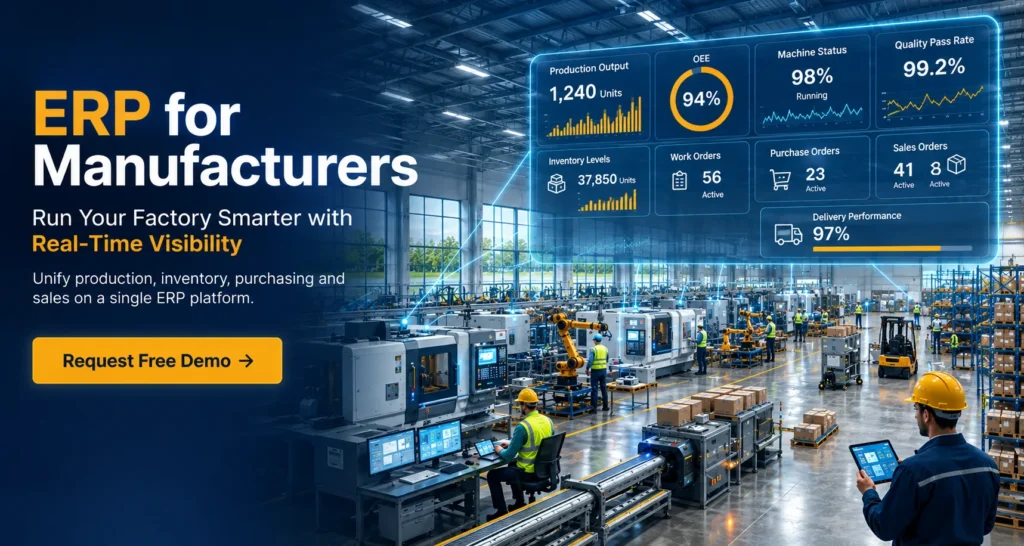
Walk onto most factory floors in India or Malaysia today and you’ll find the same story repeating itself: production schedules living in one spreadsheet, inventory counts in another, and job work orders tracked on paper or in WhatsApp messages between the shop floor supervisor and the purchase team. Somewhere in between, a delivery deadline slips, a batch of raw material runs out mid-production, or GST filing gets delayed because invoice data has to be manually reconciled from three different systems.
This is exactly the gap that ERP for manufacturers was built to close. Enterprise Resource Planning software brings production, inventory, procurement, quality, and finance onto a single connected platform, so decisions are based on real-time shop floor data instead of guesswork and end-of-day phone calls.
This guide covers everything a manufacturing business owner or operations leader needs to know before choosing an ERP system: what manufacturing ERP actually includes, the features that matter most, how to evaluate vendors, and a realistic implementation roadmap. Whether you run a 20-machine job shop or a multi-plant operation, the goal here is the same: help you separate genuine manufacturing capability from generic business software wearing an ERP label.
What Is ERP for Manufacturers?
ERP for manufacturers is enterprise software purpose-built to manage the full production lifecycle, from raw material procurement and bill of materials (BOM) planning through shop floor execution, quality checks, and finished goods dispatch, all within one connected system.
How Manufacturing ERP Differs from Generic Business ERP
Generic ERP systems are often built first for services, retail, or distribution businesses, with manufacturing features added on as an afterthought. A true manufacturing ERP is built around production logic from day one: it understands multi-level BOMs, job work orders sent to subcontractors, machine-wise capacity planning, and shop floor data capture. Generic systems can track invoices and stock levels well enough, but they typically struggle with production scheduling, OEE (Overall Equipment Effectiveness) tracking, and work-in-progress (WIP) visibility – the things that actually run a factory.
Core Modules Every Manufacturing ERP Should Have
At minimum, a manufacturing ERP should include:
- Production planning and scheduling – machine and labour capacity planning
- Inventory and raw material management – real-time stock across multiple warehouses
- BOM and job work order management – multi-level bills of materials and subcontractor tracking
- Quality control – inspection checkpoints tied to production stages
- Finance and compliance – GST, e-invoicing, and e-waybill generation built in, not bolted on
Why Manufacturers Need ERP in 2026
Common Operational Problems ERP Solves
Manufacturers without a connected system typically run into the same recurring issues: BOM errors that cause material shortages mid-run, no visibility into which machines are actually causing downtime, purchase orders raised without checking existing stock, and finance teams reconciling GST data days after invoices are issued. Each of these problems compounds – a BOM error doesn’t just delay one order; it cascades into missed delivery commitments and rush freight costs.
Cost of Not Having an ERP System
The cost of staying on spreadsheets and disconnected tools isn’t always visible on a single line item, but it shows up in rework percentages, excess safety stock tied up as working capital, overtime paid to fix scheduling conflicts, and GST late-filing penalties. For most SME manufacturers, these hidden costs add up to far more than the price of an ERP subscription.
Key Features to Look for in Manufacturing ERP Software
Production Planning & Scheduling
The system should let planners see machine and labour capacity at a glance and reschedule jobs when priorities shift – without manually re-checking every dependent order.
Inventory & Raw Material Management
Real-time stock visibility across raw materials, WIP, and finished goods, with automatic reorder triggers based on actual consumption rather than fixed reorder points.
Bill of Materials (BOM) & Job Work Order Management
Support for multi-level BOMs, engineering change tracking, and job work orders issued to and received from subcontractors is critical for manufacturers who outsource part of their process.
Quality Control & Compliance Tracking
In-process and final inspection checkpoints that can hold a batch from moving forward until quality parameters are met, with a full audit trail.
Real-Time Shop Floor & OEE Monitoring
Machine-level data capture for availability, performance, and quality – the three components of OEE – so downtime causes are visible instead of anecdotal.
Financial Management & GST/e-Invoicing Compliance
Native GST computation, e-invoicing, and e-waybill generation for Indian manufacturers, with equivalent compliance handling (such as LHDN e-Invoice requirements) for manufacturers operating in Malaysia.
Benefits of ERP for Manufacturers
Improved Production Efficiency & Reduced Downtime
With machine-level data and automated scheduling, planners catch bottlenecks before they cause missed deadlines rather than after.
Better Inventory Accuracy & Lower Carrying Costs
Real-time stock data reduces both stockouts and the excess safety stock manufacturers often hold to compensate for poor visibility.
Faster, Data-Driven Decision Making
Instead of waiting for end-of-week reports, managers can see production and financial data as it happens and act on it the same day.
Regulatory Compliance Made Simple
Built-in GST, e-invoicing, and e-waybill functionality removes the manual reconciliation work that otherwise falls on finance teams every filing cycle.
Types of ERP Systems for Manufacturers
Cloud-Based vs On-Premise ERP
Cloud ERP requires no in-house server infrastructure, is accessible from multiple plant locations, and typically comes with a lower upfront cost, a significant factor for SME manufacturers. On-premise systems offer more control over data hosting but require dedicated IT resources to maintain them.
Industry-Specific ERP vs Generic ERP
Industry-specific manufacturing ERP is pre-configured with BOM, job work, and shop floor logic out of the box, reducing customisation time compared to generic ERP platforms retrofitted for manufacturing use.
ERP for SMEs vs Large Enterprises
SME-focused ERP platforms prioritise faster implementation timelines and simpler pricing structures, while enterprise ERP systems are built for complex multi-entity, multi-currency operations, often at a cost and implementation timeline that doesn’t suit a single or dual-plant manufacturer.
How to Choose the Right ERP for Your Manufacturing Business
Assessing Your Current Pain Points
Start with a clear list of the specific problems costing you time or money today, whether that’s BOM errors, inventory mismatches, or delayed compliance filings, rather than starting from a generic feature checklist.
Must-Have vs Nice-to-Have Features Checklist
Separate features your production process cannot run without (multi-level BOM, job work tracking) from features that are useful but not essential at your current scale (advanced AI forecasting, for instance).
Budget Considerations & Total Cost of Ownership
Look beyond the subscription price to implementation costs, training time, and the cost of any customisation your process requires.
ERP Implementation Roadmap for Manufacturers
Pre-Implementation Planning
Before go-live, map your current processes and audit existing data (BOMs, vendor lists, and inventory records) so the migration reflects how your factory actually operates, not a theoretical ideal.
Rollout Phases
Most successful implementations run a pilot in one department or product line first, expand department by department, and only move to full deployment once the pilot data confirms accuracy.
Change Management & Team Training
ERP adoption succeeds or fails on the shop floor, not in the boardroom – operators need hands-on training on data entry and daily workflows, not just managers.
Common Implementation Mistakes to Avoid
The most frequent implementation failures come from skipping the data audit stage, underestimating training time, and trying to replicate every old spreadsheet workflow inside the new system instead of adapting to it.
Chirix ERP for Manufacturers – Why It Fits
Manufacturing-Specific Capabilities Built for SMEs
Chirix ERP is built around manufacturing workflows from the ground up – multi-level BOM, job work order tracking, and shop-floor data capture are designed for SME production environments rather than adapted from a generic platform.
India & Malaysia Market Readiness
Chirix ERP handles GST computation, e-invoicing, and e-waybill generation for Indian manufacturers and supports LHDN e-Invoice compliance for manufacturers operating in Malaysia – built in as core functionality rather than a third-party add-on.
Frequently Asked Questions
The right ERP for a small manufacturer depends on production complexity, but industry-specific platforms built for SME manufacturing workflows generally implement faster and cost less than enterprise-grade systems retrofitted for smaller operations.
Implementation timelines vary by scope, but SME-focused manufacturing ERP typically goes live in weeks rather than months when the rollout is phased and data is prepared in advance.
Reputable cloud ERP providers use encryption, access controls, and regular backups that meet or exceed what most SME manufacturers can maintain with in-house infrastructure.
MRP (Material Requirements Planning) focuses specifically on material and production planning, while ERP is the broader system that connects MRP with inventory, finance, quality, and compliance in one platform.
Costs vary significantly based on user count, modules required, and implementation scope. SME-focused platforms are generally priced to be accessible without enterprise-level budgets.
Conclusion
ERP for manufacturers isn’t just about digitising paperwork; it’s about connecting production, inventory, quality, and compliance so decisions are made on real data instead of guesswork. The manufacturers who benefit most are the ones who choose a system built around how factories actually run, implement it in phases, and train their teams properly from day one.
Ready to see what a manufacturing-first ERP looks like for your factory?