
Introduction: Why Construction Businesses Need ERP Software Today
The construction industry operates on thin margins, tight timelines, and complex coordination between projects, people, materials, and subcontractors. Yet many construction companies still rely on disconnected systems, spreadsheets, and manual processes—leading to cost overruns, delayed projects, and poor visibility.
This is where ERP Software for the Construction Industry becomes a strategic necessity rather than a luxury.
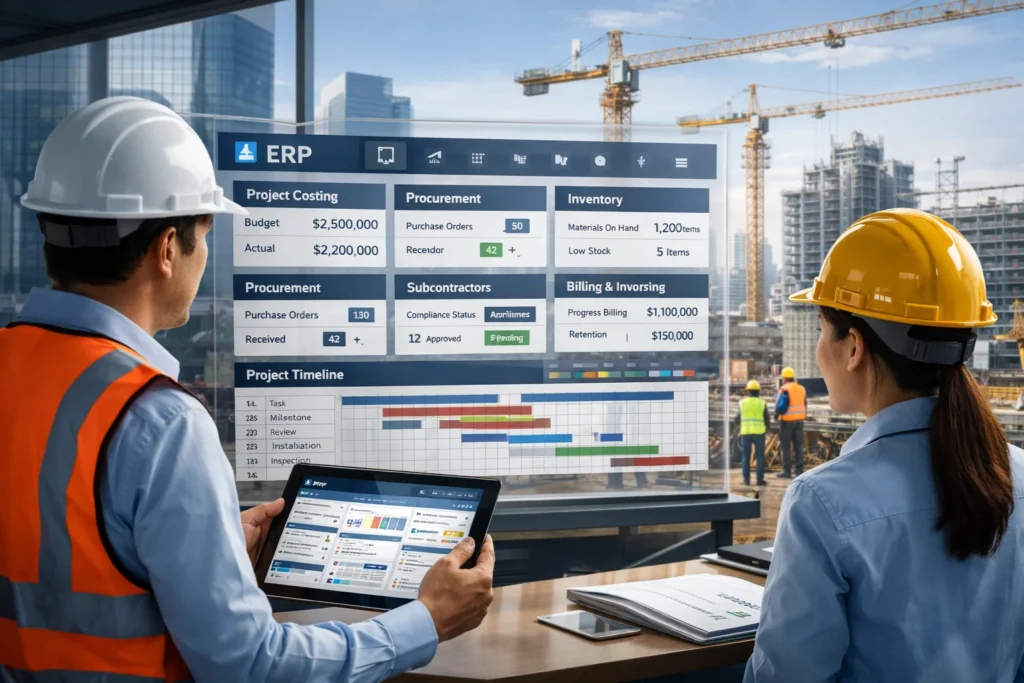
A construction-specific ERP system centralises project management, financials, procurement, inventory, equipment, and reporting into a single platform. It provides real-time visibility into costs and progress, helping construction firms control budgets, reduce risks, and improve profitability.
In this guide, we compare the best ERP software for the construction industry, break down key features, pricing models, and ROI, and help you choose the right ERP solution for your business.
What Is ERP Software for the Construction Industry?
ERP Software for the Construction Industry is a specialised enterprise resource planning system designed to manage construction-specific workflows such as job costing, project billing, subcontractor management, and equipment tracking.
Unlike generic ERP systems, construction ERP solutions are built to handle:
- Project-based operations instead of repetitive manufacturing processes
- Variable costs and frequent change orders
- Complex contractor and vendor relationships
- Compliance, retention, and milestone-based billing
Key Construction Processes Managed by ERP
A modern construction ERP system typically manages:
- Project planning and scheduling
- Job costing and budget control
- Procurement and inventory management
- Contract and subcontractor management
- Billing, accounting, and financial reporting
- Equipment and asset management
Key Features to Look for in ERP Software for the Construction Industry
Choosing the right ERP starts with understanding the features that directly impact project success and profitability.
Project Management and Job Costing
- Real-time project tracking across multiple sites
- Budget vs actual cost monitoring
- Change order tracking and approvals
- Profitability analysis at project and task level
This feature is critical for preventing cost overruns and improving margin control.
Financial Management and Accounting
Construction ERP software includes accounting features tailored to project-based billing, such as:
- Progress billing and milestone invoicing
- Revenue recognition
- Retention and advance management
- Multi-company and multi-project accounting
Procurement and Inventory Control
- Material requirement planning per project
- Vendor and purchase order management
- Site-wise inventory tracking
- Reduction of material wastage and theft
Subcontractor and Contract Management
- Subcontractor onboarding and compliance tracking
- Contract lifecycle management
- Work completion and payment tracking
- Retention and penalty handling
Equipment and Asset Management
- Equipment allocation to projects
- Utilisation and idle time tracking
- Maintenance scheduling
- Cost allocation per asset
Reporting, Analytics, and Dashboards
- Real-time dashboards for management
- Project profitability and cost variance reports
- Cash flow forecasting
- Custom KPIs for executives
Best ERP Software for the Construction Industry: Top Solutions Compared
There is no one-size-fits-all ERP. The best ERP depends on your company size, project complexity, and growth plans.
ERP Software Comparison (High-Level)
| Criteria | Construction ERP (Industry-Specific) | Generic ERP |
|---|---|---|
| Job Costing | Advanced | Limited |
| Project Billing | Built-in | Custom |
| Subcontractor Management | Yes | Partial |
| Construction Compliance | Strong | Weak |
| ROI for Contractors | High | Moderate |
Best ERP for Small and Mid-Size Construction Companies
Ideal for:
- Growing contractors
- Infrastructure and real estate developers
- EPC companies
Key benefits:
- Faster implementation
- Lower total cost of ownership
- Scalable modules as business grows
Best ERP for Large and Enterprise Construction Firms
Ideal for:
- Multi-location construction groups
- Large EPC and infrastructure companies
Key benefits:
- Advanced analytics
- Multi-company consolidation
- High customisation and integrations
Pricing Models of ERP Software for the Construction Industry
ERP pricing varies significantly depending on deployment and scope.
Cloud-Based ERP Pricing
- Subscription-based (per user/month or per module)
- Lower upfront cost
- Automatic upgrades and maintenance
- Ideal for fast-growing construction companies
On-Premise ERP Pricing
- One-time licence fee
- Higher infrastructure and IT costs
- Suitable for companies with strict data control requirements
Factors That Affect ERP Cost
- Number of users
- Modules selected
- Customisation requirements
- Implementation, training, and support
ROI of ERP Software for the Construction Industry
Investing in ERP delivers measurable returns when implemented correctly.
Tangible Benefits
- Reduced project delays
- Improved cost control and forecasting
- Lower material wastage
- Faster billing and cash flow
Intangible Benefits
- Better decision-making through real-time data
- Improved collaboration between site and office teams
- Higher client satisfaction and repeat business
How to Calculate ERP ROI for Construction Companies
ROI =
(Annual cost savings + productivity gains – ERP cost) ÷ ERP cost
Most construction companies recover ERP investment within 12–24 months through better project control and reduced inefficiencies.
How to Choose the Right ERP Software for Your Construction Business
Assess Your Business Needs
- Number and type of projects
- Complexity of costing and billing
- Growth and scalability plans
Evaluate Construction Industry Expertise
Choose an ERP vendor with proven experience in construction—not a generic ERP adapted later.
Check Scalability and Integrations
- Can the ERP grow with your business?
- Does it integrate with existing tools and systems?
Implementation, Support, and Training
- Clear implementation roadmap
- Strong post-go-live support
- User training for faster adoption
Common Mistakes to Avoid When Implementing Construction ERP
- Selecting generic ERP without construction-specific features
- Underestimating change management
- Skipping user training
- Not defining KPIs before implementation
Future Trends in ERP Software for the Construction Industry
- AI-driven project forecasting
- Mobile ERP for on-site teams
- IoT integration for equipment monitoring
- Advanced predictive analytics
Conclusion: Invest in the Best ERP Software for the Construction Industry
Choosing the right ERP Software for the Construction Industry is a strategic decision that directly impacts project success, profitability, and long-term growth.
By selecting a construction-focused ERP with strong project control, financial visibility, and scalability, construction companies can reduce risks, improve margins, and stay competitive in an increasingly complex market.
The right ERP is not an expense—it’s a growth enabler.