
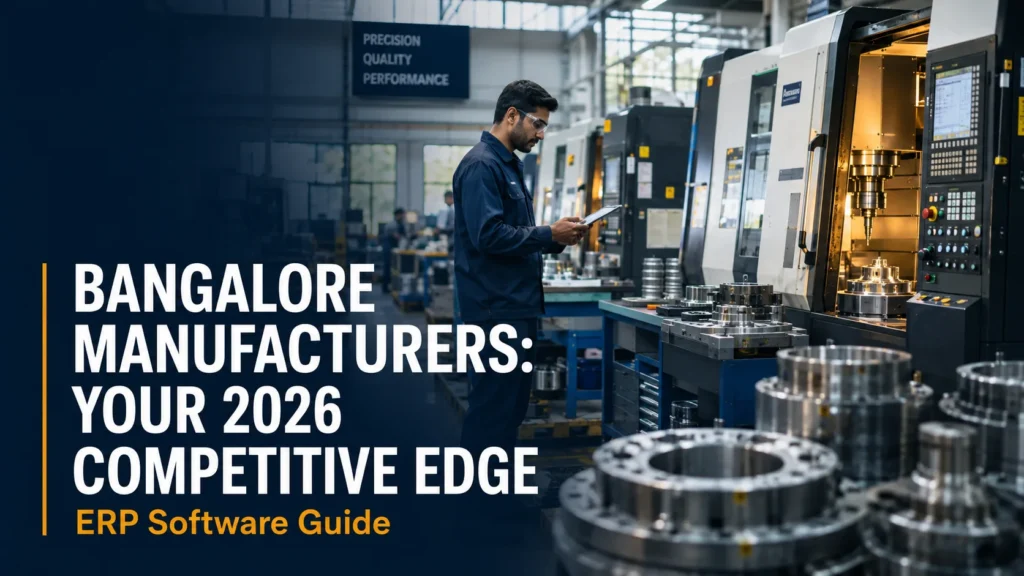
Bangalore’s manufacturing identity has changed. The city once known primarily as India’s IT capital is now home to a fast-growing base of precision engineering firms, auto component makers, aerospace ancillary units, and industrial machinery manufacturers. These businesses are competing on tighter margins, shorter lead times, and higher compliance expectations than ever before.
For many small and mid-sized manufacturers, the tools running the shop floor haven’t kept pace with the tools running the sales pipeline. Spreadsheets track inventory. Tally handles the books. WhatsApp groups coordinate job work orders. It works until it doesn’t.
In 2026, ERP software for Bangalore manufacturers isn’t a “nice to have” reserved for large enterprises. It’s becoming the line between manufacturers who scale predictably and those who stay stuck firefighting the same problems every quarter. This guide breaks down why ERP has become a genuine competitive edge, what capabilities actually matter, and how to evaluate the right platform for your operation.
Why Bangalore’s Manufacturing Landscape Demands ERP in 2026
The shift from IT hub to diversified manufacturing base
Bangalore’s manufacturing corridor now spans precision components, electronics assembly, industrial equipment, and packaging sectors that didn’t dominate the city’s industrial identity a decade ago. This diversification has brought new customers, new compliance requirements, and new expectations around documentation and traceability that manual systems weren’t built to handle.
Rising competition from Coimbatore, Chennai, and Tirupur clusters
Manufacturing SMEs in Bangalore aren’t just competing locally; they’re competing against established clusters in Coimbatore, Chennai, and Tirupur, many of which have already digitised core operations. Buyers comparing vendors across these regions increasingly factor in responsiveness, documentation quality, and delivery reliability, all of which are harder to demonstrate consistently without a system of record.
Customer expectations: faster quotes, on-time delivery, traceability
B2B buyers, especially larger OEMs and export-orientated clients, now expect quick, accurate quotes, real-time order status, and traceability back to raw material batches. Meeting these expectations manually is possible at a small scale. It breaks down as order volume grows.
The Real Cost of Running Without ERP Software
Manual BOM and inventory errors eating into margins
When bills of materials live in spreadsheets that get copied, edited, and re-copied across teams, version mismatches are almost inevitable. A single outdated BOM can mean over-ordering raw material, under-costing a job, or missing a component mid-production, all of which quietly erode margins.
Delayed GST and e-invoicing compliance risk
India’s GST and e-invoicing requirements leave little room for error. Manufacturers reconciling invoices manually at month-end often discover mismatches too late, resulting in compliance follow-up, penalty exposure, or strained relationships with the accounts team chasing missing documentation.
No real-time visibility into shop floor or job work orders
Without a centralised system, owners and production managers often don’t know a job is behind schedule until a customer calls asking where their order is. That reactive cycle firefighting instead of forecasting is one of the clearest signs a business has outgrown manual tracking.
What ERP Software for Bangalore Manufacturers Should Actually Do
Not all ERP platforms are built with manufacturing SMEs in mind. Here’s what genuinely matters on the shop floor, not just in a sales deck.
Production planning and MRP
A manufacturing-first ERP should calculate material requirements automatically based on confirmed orders and production schedules, not leave planners doing the maths by hand every week.
OEE tracking and shop-floor data capture
Overall Equipment Effectiveness (OEE) tracking turns machine uptime, downtime, and output into numbers owners can actually act on, rather than gut-feel assessments of which machines are underperforming.
BOM management for multi-level, engineered products
For manufacturers producing components with multiple sub-assemblies, ERP needs to handle multi-level BOMs cleanly, including engineering changes, without requiring a parallel spreadsheet system to keep track of revisions.
GST, e-way bill, and e-invoicing compliance built in
Compliance shouldn’t be a separate workflow bolted onto operations. ERP built for the Indian manufacturing context should generate GST-compliant invoices, e-way bills, and e-invoices directly from transaction data.
BI dashboards for owners’ margins, WIP, and delivery performance
Owners need a single view of what’s actually happening: job margins, work-in-progress status, and on-time delivery rates without waiting for someone to compile a report.
How ERP Software Becomes a Competitive Edge, Not Just a Compliance Tool
Faster quoting and costing accuracy
When BOM, material cost, and machine time data live in one system, quotes can be generated in minutes with realistic costing instead of days of back-and-forth with the shop floor to confirm feasibility and cost.
Reduced rework and material wastage
Real-time visibility into material consumption and production data helps catch quality and process issues before they compound into wasted batches or reworked orders.
On-time delivery as a sales differentiator
For manufacturers competing for OEM and export contracts, a demonstrable track record of on-time delivery backed by system data, not verbal assurances, becomes a genuine differentiator in vendor evaluations.
Scaling operations without scaling headcount proportionally
ERP allows manufacturers to take on more orders and more complexity without needing to add administrative headcount at the same rate, which directly protects margins as the business grows.
Choosing the Right ERP Software: A Checklist for Bangalore SMEs
Cloud vs. on-premise for manufacturing SMEs
Cloud ERP typically means a lower upfront cost, faster deployment, and easier remote access for owners managing multiple shifts or sites, which is worth weighing against on-premise control if IT infrastructure is already in place.
Industry-specific vs. generic ERP platforms
Generic ERP platforms often require heavy customisation to handle manufacturing-specific workflows like job work orders or multi-level BOMs. Manufacturing-first platforms tend to reduce implementation time because these workflows are built in from the start.
Implementation timeline and support expectations
Ask vendors directly how long implementation typically takes for a business of similar size and complexity and what support looks like in the first 90 days; this is often where ERP rollouts succeed or stall.
Pricing models to watch for hidden costs
Per-user licensing, module add-ons, and implementation fees can significantly change the real cost of an ERP platform. A clear, itemised quote upfront avoids budget surprises later.
Chirix ERP for Bangalore Manufacturers
Chirix ERP is built specifically for manufacturing and packaging SMEs, not adapted from a generic business platform. For Bangalore manufacturers evaluating ERP in 2026, that distinction matters in three ways:
Purpose-built for manufacturing and packaging SMEs
Production planning, MRP, BOM management, and OEE tracking are core to the platform, not add-on modules built around how manufacturing SMEs actually operate day to day.
Compliance-ready for Indian GST and e-invoicing norms
GST, e-way bill, and e-invoicing requirements are handled within the platform, reducing the manual reconciliation work that often falls on accounts teams at month-end.
Quick implementation without disrupting production
Cloud deployment means manufacturers can get up and running without the extended downtime or heavy IT lift associated with legacy on-premises systems.
Frequently Asked Questions
Cost varies by user count, modules required, and implementation scope. Cloud-based platforms built for SMEs typically offer more predictable, subscription-based pricing than legacy on-premises systems.
For manufacturing SMEs, implementation timelines commonly range from a few weeks to a couple of months depending on data migration complexity and the number of processes being digitised.
Reputable cloud ERP providers use encryption, role-based access controls, and regular backups, generally offering stronger data protection than spreadsheets or unsecured local servers.
Most modern ERP platforms offer integration or migration paths from Tally and similar accounting tools, though the depth of integration varies by vendor and should be confirmed during evaluation.
Conclusion
The manufacturers who treat ERP as infrastructure, not overhead, are the ones building a real competitive edge in 2026. Visibility, compliance, and speed aren’t separate initiatives; they come from the same system working together.
If you’re evaluating ERP software for your Bangalore manufacturing operation, the right platform should reduce firefighting, not add another tool to manage.
Ready to see it in action? Book a free Chirix ERP demo today.