
In today’s competitive business landscape, data is one of the most valuable assets an organization can leverage. Whether you’re a manufacturer, distributor, retailer, or service provider, making informed decisions depends on your ability to access accurate business insights quickly.
As companies generate increasing volumes of data, choosing the right analytics solution has become more important than ever. Two popular options are ERP Analytics Software and Standalone Business Intelligence (BI) Tools. While both help organizations transform raw data into actionable insights, they serve different purposes and offer unique advantages.
So, which solution is right for your business?
In this guide, we’ll compare ERP Analytics Software and standalone BI tools, explore their strengths and limitations, and help you determine the best fit for your organization’s needs.
What Is ERP Analytics Software?
ERP Analytics Software is an analytics solution embedded within an Enterprise Resource Planning (ERP) system. It collects and analyzes data from various ERP modules, including finance, inventory, procurement, manufacturing, sales, and human resources.
Unlike traditional reporting systems, ERP Analytics Software provides real-time visibility into business operations through dashboards, reports, KPIs, and predictive insights.
Key Features of ERP Analytics Software
Modern ERP Analytics Software typically includes:
- Real-time business dashboards
- Operational and financial reporting
- KPI monitoring
- Predictive analytics
- AI-powered insights
- Automated report generation
- Data visualization tools
- Self-service reporting capabilities
These features help decision-makers identify trends, monitor performance, and respond quickly to changing business conditions.
How ERP Analytics Software Works
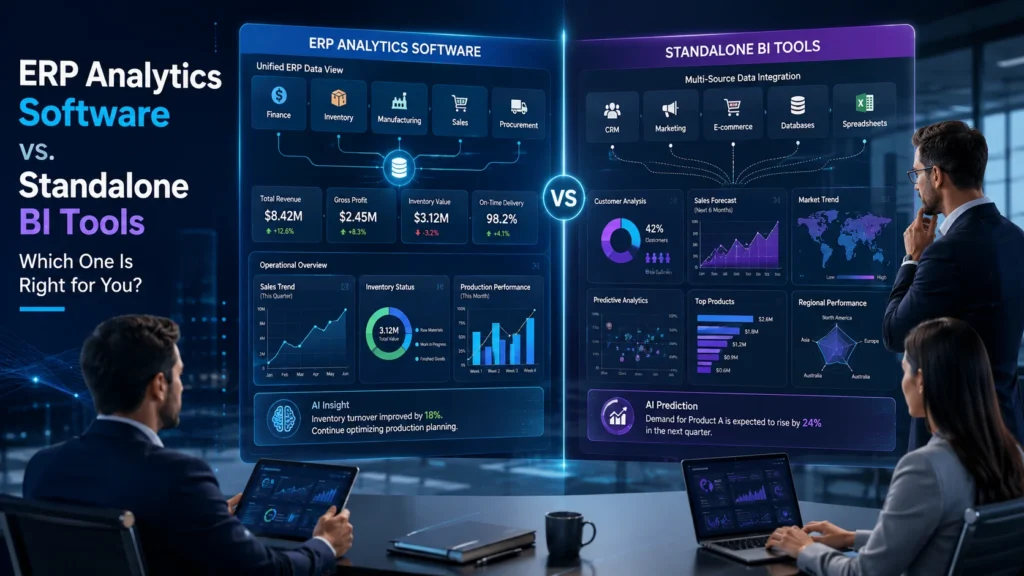
ERP Analytics Software extracts data directly from the ERP system and consolidates it into a unified analytics environment. Since all information comes from a centralized database, businesses benefit from consistent and accurate reporting across departments.
For example, a manufacturing company can view production performance, inventory levels, procurement activities, and financial metrics from a single dashboard.
Benefits of ERP Analytics Software
Organizations choose ERP Analytics Software because it offers:
- A single source of truth
- Faster reporting and analysis
- Improved operational efficiency
- Reduced manual data entry
- Better decision-making
- Real-time business visibility
What Are Standalone BI Tools?
Business Intelligence (BI) tools are independent analytics platforms designed to collect, process, and visualize data from multiple sources.
Unlike ERP Analytics Software, standalone BI solutions are not tied to a specific ERP system. Instead, they connect to various databases, cloud applications, spreadsheets, CRMs, and third-party software.
Popular BI platforms are commonly used for advanced analytics, strategic reporting, and enterprise-wide data analysis.
Core Features of Standalone BI Tools
Standalone BI solutions generally offer:
- Advanced data visualization
- Interactive dashboards
- Data modeling
- Forecasting and predictive analytics
- Data warehousing capabilities
- Multi-source integration
- Custom reporting
How BI Tools Analyze Data
Most BI platforms use connectors and ETL (Extract, Transform, Load) processes to gather information from multiple systems.
The data is then cleaned, transformed, and stored in a data warehouse before being analyzed and visualized.
This approach allows organizations to gain insights across different business applications.
Benefits of Standalone BI Tools
Businesses often choose BI tools because they provide:
- Greater flexibility
- Enterprise-wide reporting
- Advanced analytics capabilities
- Cross-platform data integration
- Extensive customization options
ERP Analytics Software vs. Standalone BI Tools: Key Differences
While both solutions provide business intelligence capabilities, there are important differences to consider.
Data Source Integration
ERP Analytics Software
ERP Analytics Software primarily focuses on ERP-generated data. Since it is integrated directly into the ERP environment, data synchronization is seamless.
Standalone BI Tools
BI platforms can connect to multiple systems simultaneously, including CRM software, marketing platforms, e-commerce systems, spreadsheets, and databases.
Winner: BI Tools for multi-source analytics.
Ease of Implementation
ERP Analytics Software
Implementation is typically faster because the analytics module is already integrated with the ERP platform.
Standalone BI Tools
BI implementations often require data mapping, integration development, ETL processes, and ongoing maintenance.
Winner: ERP Analytics Software.
Cost Considerations
ERP Analytics Software
- Lower implementation costs
- Reduced maintenance requirements
- Minimal integration expenses
Standalone BI Tools
- Additional licensing fees
- Data warehouse costs
- Integration and consulting expenses
Winner: ERP Analytics Software for cost efficiency.
Reporting Capabilities
ERP Analytics Software
Excellent for operational reporting and day-to-day business monitoring.
Examples include:
- Inventory analysis
- Production tracking
- Sales performance monitoring
- Financial reporting
Standalone BI Tools
Ideal for advanced reporting, complex forecasting, and enterprise-wide analysis.
Examples include:
- Customer behavior analysis
- Market trend forecasting
- Cross-platform reporting
Winner: Depends on business needs.
User Experience
ERP Analytics Software is generally designed for business users who need quick access to operational insights.
BI tools often require more technical expertise, especially when building custom dashboards and managing data models.
Winner: ERP Analytics Software for ease of use.
Data Accuracy
Because ERP Analytics Software pulls data directly from ERP modules, businesses experience fewer discrepancies and synchronization issues.
Standalone BI tools depend on integrations and ETL processes, which may introduce delays or data inconsistencies.
Winner: ERP Analytics Software.
When ERP Analytics Software Is the Better Choice
ERP Analytics Software is ideal for businesses that rely heavily on ERP data and need immediate visibility into operations.
Manufacturing Companies
Manufacturers can monitor:
- Production efficiency
- Machine utilization
- Inventory levels
- Quality metrics
- Procurement performance
Distribution Businesses
Distributors can track:
- Warehouse operations
- Supply chain performance
- Order fulfillment
- Vendor management
Growing SMEs
Small and medium-sized businesses often prefer ERP Analytics Software because it offers:
- Faster implementation
- Lower costs
- Easier user adoption
- Quicker return on investment
Businesses Seeking Real-Time Insights
Organizations requiring instant access to operational data benefit significantly from ERP Analytics Software.
When Standalone BI Tools Are the Better Choice
Standalone BI solutions are better suited for organizations with complex data environments.
Enterprises with Multiple Systems
If your organization uses:
- ERP software
- CRM platforms
- Marketing automation tools
- E-commerce systems
- Customer support software
A BI platform can consolidate all data into a unified analytics environment.
Advanced Analytics Requirements
BI tools are ideal for businesses needing:
- Predictive modeling
- Advanced forecasting
- Machine learning
- Customer segmentation
- Complex data analysis
Dedicated Analytics Teams
Organizations with data analysts, BI developers, and data engineers can maximize the capabilities of standalone BI platforms.
Can ERP Analytics Software and BI Tools Work Together?
Absolutely.
Many organizations adopt a hybrid analytics strategy.
Operational Analytics with ERP Analytics Software
ERP Analytics Software handles:
- Daily reporting
- KPI tracking
- Financial monitoring
- Inventory management
- Production visibility
Strategic Analytics with BI Tools
BI platforms support:
- Executive dashboards
- Long-term forecasting
- Market analysis
- Customer insights
- Enterprise reporting
Combining both solutions can provide comprehensive visibility across the organization.
Key Questions to Ask Before Choosing an Analytics Solution
Before making a decision, consider the following questions:
What Are Your Business Goals?
Do you need:
- Operational visibility?
- Strategic planning capabilities?
- Revenue forecasting?
- Cost optimization?
Where Does Your Data Come From?
If most of your data resides within your ERP system, ERP Analytics Software may be sufficient.
If data is spread across multiple applications, a BI platform may be necessary.
What Is Your Budget?
Evaluate:
- Licensing costs
- Implementation expenses
- Maintenance requirements
- Training investments
Who Will Use the Platform?
Business users often prefer ERP Analytics Software due to its simplicity.
Technical teams may benefit more from advanced BI solutions.
Why Modern ERP Analytics Software Is Evolving Beyond Traditional Reporting
The latest generation of ERP Analytics Software is no longer limited to static reports and dashboards.
Modern solutions now include:
AI-Powered Analytics
Artificial intelligence helps businesses:
- Identify trends automatically
- Detect anomalies
- Generate recommendations
- Improve forecasting accuracy
Predictive Analytics
Organizations can anticipate:
- Demand fluctuations
- Inventory shortages
- Equipment maintenance needs
- Financial performance trends
Self-Service Analytics
Business users can access insights without relying on IT teams, reducing reporting bottlenecks and improving agility.
How Chirix Analytics Simplifies Business Intelligence
Businesses today need analytics solutions that are powerful, easy to use, and deeply connected to operational data.
Built for ERP-Driven Organizations
Chirix Analytics provides:
- Real-time dashboards
- Financial analytics
- Inventory intelligence
- Production performance tracking
- Executive KPI monitoring
AI Chatbot for Instant Insights
One of the standout features of Chirix Analytics is its AI-powered chatbot.
Users can simply ask questions such as:
- “What were our top-selling products this month?”
- “Show inventory shortages.”
- “Compare production performance across plants.”
The chatbot instantly generates insights, eliminating the need for manual report creation.
Faster Decision-Making
By combining ERP data, AI capabilities, and intuitive dashboards, Chirix Analytics empowers organizations to make smarter decisions faster.
Conclusion
Both ERP Analytics Software and standalone BI tools play important roles in modern business intelligence strategies.
If your primary goal is operational visibility, real-time reporting, and seamless ERP integration, ERP Analytics Software is often the best choice.
If your organization requires advanced analytics across multiple systems, standalone BI tools may provide greater flexibility and depth.
For many growing businesses, an integrated solution like Chirix Analytics delivers the perfect balance of simplicity, speed, and actionable insights, helping teams turn data into better business decisions without the complexity of traditional BI platforms.
As data continues to drive business success, investing in the right analytics solution today can create a significant competitive advantage tomorrow.