
Bangalore’s manufacturing belt doesn’t run like a typical factory town. Between the precision machining units of Peenya, the auto-component clusters of Bommasandra and Electronics City, and the aerospace and defence ancillary units scattered across Jigani and Hosur Road, the city hosts some of India’s most technically demanding production environments. Tight tolerances, multi-tier supplier chains, and JIT (just-in-time) delivery commitments to OEMs like Toyota Kirloskar, Bosch, and HAL define the daily reality here.
Yet a surprising number of these units, including many with ISO and TS 16949 certifications, are still running production planning on spreadsheets, WhatsApp groups, and paper shop-floor logs. The gap between certified quality systems and the actual tools used to plan, track, and report production is where output gets lost.
This is the gap Chirix ERP is built to close, and manufacturers switching to it are seeing output gains of up to 40% without adding a single machine or shift.
Why Bangalore Manufacturers Are Hitting an Output Ceiling
Talk to any production head in Peenya or Bommasandra and the same five problems come up, almost word for word:
1. No real-time visibility into machine and shop-floor status Production managers often find out about a bottleneck, a machine down, a batch delayed, or a material shortage — only when the delivery deadline is already at risk. By then, the damage to the day’s output is already done.
2. Manual BOM and job card management Multi-level bills of material, especially in auto-ancillary and precision engineering units, get maintained in Excel sheets that go out of sync the moment an engineering change happens. Rework and material mismatches follow.
3. GST and e-invoicing handled outside the production system Compliance work, GST returns, e-way bills, and job work challans for subcontracted processes are typically bolted onto accounting software that has no link to what’s actually happening on the floor. This creates duplicate data entry and reconciliation headaches every month end.
4. Poor OEE tracking Very few SMEs in Bangalore’s manufacturing clusters actually measure Overall Equipment Effectiveness. Without it, machine downtime, changeover time, and quality losses stay invisible and unfixable.
5. Subcontracting and job work chaos Bangalore’s ancillary ecosystem depends heavily on job work, sending semi-finished parts out for plating, heat treatment, or specialised machining. Tracking what’s out, what’s returned, and reconciling job work challans manually are persistent sources of errors and delays.
Individually, each of these costs a few percentage points of capacity. Together, they routinely account for a 30–40% output gap between what a factory’s machines are capable of producing and what actually leaves the floor.
How ERP Closes the Gap Function by Function
Real-Time Production Tracking
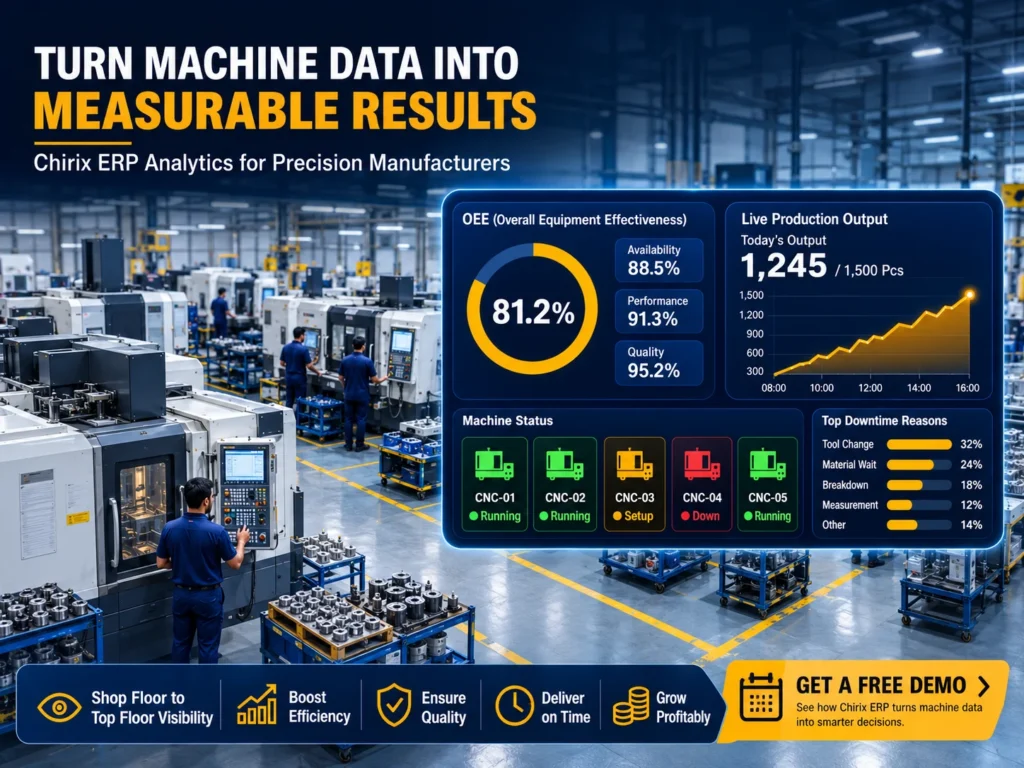
Chirix ERP pulls live status from shop floor job progress, machine allocation, and operator assignment into a single dashboard. Production heads see bottlenecks as they form, not after the shift report is filed. For a Pinya machine shop running three shifts, this alone typically recovers several hours of otherwise-lost machine time per week.
Multi-Level BOM and Engineering Change Control
For auto-component and precision-engineering manufacturers, BOM accuracy isn’t optional; a single unrecorded engineering change can scrap an entire batch. Chirix ERP keeps BOM revisions version-controlled and tied directly to job cards, so the shop floor is always working off the current specification.
MRP That Actually Prevents Material Shortages
Material Requirements Planning in Chirix ERP calculates raw material and component needs against confirmed orders and current stock, not gut feeling. For units sourcing castings, forgings, or speciality alloys with long lead times, this is the difference between a planned procurement cycle and an emergency stock-out that stalls the line.
Built-In GST, E-Invoicing, and E-Way Bill Compliance
Every production transaction, job work dispatch, finished goods movement, and inter-unit transfer generates compliant GST documentation automatically. No separate accounting re-entry, no month-end scramble to match production records against tax filings.
OEE Monitoring, Out of the Box
Chirix ERP tracks availability, performance, and quality at the machine level automatically, turning OEE from a theoretical KPI into a number your production managers check every morning. Units that start measuring OEE typically find 15–20% of “lost” capacity within the first quarter, simply because problems that were invisible become visible.
Job Work and subcontracting Management
For the job-work-heavy Bangalore ancillary model, Chirix ERP tracks materials sent out and expected return dates and automatically generates the required challans, closing one of the most error-prone parts of the production cycle.
What “40% Output Increase” Actually Looks Like
Manufacturers rarely get there through one big change. It’s the compounding effect of several fixes:
- Reduced machine idle time from real-time visibility (typically 8–12%)
- Fewer rework cycles from accurate, version-controlled BOMs (typically 5–8%)
- Faster material availability from proper MRP instead of reactive buying (typically 6–10%)
- Recovered “invisible” capacity once OEE is actually measured and acted on (typically 10–15%)
Stack these together across a quarter, and a 40% output improvement without new equipment or additional shifts is a realistic, achievable target for most mid-sized manufacturing units in Bangalore’s industrial clusters.
Built for How Bangalore Manufacturers Actually Work
Chirix ERP isn’t a generic ERP with a manufacturing module bolted on. It’s built around the workflows that define Karnataka’s manufacturing ecosystem: multi-tier job work, TS 16949-aligned quality tracking, GST-compliant multi-location operations, and the shop-floor realities of running precision machining, auto ancillary, or electronics assembly units.
Whether you’re running a 20-machine job shop in Peenya or a multi-location auto-component supplier across Bommasandra and Electronics City, the system scales to how your production actually happens, not how a textbook says it should.
Ready to See Where Your Output Is Leaking?
Most manufacturers are surprised by how much capacity they’re leaving on the table, not because of bad machines or bad people, but because of systems that were never built to show them the full picture.
Book a free production audit with Chirix ERP and get a clear, data-backed view of exactly where your output gains are hiding.
Chirix ERP is a manufacturing ERP built for India’s industrial clusters.