
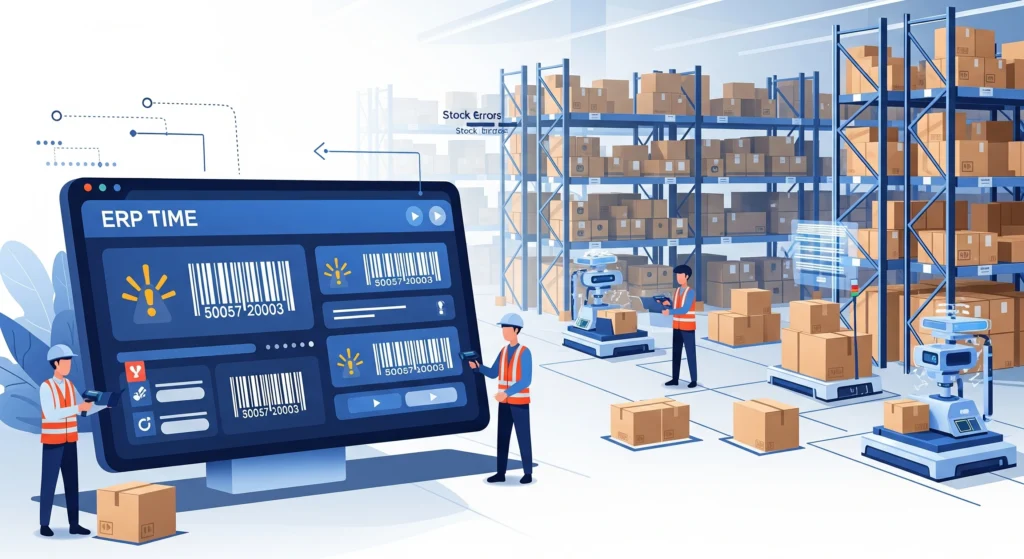
Warehouse stock errors might seem like small mistakes—an item misplaced here, a wrong entry there—but the consequences are huge. According to industry studies, inventory inaccuracies cost businesses billions of dollars every year, leading to lost sales, customer dissatisfaction, and wasted operational costs.
The root cause? Manual processes, siloed data, and a lack of real-time visibility. When warehouse teams rely on spreadsheets, disconnected software, or paper logs, errors pile up fast.
This is where Enterprise Resource Planning (ERP) systems step in. More than just a tool for accounting or sales, ERP reduces warehouse stock errors by providing real-time inventory tracking, barcode integration, automated stock replenishment, and data accuracy across the supply chain.
In this blog, we’ll not only explain how ERP reduces warehouse stock errors but also dive into real case studies of businesses that transformed their warehouse efficiency with ERP.
Why Stock Errors Are a Major Challenge in Warehousing
The True Cost of Inventory Mistakes
Stock errors don’t just mess up the balance sheet—they ripple across the entire business:
- Financial losses from overstocking, stockouts, or misplaced items.
- Customer dissatisfaction when incorrect or delayed orders lead to complaints and lost trust.
- Operational inefficiencies, as employees waste hours reconciling mismatched records.
One wrong entry in the system can delay production, disrupt logistics, and even harm long-term customer relationships.
Common Causes of Warehouse Stock Errors
Warehouse errors are often symptoms of outdated processes. Common culprits include:
- Manual data entry – prone to typos and oversight.
- Poor visibility – stock scattered across multiple storage locations without centralized monitoring.
- Lack of integration – sales, procurement, and warehouse teams operating in silos.
These gaps highlight why digital transformation through ERP is no longer optional.
How ERP Reduces Warehouse Stock Errors
Real-Time Inventory Tracking
ERP systems offer centralised visibility across warehouses, stores, and distribution centres. Every time goods are received, moved, or shipped, the system updates in real time. This ensures:
- Accurate stock levels at all times.
- Fewer discrepancies between physical and digital records.
- Better planning for demand and supply.
Barcode & RFID Integration with ERP
One of the most powerful ways ERP reduces warehouse stock errors is through barcode scanning and RFID technology. Instead of relying on manual entries, warehouse staff simply scan items:
- Picking, packing, and receiving become error-free.
- Cycle counts are completed faster with greater accuracy.
- Human errors from manual input are nearly eliminated.
Automated Stock Replenishment
Stockouts and overstocking often stem from poor planning. ERP automates replenishment by:
- Setting minimum stock levels and triggering alerts.
- Creating purchase orders automatically when stock runs low.
- Preventing over-purchasing with data-driven insights.
This not only reduces errors but also optimises working capital.
Data Accuracy & Reporting
ERP systems unify data from sales, procurement, and warehouse operations. The result:
- No duplicate entries or mismatched records.
- Real-time dashboards showing stock status.
- Accurate reporting for better decision-making.
With fewer errors, managers can shift their focus from fixing mistakes to improving efficiency.
Real Case Studies – ERP in Action
Case Study 1 – Manufacturing Company
The Challenge:
A mid-sized manufacturer constantly faced stock discrepancies that delayed production. Workers spent hours reconciling mismatched inventory records, and production lines often halted due to “missing” parts.
The ERP Solution:
After implementing ERP with real-time tracking and barcode scanning:
- Stock discrepancies dropped by 70%.
- Production delays caused by missing parts were reduced significantly.
- The company reported saving thousands of labour hours per year.
Case Study 2 – Retail Chain
The Challenge:
A retail chain with multiple outlets struggled with inconsistent stock levels. Some stores were overstocked, while others constantly faced shortages. This led to customer dissatisfaction and lost sales opportunities.
The ERP Solution:
With centralised ERP inventory management:
- Stock levels were balanced across outlets.
- Automated replenishment ensured the right products reached the right stores.
- Customer satisfaction improved, and the retailer saw a 25% increase in order accuracy.
Case Study 3 – Logistics & Distribution Company
The Challenge:
A logistics provider relied on manual entries for receiving and shipping, leading to frequent errors and shipment delays. Customer complaints were increasing, and efficiency was suffering.
The ERP Solution:
By integrating barcode scanning with ERP:
- Order accuracy improved to 98%.
- Shipment errors were reduced to almost zero.
- The company gained a strong reputation for reliable and timely delivery.
Additional Benefits Beyond Error Reduction
ERP doesn’t just reduce warehouse stock errors—it unlocks a host of other advantages.
Improved Order Fulfilment Speed
Automation speeds up picking, packing, and shipping, ensuring faster delivery times and happier customers.
Better Demand Forecasting
With ERP analytics, companies can track seasonal trends, predict demand, and optimise stock levels—preventing both shortages and overstocking.
Compliance & Traceability
ERP maintains detailed records of product movements, making it easier to meet regulatory requirements and conduct audits with confidence.
Choosing the Right ERP for Your Warehouse
Not all ERP systems are the same. When evaluating options, businesses should look for features like:
- Real-time inventory management with centralised dashboards.
- Barcode and RFID integration for error-free stock handling.
- Automation in replenishment, order management, and reporting.
- Scalability to grow alongside the business.
- Cloud vs On-Premise options, depending on flexibility and budget needs.
Selecting the right ERP is an investment that pays for itself by minimising stock errors and improving warehouse efficiency.
Conclusion
Warehouse stock errors are costly, frustrating, and damaging to customer trust. But with ERP, businesses can turn these challenges into opportunities.
Through real-time tracking, barcode integration, automated replenishment, and accurate reporting, ERP reduces warehouse stock errors and ensures smooth, efficient operations.
The real-world case studies we explored prove that ERP isn’t just theory—it delivers measurable results. Whether you’re in manufacturing, retail, or logistics, ERP can dramatically improve accuracy, reduce costs, and streamline operations.
👉 Ready to see how ERP can transform your warehouse? Book a free consultation with JM-Origin today and take the first step toward error-free inventory management.