
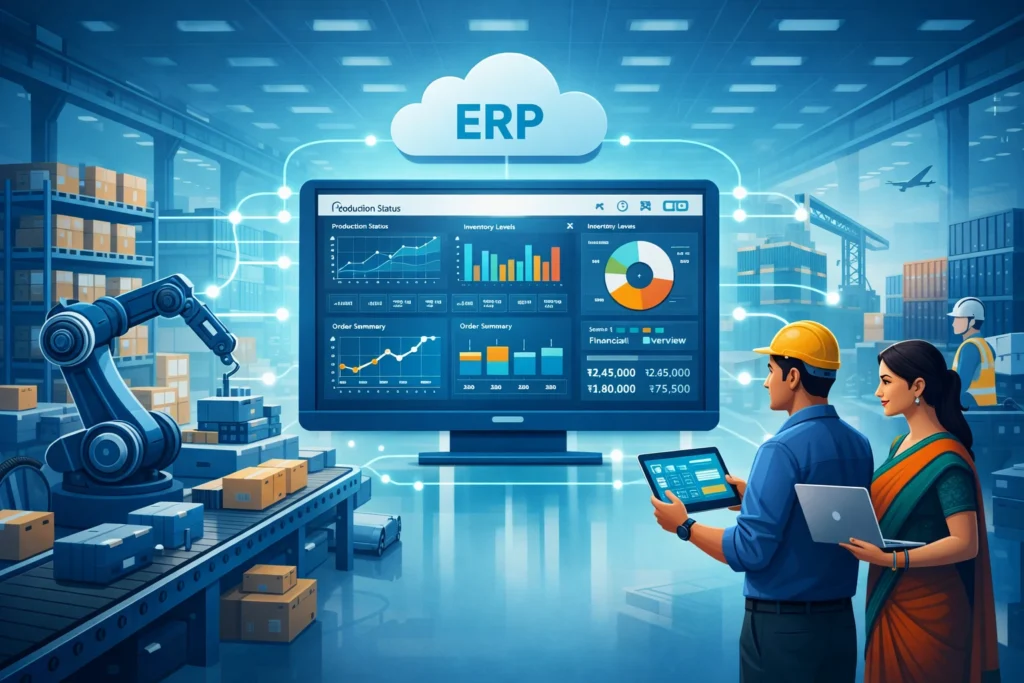
ERP software helps Indian manufacturing businesses streamline operations by integrating production, inventory, finance, procurement, and sales into a single system. This allows manufacturers to automate workflows, track production in real time, reduce operational costs, and make faster data-driven decisions.
As manufacturing in India becomes more competitive, companies are adopting ERP systems to improve efficiency and scale their operations digitally.
What is ERP Software in Manufacturing?
Enterprise Resource Planning (ERP) software is a centralised platform that connects multiple business functions into one system. Instead of managing separate tools for finance, inventory, and production, ERP integrates everything into a single dashboard.
For manufacturing businesses, ERP typically manages:
- Production planning
- Inventory management
- Procurement and supplier management
- Sales and order processing
- Accounting and financial management
- Human resources
By consolidating these operations, ERP eliminates data silos and improves operational transparency.
Why Do Indian Manufacturing Businesses Need ERP Software?
Many manufacturing companies in India still rely on manual workflows, spreadsheets, or disconnected software systems. This creates inefficiencies that affect productivity and profitability.
Common challenges include:
- Lack of real-time inventory visibility
- Production delays due to poor planning
- Difficulty tracking operational costs
- Limited coordination between departments
- Inefficient supply chain processes
ERP software solves these issues by creating a single source of truth for business data.
How ERP Software Improves Manufacturing Operations
1. Real-Time Production Monitoring
ERP systems allow manufacturers to monitor production activities in real time. Managers can track work orders, machine utilisation, and production progress from a centralised dashboard.
This helps businesses identify bottlenecks early and optimise production workflows.
2. Smart Inventory Management
Inventory control is critical in manufacturing. ERP software provides real-time visibility into stock levels and warehouse activity.
Key capabilities include:
- Automated stock updates
- Reorder level alerts
- Batch and lot tracking
- Warehouse inventory management
These features ensure raw materials and finished goods are managed efficiently.
3. Improved Supply Chain Management
Manufacturers depend on reliable supplier and logistics networks. ERP systems help businesses manage procurement and supplier relationships more effectively.
ERP enables companies to:
- Track supplier performance
- Manage purchase orders
- Monitor delivery schedules
- Optimise procurement planning
This results in a more reliable and cost-efficient supply chain.
4. Accurate Financial Management
ERP integrates accounting with operational data, allowing businesses to track financial performance in real time.
Manufacturers can benefit from:
- Automated financial reporting
- Cost tracking for production processes
- Profitability analysis
- GST-compliant invoicing and tax reporting
This improves financial transparency and simplifies compliance.
5. Data-Driven Decision Making
ERP dashboards provide analytics and reports that help business leaders make informed decisions.
Key insights include the following:
- Production performance metrics
- Inventory turnover rates
- Sales and demand trends
- Operational efficiency reports
With real-time analytics, manufacturers can respond faster to market changes.
How ERP Helps a Manufacturing Company
Consider a manufacturing business that produces industrial components.
Without ERP:
- Inventory data is stored in spreadsheets.
- Procurement teams manually track supplier orders.
- Production managers lack real-time updates.
With ERP:
- Inventory levels update automatically
- Purchase orders are generated when stock is low.
- Production progress is visible in real time.
This automation significantly improves efficiency and reduces operational risks.
Key Benefits of ERP Software for Indian Manufacturers
ERP systems provide several strategic advantages for manufacturing businesses in India.
Major benefits include:
- Centralised business data and workflows
- Improved production planning and scheduling
- Better inventory control
- Real-time operational visibility
- Faster and more accurate decision-making
- Enhanced collaboration between departments
These benefits enable manufacturers to scale their operations while maintaining efficiency.
Why ERP Adoption Is Growing in India
The adoption of ERP software in India is increasing due to several industry trends.
Key drivers include:
- Digital transformation in manufacturing
- Increasing competition in global markets
- Government initiatives promoting digital adoption
- Growth of affordable cloud-based ERP solutions
As a result, both small and large manufacturers are investing in ERP systems to modernise their operations.
Choosing the Right ERP Software for Manufacturing
Selecting the right ERP platform is essential for successful implementation.
Manufacturers should evaluate ERP solutions based on:
- Industry-specific features
- Scalability and customisation options
- Integration with existing tools
- Ease of use for employees
- Technical support and implementation services
A well-implemented ERP system can become the foundation for long-term business growth.
Conclusion
ERP software is transforming manufacturing businesses across India by improving operational efficiency, enabling automation, and providing real-time business insights.
By integrating production, inventory, finance, and supply chain management into one platform, ERP helps manufacturers operate smarter and remain competitive in an increasingly digital market.
Businesses that invest in ERP technology today are better positioned to achieve sustainable growth and operational excellence in the future.
ERP software in manufacturing is a centralised system that integrates key business processes such as production planning, inventory management, procurement, finance, and sales into one platform. It helps manufacturers streamline operations, reduce manual work, and improve efficiency.
ERP software helps manufacturing businesses by automating processes, providing real-time production monitoring, improving inventory control, and enabling better decision-making through data analytics.
ERP is important for Indian manufacturing companies because it helps them manage complex operations, reduce operational costs, improve supply chain efficiency, and stay competitive in a rapidly growing manufacturing market.
Yes. Modern cloud-based ERP solutions are scalable and affordable, making them suitable for small and medium-sized manufacturing businesses. These systems can grow with the company as production and operations expand.
ERP systems provide real-time inventory tracking, automated stock updates, and reorder alerts. This helps manufacturers maintain optimal inventory levels and avoid stock shortages or overstocking.
ERP software allows manufacturers to plan production schedules based on demand forecasts, available resources, and inventory levels. This improves efficiency and reduces production delays.
A manufacturing ERP system should include features such as production planning, inventory management, supply chain management, financial accounting, sales management, and real-time reporting dashboards.
Cloud ERP systems offer several advantages, including remote access, lower infrastructure costs, automatic updates, and scalability. Many manufacturing businesses are adopting cloud ERP to support digital transformation.
Businesses should evaluate ERP software based on industry-specific features, scalability, integration capabilities, ease of use, customer support, and long-term implementation costs.