
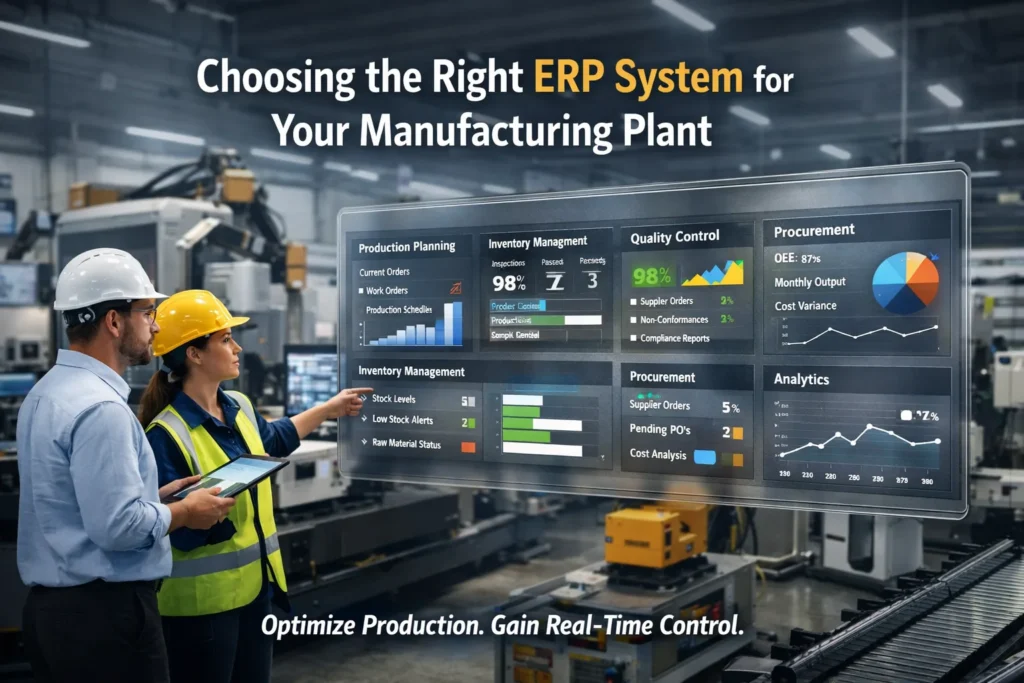
Why Choosing the Right ERP Matters for Modern Manufacturing
Manufacturing plants today operate in an environment of rising costs, tighter delivery timelines, increasing compliance requirements, and intense competition. Yet many manufacturers still rely on disconnected software, spreadsheets, and manual processes that slow down operations and limit visibility.
This is where ERP Systems for Manufacturing play a crucial role. A well-implemented ERP system connects production, inventory, procurement, quality, finance, and management into one centralised platform—giving plant leaders real-time control over their operations.
In this guide, we’ll walk you through how ERP Systems for Manufacturing work, what features truly matter, and how to choose the right system for your specific plant needs.
What Are ERP Systems for Manufacturing?
ERP Systems for Manufacturing are specialised enterprise resource planning solutions designed to manage and integrate all core manufacturing operations. Unlike generic ERP software, manufacturing ERP systems are built to handle complex production workflows, shop-floor activities, and real-time operational data.
Their primary goal is to improve efficiency, reduce costs, and provide complete visibility across the manufacturing lifecycle.
Key Manufacturing Functions Covered by ERP
A robust manufacturing ERP typically includes:
- Production planning and scheduling
- Inventory and warehouse management
- Procurement and supplier management
- Quality control and compliance
- Finance, costing, and accounting
- Maintenance and asset management
By integrating these functions, ERP Systems for Manufacturing eliminate data silos and enable smarter, faster decision-making.
Common Challenges Manufacturers Face Without the Right ERP
Many manufacturing plants struggle with inefficiencies simply because their systems are not designed for manufacturing complexity.
Common challenges include:
- Frequent stockouts or excess inventory
- Production delays due to poor planning
- Manual data entry and reporting errors
- Lack of real-time shop-floor visibility
- Difficulty scaling operations as demand grows
How ERP Systems for Manufacturing Solve These Challenges
Manufacturing ERP systems address these problems by:
- Centralising all operational data
- Automating routine processes
- Providing real-time dashboards and reports
- Improving coordination between departments
- Supporting proactive, data-driven decisions
Key Features to Look for in ERP Systems for Manufacturing
Not all ERP systems are created equal. The right solution should align with your production processes—not force you to change how your plant works.
Production Planning & Control
Effective production management is the backbone of manufacturing ERP.
Key capabilities include:
- Bill of Materials (BOM) management
- Work orders and routing
- Capacity planning and production scheduling
- Tracking work-in-progress (WIP)
Inventory & Material Management
Inventory accuracy directly impacts production efficiency and cash flow.
Look for features such as:
- Real-time stock visibility
- Batch, lot, and serial number tracking
- Scrap and waste management
- Multi-warehouse support
Quality Management
Quality issues can be costly and damaging to your reputation.
Manufacturing ERP systems should support:
- In-process and final inspections
- Non-conformance and corrective actions
- Compliance with standards like ISO or industry-specific regulations
- Traceability from raw material to finished goods
Financial & Cost Management
Understanding true production costs is critical for profitability.
ERP Systems for Manufacturing should provide:
- Job and production costing
- Profitability analysis by product or order
- Integration with accounting and tax compliance (e.g., GST)
- Real-time financial reporting
Reporting & Analytics
Data is only valuable if it’s easy to understand.
Key analytics features include:
- Customisable dashboards
- KPI tracking for production, inventory, and quality
- Management reports for faster decision-making
How to Choose the Right ERP System for Your Plant
Choosing an ERP is a strategic decision that impacts your plant for years. A one-size-fits-all approach rarely works in manufacturing.
Assess Your Manufacturing Type
Different production models require different ERP capabilities:
- Discrete manufacturing
- Process manufacturing
- Batch or job-based production
- Make-to-order vs make-to-stock
Ensure the ERP system is designed to support your specific manufacturing model.
Define Your Business Goals
Before selecting software, clearly define what you want to achieve:
- Reduce production and operating costs
- Improve delivery timelines
- Increase inventory accuracy
- Scale operations efficiently
- Enhance quality and compliance
The right ERP should directly support these goals.
Evaluate ERP Deployment Options
Manufacturers typically choose between:
- Cloud-based ERP – lower upfront cost, remote access, faster updates
- On-premise ERP – greater control, suitable for plants with strict data policies
Consider factors such as data security, internet reliability, and long-term scalability.
ERP Systems for Manufacturing – Implementation Best Practices
Even the best ERP system can fail without proper implementation.
Involve Key Stakeholders Early
Successful ERP projects include input from:
- Plant managers
- Production supervisors
- Finance and procurement teams
- IT and operations leaders
Early involvement improves system adoption and accuracy.
Data Migration and Process Mapping
Before going live:
- Clean and standardise existing data
- Map current processes to ERP workflows
- Eliminate unnecessary manual steps
This ensures smoother implementation and better results.
Training and Change Management
User adoption is critical.
- Provide role-based training
- Offer hands-on support during rollout
- Continuously optimise workflows after implementation
Signs You’ve Chosen the Right ERP System for Manufacturing
You’ll know your ERP is working when you see:
- Improved production efficiency
- Accurate, real-time inventory data
- Faster and more confident decision-making
- Reduced operational costs
- A system that scales as your plant grows
Common Mistakes to Avoid When Selecting ERP Systems for Manufacturing
Avoid these common pitfalls:
- Choosing ERP based on price alone
- Ignoring manufacturing-specific requirements
- Underestimating implementation time and effort
- Failing to plan for training and post-go-live support
How ERP Systems for Manufacturing Drive Long-Term Plant Success
Over time, ERP Systems for Manufacturing enable:
- Continuous improvement through data insights
- Higher customer satisfaction and on-time deliveries
- Better compliance and traceability
- Stronger competitive advantage in a digital manufacturing landscape
Take the Next Step Toward Smarter Manufacturing
Choosing the right ERP system for Manufacturing is not just an IT decision—it’s a business transformation. The right system gives you visibility, control, and scalability to run a more efficient and profitable plant.
If your manufacturing operations are growing or becoming more complex, now is the time to evaluate whether your current systems are holding you back.
👉 Get a personalised ERP assessment or request a demo to find the right ERP system for your manufacturing plant.
ERP Systems for Manufacturing are specialized software solutions that integrate production planning, inventory management, procurement, quality control, finance, and reporting into one centralized platform. They are designed specifically to manage manufacturing operations efficiently.
ERP systems improve production efficiency by providing real-time visibility into shop-floor activities, automating work orders, optimizing production schedules, reducing downtime, and ensuring materials are available when needed.
Key features include production planning, BOM management, inventory tracking, quality management, job costing, real-time reporting, and scalability to support business growth.
Yes. Modern ERP Systems for Manufacturing are scalable and available in cloud-based models, making them cost-effective and flexible for small and mid-sized manufacturing businesses.
Implementation timelines vary depending on plant size and complexity. On average, ERP implementation can take anywhere from 3 to 9 months, including planning, data migration, training, and go-live.
Generic ERP focuses on basic business functions, while ERP Systems for Manufacturing include advanced production planning, inventory control, quality management, and shop-floor visibility tailored specifically for manufacturing environments.