
Running a print shop today isn’t as simple as it used to be. Customer orders have become more customised, raw material prices fluctuate frequently, and deadlines are tighter than ever. Managing all this manually — or with spreadsheets — leads to errors, wastage, delays, and lost revenue.
If you want to scale operations, stay profitable, and outperform competitors, ERP Software for Printing Industry has become a necessity, not an option.
What is ERP Software for Printing Industry?
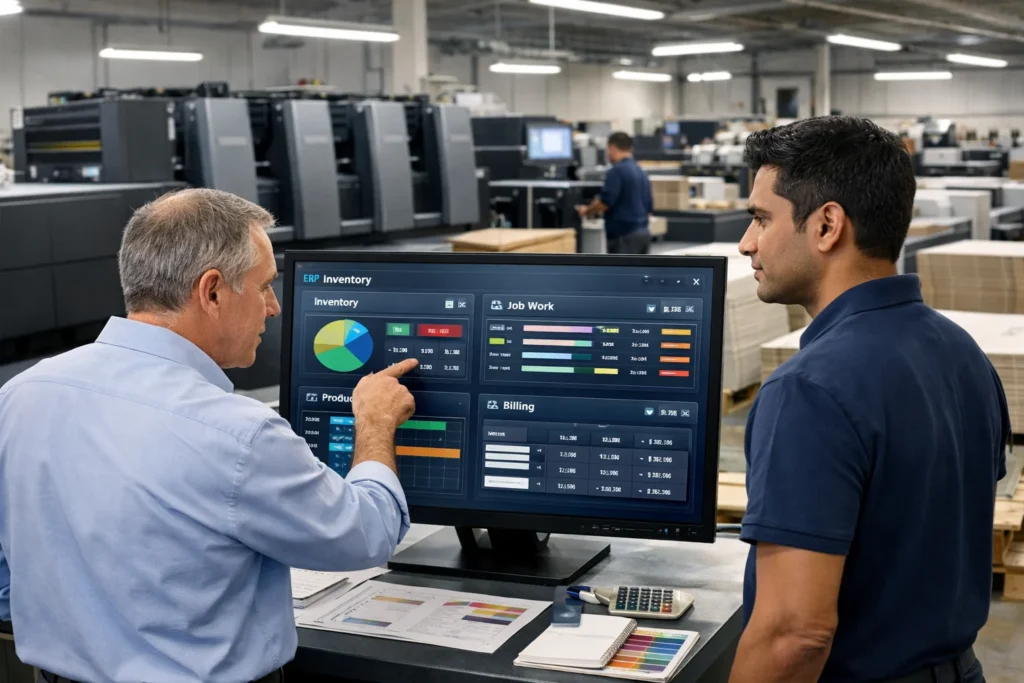
ERP (Enterprise Resource Planning) software connects all printing operations—from inventory to production to billing—into one integrated system. It’s designed specifically to handle the complexities of printing units, including:
- Paper & Ink Inventory Control
- Production Scheduling & Job Tracking
- Machine-wise Performance Monitoring
- Costing & Quotation Management
- GST Billing & E-Way Bill Integration
Instead of juggling multiple tools, everything happens in one place.
Challenges Faced by Modern Print Shops
1️⃣ Manual Job Tracking = Missed Deadlines
Delays happen when supervisors don’t know real-time job status or machine availability. This impacts customer satisfaction and repeat business.
2️⃣ High Paper Wastage & Material Mismanagement
Incorrect UOM conversions (KG ↔ Sheet ↔ Ream) and lack of stock visibility reduce margins.
3️⃣ Pricing & Quotation Errors
Manual or Excel-based costing often leads to underquoting or inconsistent pricing.
4️⃣ Limited Visibility of Production
Owners struggle to track efficiency, bottlenecks, and delays in every department.
How ERP Software for Printing Industry Solves These Problems
📌 Real-Time Inventory & Material Control
- FIFO-based stock usage
- Purchase reminders & consumption tracking
- Multi-UOM conversion for paper & board
📌 Accurate Job Work & Production Costing
- Machine-wise costing
- Labour & overhead calculations
- Wastage tracking
📌 Faster Quotation & Customer Management
- Automated price list rules
- Standardised quotation formats
- Customer history-based pricing
📌 GST Billing, E-Way Bill & Tally/Zoho Integration
- Reduces manual accounting errors
- Saves time & ensures compliance
Real Business Impact for Print Shops
| Business Area | Without ERP | With ERP |
|---|---|---|
| Wastage | 15–25% | 5–10% |
| Production Time | Slow & manual | 40% Faster |
| Costing Accuracy | Low | 95% Accurate |
| Customer Retention | Unstable | Higher repeat orders |
🔍 Example:
A packaging print unit saved ₹8–12 lakhs annually by automating production planning and materials tracking.
Who Should Use Printing ERP?
- Offset Printers
- Digital Printing Units
- Packaging / Carton Manufacturers
- Label & Sticker Printing
- Corrugated Box Plants
- Screen Printing
If you fall into any of these categories, ERP will help.
Top Features to Look For
- Job Work / Subcontractor Tracking
- Multi-UOM Paper Conversion
- Barcode/QR Code Production Tracking
- Template-Based Quotation System
- Live Production Dashboard
Implementation Roadmap
- Audit your current processes
- Import customer and stock data
- Set up modules in phases
- Train teams by department
- Go-Live & monitor results
Why Your Print Shop Needs ERP Software Now
📌 Competition is increasing.
📌 Customer expectations are higher.
📌 Margins are shrinking.
Automation is now the competitive advantage.
If you don’t upgrade, your competitors will.
Conclusion
ERP Software for Printing Industry empowers print shops to operate faster, smarter, and more profitably. From inventory to delivery, automation eliminates guesswork.
👉 Ready to start? Book a free demo & see how ERP can transform your print shop.
It depends on users & modules; typically ₹2,000–₹20,000/month.
Yes, modules are configurable for both.
Yes — that’s one of the main advantages.
Yes — data is encrypted & backed up regularly.