
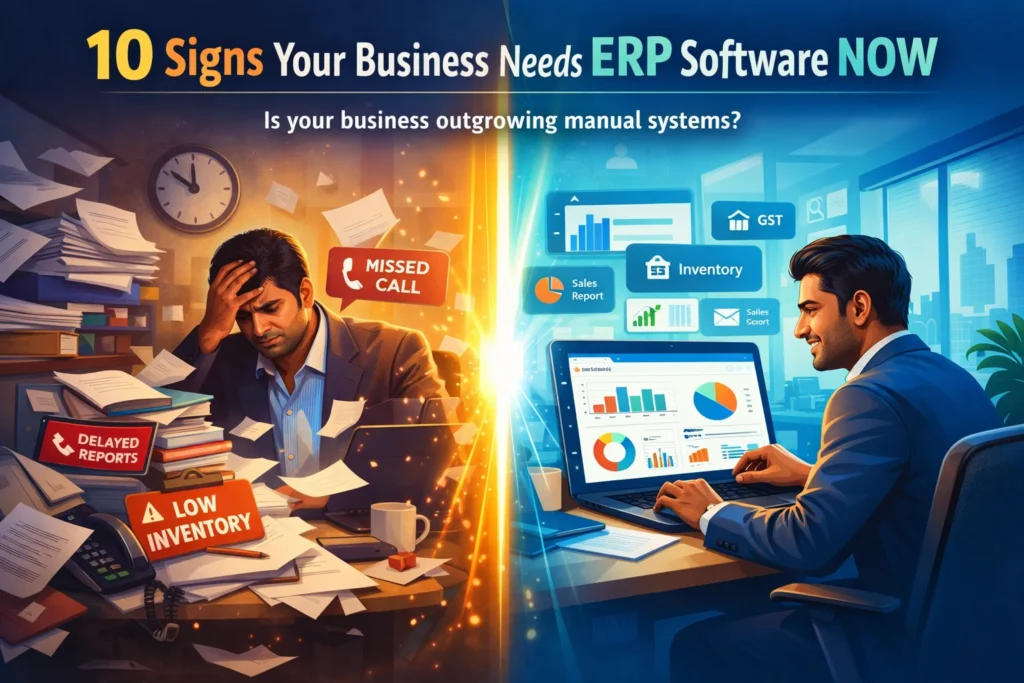
If your business is growing but your systems are still held together by spreadsheets, manual workarounds, and disconnected software, you are probably paying for it in ways you cannot fully see.
Missed orders. Reporting delays. Inventory mistakes. Rising admin costs. Frustrated teams. Unhappy customers.
These are not just operational headaches. They are warning signs.
At a certain point, patching problems with more spreadsheets, more tools, or more staff stops working. That is when businesses start looking at ERP software.
An ERP system helps bring your core business functions — finance, inventory, purchasing, operations, sales, and reporting — into one centralised platform. Instead of managing your business across separate tools, your team works from a single source of truth.
If you are wondering whether now is the right time, here are 10 signs your business needs ERP software now — and why waiting may cost more than you think.
Quick Answer: When Does a Business Need ERP Software?
Your business likely needs ERP software if you are experiencing:
- Too much manual data entry
- Multiple systems that do not sync
- Inventory errors or stock problems
- Slow financial reporting
- Limited visibility across departments
- Growing complexity that current tools cannot handle
- Customer service issues caused by internal inefficiency
- Compliance and audit challenges
- Rising operational costs
- Poor decisions caused by incomplete or outdated data
If several of these sound familiar, your business may have already outgrown its current systems.
1. Your Team Is Spending Too Much Time on Manual Work
When employees are copying data between spreadsheets, updating multiple systems, or chasing approvals through email, productivity drops fast.
What looks like “just how things work” is often a major drain on time and profit.
What this is costing you
- More admin time
- More human error
- Slower processing
- Lower employee productivity
- Higher payroll costs without better output
How ERP changes it
ERP automates repetitive tasks and centralises data, so your team spends less time managing information and more time moving the business forward.
If you have talented people doing manual data entry every day, ERP is worth serious consideration.
2. Your Systems Don’t Talk to Each Other
If accounting uses one platform, sales uses another, inventory lives in spreadsheets, and reporting comes from a mix of all three, your business is running with fragmented data.
That means different teams are making decisions from different versions of the truth.
Common red flags
- Sales numbers do not match finance reports
- Inventory counts are inconsistent
- Staff re-enter the same data multiple times
- Teams constantly ask, “Which report is correct?”
Why this hurts conversion and growth
Disconnected systems slow down every process in the business. They also make it harder to serve customers quickly and accurately.
How ERP changes it
ERP software connects your departments so everyone works from the same real-time data. That means fewer delays, fewer mistakes, and better decision-making.
3. Inventory Issues Are Hurting Revenue
If you sell products, inventory problems are not minor issues. They directly affect revenue, cash flow, and customer satisfaction.
Stockouts mean missed sales. Overstock means tied-up cash. Inaccurate stock data creates avoidable chaos across purchasing, warehousing, and fulfillment.
Signs this is happening
- You run out of best-selling items unexpectedly
- You are carrying too much slow-moving stock
- Your warehouse data does not match reality
- Reordering is more reactive than planned
What this is costing you
- Lost sales
- Excess inventory carrying costs
- Rush orders and avoidable purchasing expenses
- Frustrated customers
- Lower margins
How ERP changes it
ERP gives you real-time inventory visibility, better forecasting, and stronger purchasing control so you can stock smarter and fulfil more reliably.
4. Financial Reporting Takes Too Long
If month-end close feels stressful, reporting takes days instead of hours, or leadership has to wait too long for accurate numbers, your finance process is already under strain.
In a fast-moving business, delayed reporting leads to delayed decisions.
What this usually means
- Finance is reconciling data from multiple systems
- Reports are manually compiled
- Numbers are often outdated by the time they are reviewed
- Leadership lacks confidence in the data
How ERP changes it
ERP connects finance with inventory, purchasing, operations, and sales, making reporting faster, cleaner, and more reliable.
When leaders can see financial performance in real time, they can act faster and with more confidence.
5. You Do Not Have Real-Time Visibility Across the Business
Growth gets harder when leaders cannot clearly see what is happening across departments.
If operations, finance, sales, and procurement are each working in separate silos, the business becomes harder to manage and easier to misjudge.
Signs of poor visibility
- You rely on weekly or monthly summaries instead of live data
- Department heads report different numbers
- Important information is buried in email threads
- Management decisions are based on assumptions, not current facts
How ERP changes it
ERP provides a centralised view of business performance so leaders can monitor operations, track KPIs, and respond faster to issues before they become expensive problems.
6. Growth Is Making Your Current Systems Break Down
Many businesses do not look for ERP because something failed. They look because growth exposed the limits of their current setup.
The tools that worked when you had fewer products, customers, transactions, or employees often stop working as complexity increases.
Warning signs
- You need more staff just to keep up with admin work
- Errors are increasing as volume increases
- Managing multiple locations is difficult
- New products, entities, or workflows are hard to support
- Existing software cannot scale with the business
Why this matters
If growth creates confusion instead of efficiency, your systems are now limiting your business.
How ERP changes it
ERP gives you structure, standardisation, and scalability so you can grow without multiplying inefficiency.
7. Customer Experience Is Starting to Suffer
Customers do not care whether your internal systems are disconnected. They only notice the outcome.
Late shipments. Wrong invoices. Unclear order status. Delayed answers. Missed promises.
These issues damage trust, increase churn, and make it harder to grow profitably.
Common customer-facing symptoms
- Orders are delayed because stock information is wrong
- Support teams cannot quickly access full order history
- Billing mistakes create friction
- Sales commits to timelines operations cannot meet
How ERP changes it
ERP improves coordination between sales, inventory, finance, and fulfilment so customers get faster answers, more accurate orders, and a better overall experience.
Better internal systems lead directly to better customer retention.
8. Compliance and Audit Preparation Are Becoming More Painful
As your business grows, the cost of weak controls goes up.
Whether you need cleaner financial records, approval workflows, audit trails, or better access controls, scattered systems make compliance harder than it should be.
Warning signs
- Audit prep takes too much time
- Key documents are stored in multiple places
- Approvals happen informally
- It is difficult to control who sees or changes data.
How ERP changes it
ERP systems help standardise workflows, improve recordkeeping, and create better accountability across the organisation.
This reduces risk and makes audit and compliance processes more manageable.
9. Your Operational Costs Keep Climbing
One of the biggest hidden costs in a growing business is inefficiency.
You may not see it as one line item, but it shows up everywhere:
- extra labour
- duplicate work
- correction of avoidable errors
- excess inventory
- slower invoicing
- delayed collections
- missed opportunities
If this sounds familiar, ask:
Are we spending more because we are growing — or because our systems are inefficient?
How ERP changes it
ERP helps reduce waste, automate workflows, and improve process consistency so you can grow with more control and better margins.
10. Leadership Is Making Important Decisions Without Reliable Data
This is one of the biggest signs your business needs ERP software now.
If your leadership team is making decisions based on outdated reports, manually built dashboards, or conflicting numbers from different departments, the business is operating with unnecessary risk.
What this affects
- Forecasting
- Cash flow planning
- Hiring decisions
- Purchasing strategy
- Margin analysis
- Expansion planning
How ERP changes it
ERP gives leaders access to accurate, connected, real-time business data so decisions are faster, smarter, and easier to defend.
The Real Cost of Waiting Too Long
Many businesses delay ERP because they assume their current setup is “good enough for now”.
But the cost of waiting often shows up in ways that are easy to underestimate:
- More manual work as volume grows
- More errors as complexity increases
- More customer frustration
- More reporting delays
- More pressure on staff
- More money spent fixing issues that better systems would prevent
By the time the need for ERP feels urgent, the business has often already absorbed months or years of preventable inefficiency.
ERP is not just about replacing software. It is about removing the friction that slows growth.
What ERP Software Helps You Do
The right ERP system can help your business:
- Eliminate duplicate data entry
- Improve inventory accuracy
- Speed up financial reporting
- Create better visibility across departments
- Reduce manual errors
- Strengthen process control
- Support multi-location or multi-entity growth
- Improve customer service and fulfilment
- Give leadership better decision-making data
For growing businesses, ERP often becomes the operating foundation that makes scale possible.
How to Know If You’re Ready for ERP
You are likely ready to explore ERP if:
- Your team is relying heavily on spreadsheets.
- Your systems are disconnected.
- You are struggling with inventory, orders, or reporting.
- Growth is increasing complexity faster than your tools can handle.
- Leadership needs better visibility and control
- You are hiring people to manage inefficiency instead of solving it.
If you checked several of those boxes, the question may not be whether you need ERP.
It may be how much longer you can afford to wait.
What to Do Next
If your business is showing these signs, the next step is not to buy software blindly.
The smart next step is to assess the following:
- where your biggest operational bottlenecks are
- which processes are costing you the most time and money
- which departments need better integration?
- what level of visibility leadership needs to scale confidently
That gives you a much clearer path to choosing the right ERP system.
Final Thoughts
Businesses rarely move to ERP because everything is going smoothly. They move because growth, inefficiency, and complexity have exposed the limits of their current systems.
If your team is buried in manual work, your data is fragmented, your reporting is slow, or your operations are becoming harder to control, these are not isolated issues.
They are signs your business needs ERP software now.
The right ERP solution can help you reduce waste, improve visibility, support growth, and create a stronger foundation for the future.
If disconnected systems are slowing your business down, don’t wait until the problem gets more expensive.
See how modern ERP software can unify your operations, improve visibility, and support growth.
FAQ Section
The most common signs include manual processes, disconnected systems, inventory issues, slow reporting, poor visibility, customer service problems, compliance challenges, and difficulty scaling operations.
A growing business should implement ERP when its current tools start creating inefficiency, errors, and limited visibility. The best time is usually before those issues become major barriers to growth.
Yes. ERP is not only for large enterprises. Many small and mid-sized businesses invest in ERP when spreadsheets and disconnected tools can no longer support their operations efficiently.
ERP improves business performance by centralising data, automating workflows, increasing accuracy, improving visibility, and helping teams work more efficiently across departments.