
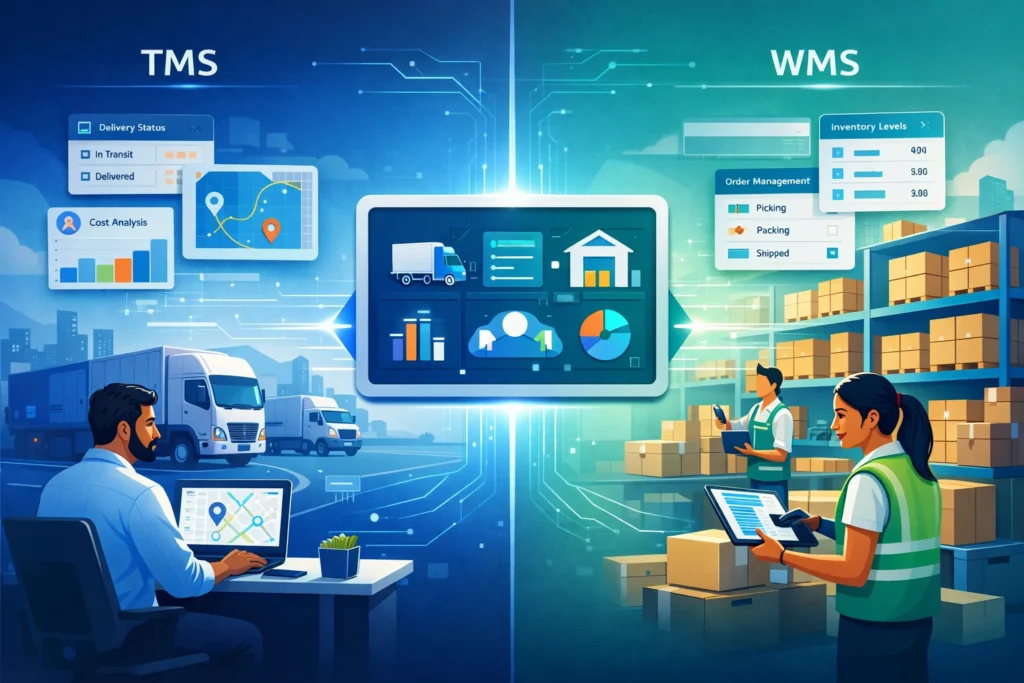
Struggling to manage deliveries, track inventory, or streamline operations? You’re not alone.
Many growing businesses reach a point where spreadsheets and manual processes simply don’t cut it anymore. That’s when systems like Transportation Management Systems (TMS) and Warehouse Management Systems (WMS) come into the picture.
But here’s the real challenge:
TMS vs WMS — which one does your business actually need?
In this guide, we’ll break down the differences, benefits, and real-world use cases so you can make the right decision for your business growth.
What is a Transportation Management System (TMS)?
A Transportation Management System (TMS) is software designed to help businesses plan, execute, and optimise the movement of goods.
Key Features of TMS
- Route optimisation for faster delivery
- Real-time shipment tracking
- Freight cost management
- Carrier selection and performance tracking
- Delivery scheduling and automation
Benefits of Using TMS
- Reduce transportation costs significantly
- Improve delivery speed and accuracy
- Gain real-time visibility into shipments
- Enhance customer satisfaction with timely deliveries
👉 If your business depends heavily on logistics and shipping, TMS can be a game-changer.
What is a Warehouse Management System (WMS)?
A Warehouse Management System (WMS) focuses on managing inventory and warehouse operations efficiently.
Key Features of WMS
- Inventory tracking in real time
- Barcode and RFID integration
- Order picking and packing optimisation
- Warehouse layout management
- Stock level monitoring
Benefits of Using WMS
- Improve inventory accuracy
- Speed up order fulfilment
- Reduce manual errors
- Optimise warehouse space utilisation
👉 If inventory chaos is your biggest issue, WMS is the solution.
TMS vs WMS: Key Differences Explained
Understanding TMS vs WMS becomes easier when you compare their core functions:
1. Core Functionality
- TMS: Manages transportation and delivery
- WMS: Manages inventory and warehouse operations
2. Scope of Operations
- TMS: External logistics (shipping, carriers)
- WMS: Internal processes (storage, picking, packing)
3. Visibility
- TMS: Tracks shipments in transit
- WMS: Tracks stock inside the warehouse
4. Cost Impact
- TMS: Reduces freight and delivery costs
- WMS: Reduces storage and labour costs
5. Integration
Both systems can integrate with ERP software for full business control.
When Does Your Business Need a TMS?
You should consider TMS if:
- You manage frequent deliveries
- You ship across multiple locations
- Transportation costs are high
- Delivery delays are affecting customer satisfaction
Best Industries for TMS
- eCommerce
- Manufacturing
- Logistics & distribution
When Does Your Business Need a WMS?
You should consider WMS if:
- You handle large inventory volumes
- You face stock mismatches or errors
- Your warehouse operations are complex
- Order fulfilment is slow
Best Industries for WMS
- Retail
- Wholesale
- FMCG
TMS vs WMS: Can You Use Both Together?
Yes — and in many cases, you should.
How They Work Together
- WMS manages inventory inside the warehouse
- TMS handles delivery after dispatch
Benefits of Using Both
- End-to-end supply chain visibility
- Better coordination between warehouse and logistics
- Faster and more accurate operations
Where ERP Comes In
An ERP system connects TMS and WMS into one unified platform, giving you:
- Centralised data
- Real-time insights
- Better decision-making
TMS vs WMS: Which One Should You Choose?
Here’s a simple way to decide:
Choose TMS if:
- Your main issue is delivery and logistics
Choose WMS if:
- Your main issue is inventory and warehouse management
Choose Both (or ERP) if:
- You want complete supply chain control
- Your business is scaling rapidly
Common Mistakes Businesses Make
- Choosing software without understanding business needs
- Ignoring integration with existing systems
- Not planning for future growth
- Underestimating training requirements
Conclusion
When comparing TMS vs WMS, the right choice depends on your business challenges:
- TMS = Better transportation and delivery management
- WMS = Better inventory and warehouse control
But if you want complete operational efficiency, integrating both through an ERP system is the smartest move.
TMS focuses on transportation, while WMS focuses on warehouse operations.
Yes, both systems are scalable and suitable for growing businesses.
If your business handles both logistics and inventory at scale, using both is ideal.
ERP acts as a central system connecting both for real-time data and automation.
Most eCommerce businesses benefit from using both TMS and WMS together.