
Manufacturers today are under immense pressure to deliver faster, reduce costs, and maintain high-quality production—while managing complex supply chains and customer expectations. Spreadsheets or outdated software simply can’t keep up.
This is where ERP for Manufacturing becomes a game-changer, offering a unified platform to automate, track, and optimise every part of your operations. Whether you run a small fabrication shop or a multi-plant enterprise, the right ERP can dramatically improve efficiency and profitability.
In this comprehensive buyer’s guide, you’ll learn what manufacturing ERP is, key features to look for, the best systems, pricing insights, and how to choose the right solution for your business.
What Is ERP for Manufacturing?
Definition and Core Purpose
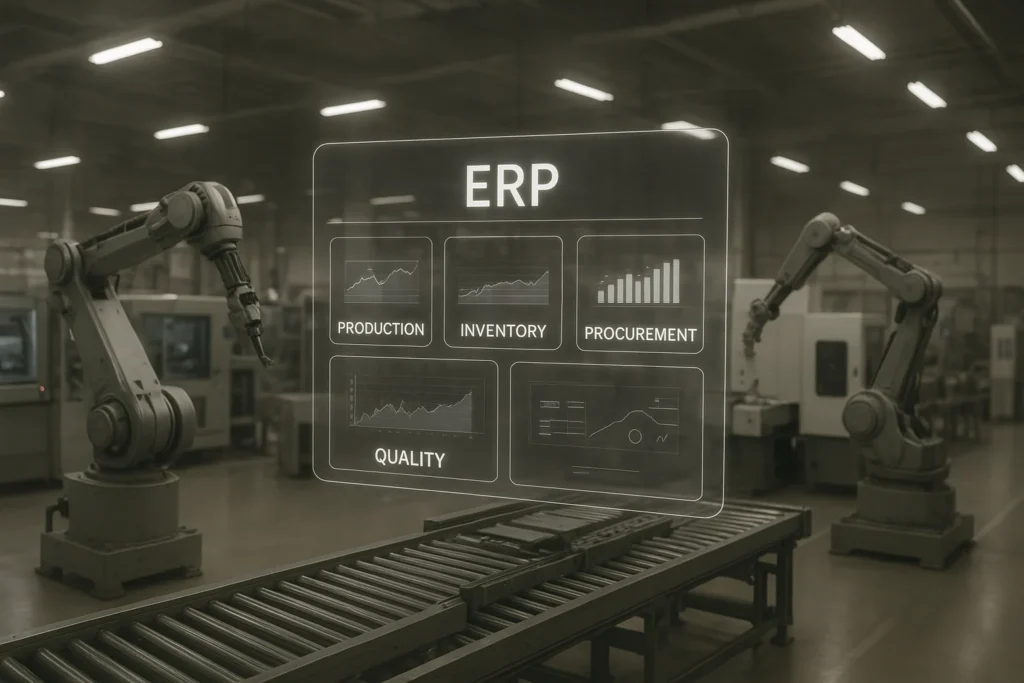
An ERP for Manufacturing is an integrated software platform built to manage production, inventory, procurement, finance, quality, and the shop floor—all from one centralised system.
It eliminates data silos and helps manufacturers plan better, execute faster, and monitor every workflow in real time.
How Manufacturing ERP Differs From Generic ERPs
A generic ERP cannot handle the complexity of manufacturing operations. A specialised manufacturing ERP includes:
- Advanced Production Scheduling (APS)
- BOM & routing management
- Shop floor automation and IoT integration
- Quality tracking and compliance modules
- Machine-level utilisation analytics
Key Benefits of ERP for Manufacturing Companies
Real-Time Production Visibility
Monitor WIP, machine performance, and production progress through live dashboards and alerts.
Improved Inventory & Material Planning
With MRP, automated reorder levels, and demand forecasting, manufacturers avoid stockouts and excess inventory.
Cost Control & Better Profit Margins
Track job costing, variance analysis, material consumption, and production overheads accurately.
Higher Efficiency Through Automation
Paperless workflows and reduced manual work increase production speed and reduce errors.
Enhanced On-Time Delivery Performance
Better planning allows you to meet customer deadlines consistently and improve service levels.
Must-Have Features in an ERP for Manufacturing
Production Planning & Scheduling (PPC/APS)
Multi-level BOM, routing, capacity planning, and optimised scheduling.
Inventory & Warehouse Management
Batch tracking, barcoding, multi-warehouse support, and automated stock updates.
Quality Management System (QMS)
Incoming QC, in-process QC, final QC, CAPA workflows, and rejection analysis.
Material Requirements Planning (MRP)
Forecasting, purchase planning, supplier lead times, and automated PO creation.
Shop Floor Automation
IoT-enabled machine monitoring, downtime analysis, and real-time work order tracking.
Costing & Finance Integration
Production costing, BOM cost comparison, and fully integrated accounting.
Supply Chain & Vendor Management
Vendor ratings, GRN-based audits, and integrated procurement workflows.
CRM & Order Management
Sales orders, customer history, pricing, delivery tracking.
Types of ERP for Manufacturing
Cloud-Based Manufacturing ERP
- Subscription-based
- Accessible from anywhere
- Faster deployment
- Lower upfront cost
On-Premise Manufacturing ERP
- One-time licence
- Full data control
- Higher initial investment
Industry-Specific ERP Solutions
- Discrete manufacturing
- Process/batch manufacturing
- ETO (Engineer-To-Order)
- Job shop/contract manufacturing
Top ERP Systems for Manufacturing in 2026
1. Chirix ERP – Best for Growing Manufacturers
Chirix ERP is built for Indian manufacturers looking for real-time visibility, cost control, and automation.
Key Modules: Production, Inventory, MRP, Finance, CRM, Procurement, Quality.
Ideal For: Small to mid-sized manufacturers.
Pricing: Affordable and customisable. Learn more….
2. SAP Business One
Strong for SMEs with global operations.
Pricing: Moderate–high.
3. Oracle NetSuite
Cloud-first ERP with advanced SCM and analytics.
Pricing: Premium.
4. Microsoft Dynamics 365
Ideal for enterprise-level manufacturing and heavy integration needs.
5. TallyPrime with Manufacturing Add-Ons
Budget option for very small manufacturers.
Manufacturing ERP Pricing Guide (2026)
Factors That Influence ERP Pricing
- Number of users
- Modules selected
- Customisation
- Deployment type
- Implementation timeline
- AMC and support plans
Average Pricing Overview
- Cloud ERP: ₹1,500–₹6,000 per user/month
- On-Prem License: ₹150,000–₹2,000,000 one-time
- Implementation: 50%–150% of software cost
- Customisation: Variable based on workflows
Hidden Costs to Watch Out For
- Data migration from legacy systems
- Third-party integrations
- Additional reports or dashboards
- Extra training sessions
How to Choose the Best ERP for Manufacturing
Identify Your Manufacturing Type & Workflows
Discrete, process, batch, and job shop—each requires different features.
Create a Requirement Checklist
List must-have modules, workflows, integrations, and compliance needs.
Evaluate Vendor Credibility
Check case studies, client reviews, demo quality, and industry experience.
Compare Total Cost of Ownership (TCO)
Evaluate long-term value, not just upfront cost.
Request a Customised Demo
Use your real production scenarios to test functionality.
Implementation Tips for Success
Start with Clean Master Data
Accurate BOMs, items, vendors, and machine data.
Involve Shop Floor Teams Early
Improves adoption and reduces resistance.
Configure Before Customising
Stick to industry-standard best practices as much as possible.
Test, Train & Go Live in Phases
Pilot → Review → Full rollout.
Conclusion
Choosing the right ERP for Manufacturing is one of the most important investments you’ll make for operational efficiency and long-term growth. With the right system, you can gain real-time visibility, reduce production costs, and deliver better customer experiences.
If you’re looking for a modern, feature-rich, and cost-effective manufacturing ERP, Chirix ERP is designed to help you scale with confidence.