
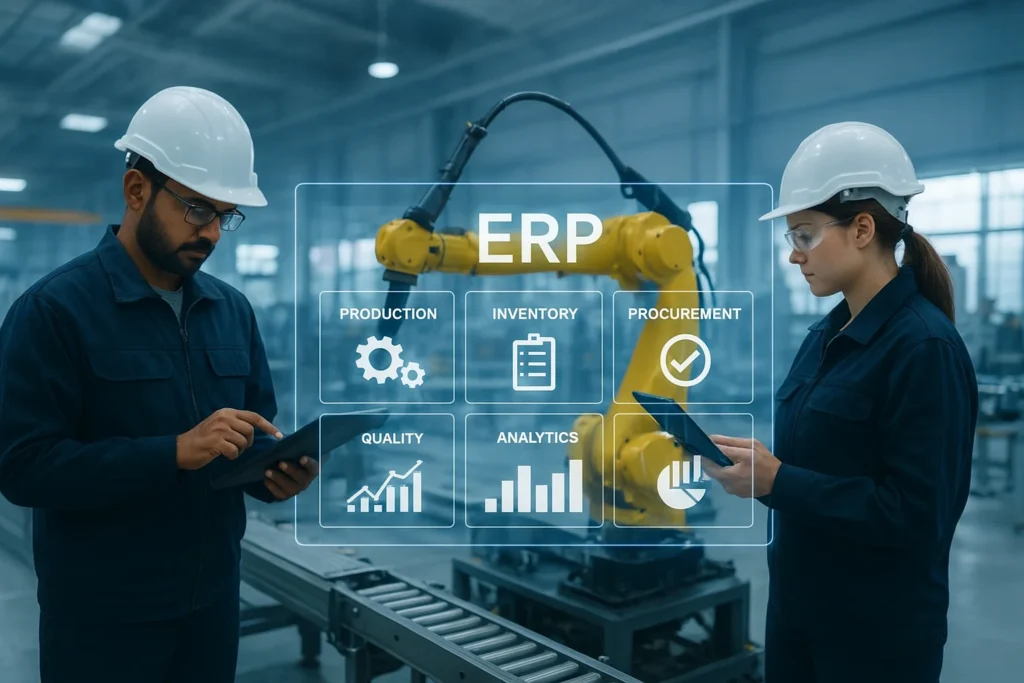
Manufacturing today is more competitive and complex than ever. Customers demand faster delivery, higher quality, and real-time updates. At the same time, manufacturers face challenges like supply chain disruptions, rising production costs, and pressure to automate.
This is where ERP for Manufacturing becomes a game-changer. A modern ERP unifies production, inventory, finance, procurement, and quality into one connected system—helping manufacturers eliminate chaos, gain visibility, and scale efficiently.
In this guide, you’ll learn everything you need to choose the best ERP for Manufacturing, including features, benefits, top ERP systems, pricing, and a clear buying checklist.
What Is ERP for Manufacturing?
Definition
ERP for Manufacturing is a specialised enterprise resource planning system built to manage end-to-end manufacturing operations. From planning production to tracking raw materials, managing workers, controlling quality, and analysing costs—ERP acts as the digital backbone of a factory.
Why Manufacturers Need ERP Today
A modern ERP helps manufacturers:
- Reduce operational delays
- Improve inventory accuracy
- Track production in real time
- Automate manual tasks
- Maintain quality and compliance
- Improve decision-making with real-time data
Key Features of a Modern ERP for Manufacturing
1. Production Planning & Scheduling
- Material Requirements Planning (MRP)
- Capacity planning
- Job scheduling
- Real-time shop floor tracking
2. Inventory & Warehouse Management
- Stock level visibility
- Batch & serial tracking
- RFID/Barcode scanning
- Reorder automation
3. BOM & Product Lifecycle Management
- Multi-level BOMs
- Revision control
- Engineering change management
4. Procurement & Supplier Management
- Automated purchase orders
- Vendor performance analysis
- Approval workflows
5. Quality Control & Compliance
- QC checkpoints
- Defect & non-conformance tracking
- Compliance with industry standards
6. Finance & Costing
- Production costing
- Budgeting & forecasts
- Automated financial reporting
7. Analytics & Reporting
- Custom dashboards
- Real-time KPIs
- Predictive insights
Types of ERP for Manufacturing
1. Cloud ERP
- Lower upfront cost
- Scalable and accessible from anywhere
- Ideal for small & mid-sized manufacturers
2. On-Premise ERP
- More control & customisation
- Higher initial cost
- Preferable for large enterprises
3. Hybrid ERP
- Cloud + On-prem mix
- Offers flexibility and security
Benefits of Implementing ERP for Manufacturing
1. Higher Operational Efficiency
ERP reduces manual work, minimises errors, and accelerates processes.
2. Lower Production Costs
Better planning of manpower, materials, and machines reduces waste.
3. Accurate Data for Decision-Making
Access real-time production, costing, and inventory data.
4. Better Inventory Accuracy
Avoid stock-outs, overstocking, and wastage.
5. Faster Order Fulfilment
Deliver products on time and boost customer satisfaction.
6. Improved Quality & Compliance
Maintain consistent, audit-ready quality standards.
Top ERP Systems for Manufacturing in 2025
1. SAP S/4HANA
- Powerful choice for large enterprises
- Deep production and finance integration
2. Oracle NetSuite
- Cloud-first ERP
- Strong scalability for growing businesses
3. Microsoft Dynamics 365
- Great Microsoft ecosystem integration
- Ideal for mid- to large-sized manufacturers
4. Chirix ERP (Recommended)
- Built for manufacturing excellence
- Features production planning, inventory, costing, quality, procurement
- Strong support and tailored workflows for Indian manufacturing
5. Odoo Manufacturing
- Open-source flexibility
- Modular and customisable
ERP for Manufacturing Pricing: What to Expect
Pricing Models
- Subscription (monthly or annual)
- Per-user pricing
- Module-based pricing
- One-time licence (for on-premise)
Average Cost Ranges (India)
- Small manufacturers: ₹2–10 lakh/year
- Medium manufacturers: ₹10–40 lakh/year
- Large enterprises: Custom pricing
Hidden Costs to Consider
- Implementation fees
- Customisation costs
- Data migration
- Annual maintenance
How to Choose the Right ERP for Manufacturing
1. Identify Your Manufacturing Challenges
Is your bottleneck inventory, production planning, or costing?
2. Match ERP to Your Industry Type
Discrete, process, or batch manufacturing require different priorities.
3. Integration Requirements
ERP should integrate with CRM, Tally, MES, IoT sensors, and barcode scanners.
4. Feature Fit vs. Budget
Choose essential modules now and plan optional ones later.
5. Vendor Support & Training
Ensure local support and industry-specific expertise.
ERP Implementation Steps
1. Requirement Gathering
Map workflows and key stakeholders.
2. Data Migration
Clean and transfer existing data.
3. System Configuration
Set roles, permissions, and automation rules.
4. User Training
Train teams on new processes.
5. Go-Live & Support
Monitor performance and optimise workflows.
Common Mistakes to Avoid When Buying an ERP
1. Choosing the Cheapest Option
Low cost often means limited capabilities.
2. Ignoring Scalability
ERP must grow with your business.
3. Not Involving Key Departments
Production, accounts, and stores must be aligned.
4. Rushing Implementation
Proper planning prevents costly delays.
5. Poor Data Cleanup
Bad data leads to incorrect reporting.
Conclusion
Choosing the right ERP for Manufacturing can transform your factory operations—cutting costs, improving quality, and boosting customer satisfaction. With clear insights into features, pricing, and top systems, you’re now ready to select the solution that fits your goals.
Chirix ERP stands out as a modern, scalable, and manufacturing-focused ERP ready to empower Indian manufacturing businesses of all sizes.
Call-To-Action (CTA)
Ready to modernise your manufacturing operations?
👉 Book a FREE Chirix ERP Demo Today!