
It’s 4 PM on a Tuesday in a spice processing unit near Kochi, and the production supervisor is doing what he does every day at this time — walking the shop floor with a clipboard, trying to figure out why Batch 47 is running two hours behind schedule. Somewhere between the raw material store, the grinding line, and the packing section, information has got lost. The inventory register says one thing. The floor says another. And the dispatch team is already calling to ask when the order will be ready.
This scene repeats itself across Kerala’s manufacturing belt — in rubber processing units in Kottayam, seafood export facilities in Kochi, coir factories in Alappuzha, and textile units in Thrissur. The raw materials are there. The machines are there. The skilled workforce is there. What’s often missing is a system that connects all of it in real time.
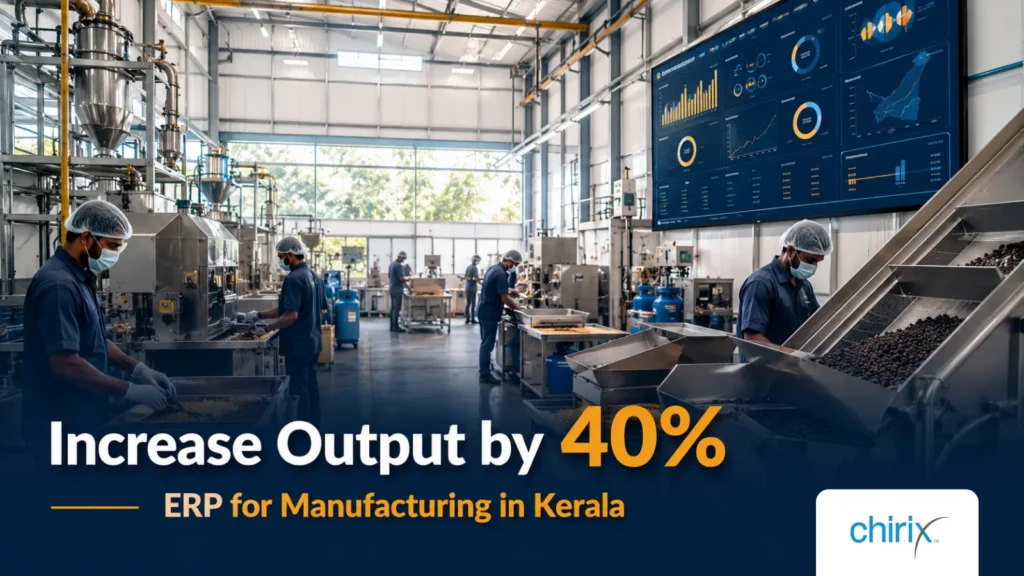
This is exactly the gap that ERP for manufacturing in Kerala is built to close. Manufacturers who move from spreadsheets and manual tracking to a purpose-built ERP system typically see production output increase by up to 40%, driven by better planning, reduced machine downtime, and real-time visibility into every stage of the process. In this guide, we’ll look at why Kerala’s manufacturing sector needs ERP now, how it actually drives output gains, and what to look for when choosing a system.
Why Kerala’s Manufacturing Sector Needs ERP Now
Unique Challenges of Kerala’s Manufacturing Landscape
Kerala’s manufacturing base looks different from the engineering-heavy clusters of Coimbatore or Chennai. A large share of output comes from labour-intensive, process-driven industries — spice processing, rubber and rubber products, seafood processing for export, coir, and textiles. These industries come with their own operational headaches: humidity-sensitive raw materials that spoil if storage isn’t tracked properly, seasonal supply fluctuations, and export documentation that has zero tolerance for error.
On top of that, many Kerala manufacturing units still run core operations — production scheduling, inventory counts, quality checks — on registers, WhatsApp groups, and disconnected Excel sheets. It works until the business scales past a certain point, and then it becomes the biggest constraint on growth.
Common Inefficiencies Without ERP
Without a connected system, manufacturers typically deal with:
- Manual bill of materials (BOM) tracking that leads to raw material wastage or shortages
- Delayed order-to-dispatch cycles because production status isn’t visible until someone physically checks
- Poor shop-floor visibility, so machine idle time and bottlenecks go unnoticed for days or weeks
- Reconciliation nightmares between what inventory registers say and what’s actually on the shelf
Industry Clusters Driving Demand
ERP adoption is picking up fastest in Kerala’s key manufacturing hubs — Kochi (seafood, engineering goods), Kozhikode (timber, textiles), Thrissur (gold, textiles, engineering), and Alappuzha (coir, rubber). As these clusters compete more directly with manufacturers in Tamil Nadu and Karnataka on cost and delivery timelines, ERP is becoming less of a nice-to-have and more of a competitive necessity.
What Is ERP for Manufacturing And Why It’s Different from Generic Software
Core Modules Relevant to Manufacturers
A manufacturing-focused ERP isn’t just accounting software with extra features. It’s built around the actual production process, with modules like:
- Bill of Materials (BOM): track exactly what raw materials go into each finished product
- Material Requirements Planning (MRP): forecast raw material needs based on order volume
- Shop floor control: track job progress in real time, machine by machine
- Quality checks: log inspection results at each production stage
- Batch and lot tracking: critical for seafood, spice, and rubber manufacturers who need full traceability for exports
Why Generic Accounting Software Falls Short
Tools like Tally or basic accounting software can track sales and expenses, but they weren’t designed to answer questions like “which machine caused today’s delay” or “how much raw material will Batch 52 actually consume?” That’s the gap manufacturing ERP is built to fill.
Cloud vs On-Premise ERP: What Suits Kerala SMEs Better
For most Kerala manufacturing SMEs, cloud-based ERP makes more sense than on-premise systems. It requires lower upfront investment, doesn’t need a dedicated IT team to maintain servers, and gives owners and managers visibility into operations from anywhere useful for businesses with multiple units or export buyers who expect quick status updates.
How ERP Increases Manufacturing Output by 40%
This is the core question every manufacturer asks before investing in ERP: does it actually move the needle on output? Here’s where the gains typically come from.
Real-Time Production Planning and Scheduling
Instead of manually assigning jobs and hoping machines are free, ERP shows exactly which machines are running, which are idle, and which orders are next in the queue. This alone eliminates a significant chunk of idle machine time that goes unnoticed in manual systems.
Inventory and Raw Material Visibility
For humidity-sensitive and perishable raw materials – a major factor in Kerala’s spice and seafood industries – ERP gives real-time stock visibility that prevents both stockouts (which halt production) and overstocking (which leads to spoilage and wasted capital).
OEE Tracking to Identify Bottlenecks
Overall Equipment Effectiveness (OEE) tracking shows exactly where production is losing time — whether it’s changeover delays, unplanned downtime, or quality rejections. Manufacturers can’t fix what they can’t see, and this visibility is often where the biggest output gains come from.
Automated Job Work Order Management
Many Kerala manufacturers rely on outsourced or job-work processes, especially in textiles and rubber. ERP automates the tracking of these job orders, cutting the back-and-forth delays that come from manually following up on outsourced production stages.
Data-Backed Decision-Making
Perhaps the biggest shift is cultural — moving from decisions based on “what usually happens” to decisions based on what the data actually shows for this batch, this week, this machine.
Industry-Specific ERP Applications in Kerala
ERP for Spice Processing and Packaging Units
Batch tracking, moisture-sensitive inventory management, and quality control checkpoints suited to spice grading and export standards.
ERP for Rubber and Rubber Products Manufacturers
Raw material yield tracking, machine utilisation monitoring, and job work order management for outsourced processing stages.
ERP for Seafood Processing and Export Compliance
Full batch and lot traceability, cold storage inventory tracking, and export documentation support built for international buyer requirements.
ERP for Coir and Textile Manufacturing
Production scheduling across multiple looms or units, raw material consumption tracking, and finished goods inventory management.
Key Features to Look for in an ERP for Manufacturing in Kerala
- GST and e-way bill compliance built directly into the system
- Multi-location and multi-currency support, especially important for export-heavy businesses
- Mobile and cloud access for shop-floor supervisors and remote monitoring by owners
- Easy integration with existing accounting or CRM tools already in use
- Local support and onboarding availability — a system is only as good as the support behind it during implementation
How to Implement ERP Without Disrupting Production
Choosing the Right Implementation Partner
Look for a partner with experience in your specific industry — spice, rubber, or seafood processing each have different operational quirks that a generic implementation team may miss.
Phased Rollout vs Full-Scale Deployment
For most SMEs, a phased rollout — starting with inventory and production modules before adding finance and CRM — reduces disruption and gives teams time to adapt.
Training Shop-Floor Staff for Adoption
ERP only delivers results if the shop floor actually uses it. Hands-on training, in the language your team is comfortable with, matters more than the software’s feature list.
Measuring ROI Post-Implementation
Track output percentage change, downtime reduction, and order cycle time in the first 90 days to validate the investment.
Frequently Asked Questions
Costs vary based on the number of users, modules required, and deployment type (cloud vs on-premise). Cloud ERP typically has lower upfront costs, making it more accessible for SMEs.
Yes. Modern cloud ERP systems are built to scale, so small manufacturers can start with core modules like inventory and production planning and add more as they grow.
Implementation timelines depend on business complexity, but a phased rollout for an SME typically takes a few weeks to a few months for full adoption.
Yes, a manufacturing-focused ERP built for the Indian market should have GST, e-way bill, and export documentation support built in.
Conclusion: Is ERP Right for Your Kerala Manufacturing Business?
If your production planning still runs on registers, WhatsApp updates, and end-of-day guesswork, the gap between where your output is and where it could be is likely larger than you think. ERP for manufacturing in Kerala isn’t about replacing people — it’s about giving your team the visibility to make faster, better-informed decisions on the shop floor, in the store, and at dispatch.
See how Chirix ERP can help your Kerala manufacturing unit increase output.