
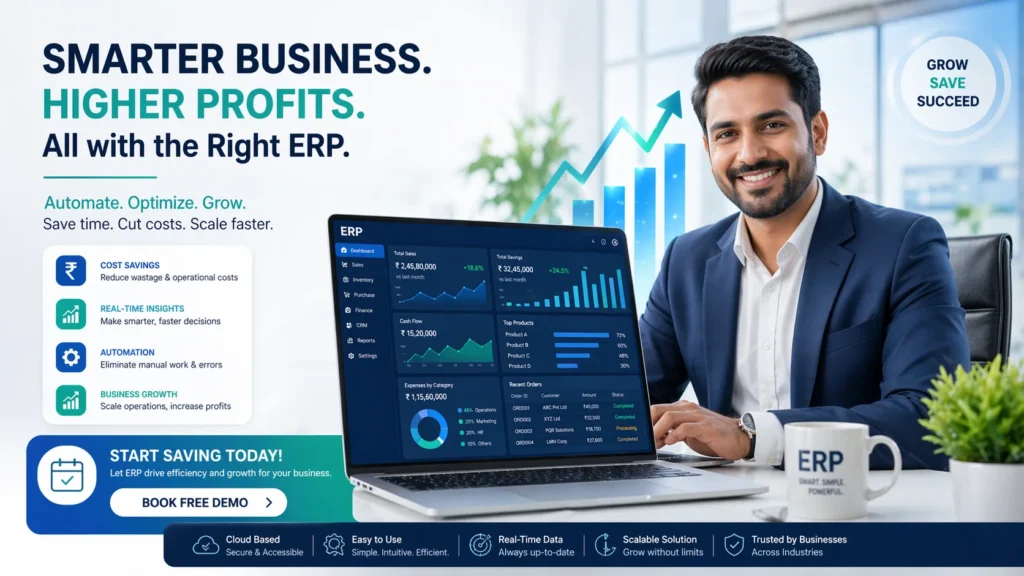
Stop Losing Money to Inefficiency
If your business is still juggling spreadsheets, manual entries, and disconnected tools, you’re likely losing money every single day—without even realising it.
Inventory mismatches, delayed dispatches, accounting errors, and poor visibility can quietly drain profits.
That’s exactly where choosing the right ERP Software to Buy becomes a game-changer.
The right ERP doesn’t just organise your business—it cuts costs, boosts productivity, and scales with you.
In this guide, you’ll discover:
- The most cost-effective ERP options
- Key features that actually save money
- How to choose the right ERP without overspending
What Is ERP Software and Why It Matters for Cost Efficiency
What Is ERP Software?
ERP (Enterprise Resource Planning) software integrates all your business processes into one system:
- Inventory
- Finance
- Sales
- HR
- Production
Instead of using multiple tools, ERP gives you one centralised platform.
How ERP Reduces Business Costs
Here’s where the real value lies:
- Eliminates manual work → saves labour costs
- Reduces errors → avoids financial losses
- Real-time data → smarter decisions, faster
- Automation → less dependency on repetitive tasks
Who Should Invest in ERP Software
ERP isn’t just for large corporations anymore.
It’s ideal for:
- Small & medium businesses (SMEs)
- Manufacturers (especially garment units)
- Retail & wholesale businesses
- Service-based companies
Key Factors to Consider Before Choosing ERP Software to Buy
1. Total Cost of Ownership (TCO)
Don’t just look at the price tag.
Consider:
- Setup cost
- Subscription/licensing
- Maintenance
- Training
👉 A cheap ERP can become expensive if hidden costs stack up.
2. Cloud vs On-Premise ERP
- Cloud ERP → Lower upfront cost, flexible, scalable
- On-Premise ERP → Higher initial cost, more control
👉 For most businesses today, cloud ERP is more cost-effective.
3. Customisation & Scalability
Your ERP should grow with your business—not limit it.
4. Ease of Use
If your team struggles to use it, productivity drops.
👉 Simple UI = faster adoption = better ROI
5. Integration Capabilities
Your ERP should easily connect with:
- Accounting tools
- CRM systems
- E-commerce platforms
Top Features to Look for in Cost-Effective ERP Software
A good ERP should include the following:
- Real-Time Reporting → Instant insights
- Inventory Management → No stock mismatches
- Financial Management → Accurate accounting
- CRM Integration → Better customer handling
- Automation → Save time and reduce workload
Best ERP Software to Buy for Cost-Effective Solutions
Here are some of the top options you should consider:
1. Chirix ERP (Best for SMEs & Manufacturers)
If you’re looking for a budget-friendly, powerful ERP, Chirix ERP stands out.
Why it’s cost-effective:
- Built for Indian businesses (especially garment & manufacturing)
- Covers inventory, production, CRM, and accounts in one system
- Reduces dependency on multiple tools
Best for:
- Garment manufacturers (Tiruppur, Chennai, etc.)
- SMEs looking for full control at a lower cost
2. Odoo
Strengths:
- Open-source flexibility
- Modular pricing (pay only for what you use)
Best for:
- Businesses needing customisation
3. Zoho ERP (Zoho One)
Strengths:
- Affordable all-in-one suite
- Strong CRM + finance integration
Best for:
- Small businesses and startups
4. SAP Business One
Strengths:
- Enterprise-level capabilities
- Scalable for growing companies
Consideration:
- Higher cost compared to others
5. Tally ERP + Integrations
Strengths:
- Widely used in India
- Strong accounting features
Limitation:
- Needs add-ons for full ERP functionality
Cloud ERP vs Traditional ERP: Which Is More Cost-Effective?
Initial Investment
- Cloud: Low
- Traditional: High
Maintenance Costs
- Cloud: Minimal
- Traditional: Expensive
Long-Term ROI
- Cloud ERP wins for most modern businesses
👉 Conclusion: Cloud ERP is the smarter investment.
How to Choose the Right ERP Software to Buy
Follow this simple framework:
1. Identify Your Needs
- Inventory issues?
- Production delays?
- Sales tracking problems?
2. Set a Clear Budget
Avoid overspending—but don’t go too cheap either.
3. Request a Demo
Always test before buying.
4. Check Support & Training
Good support = smooth implementation
5. Look for Industry Fit
Example:
- Garment industry → production + job work tracking is critical
Common Mistakes to Avoid
- Choosing based only on price
- Ignoring scalability
- Not training your team
- Skipping proper implementation
👉 These mistakes can cost more than the ERP itself.
Benefits of Investing in Cost-Effective ERP Software
When you choose the right ERP, you get:
- Better productivity
- Accurate financial control
- Faster decision-making
- Reduced operational costs
- Scalable business growth
Conclusion: Choose Smart, Save More
The right ERP Software to Buy isn’t the cheapest—it’s the one that delivers the highest return on investment.
If your business is struggling with inefficiencies, delays, or lack of visibility, the cost of not using ERP is far greater.
👉 The smarter move? Invest in a cost-effective ERP now and start scaling faster.