
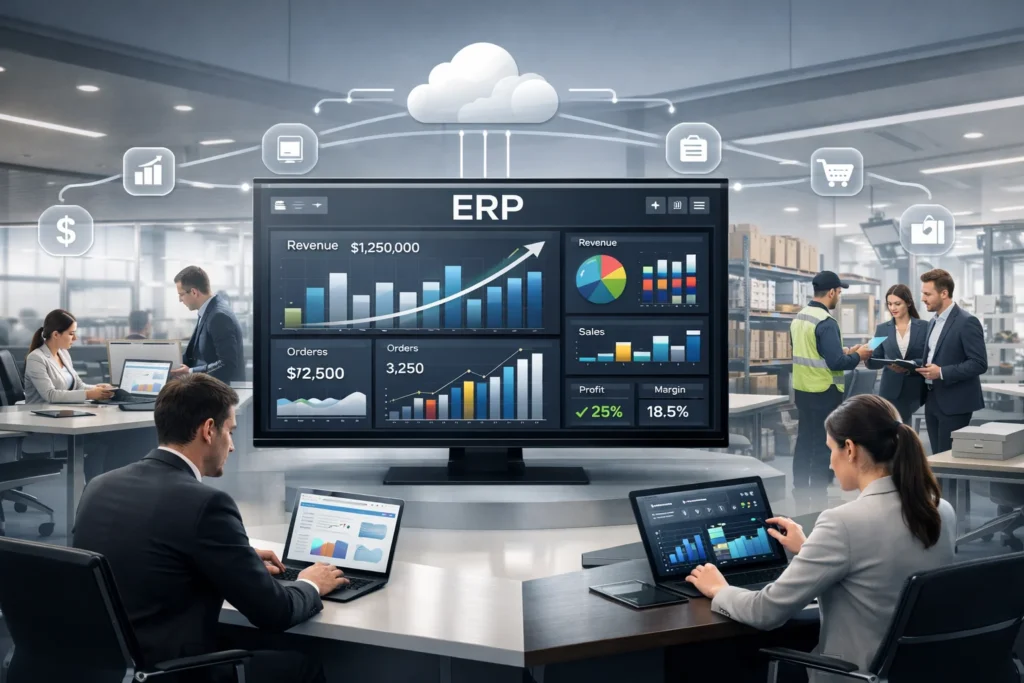
In today’s competitive and fast-moving business environment, growth brings complexity. As companies expand operations, increase order volumes, add new locations, or diversify product lines, managing data across multiple departments becomes increasingly challenging. This is where choosing the right ERP Software to Buy plays a critical role.
Enterprise Resource Planning (ERP) software integrates core business processes into a single, centralised system—helping organisations scale efficiently, reduce operational costs, and make smarter decisions. However, with dozens of ERP solutions available in the market, selecting the best ERP software to buy for scalable business growth requires careful evaluation.
This guide will help you understand what ERP software is, why it is essential for growing businesses, which features to prioritise, and how to choose an ERP solution that supports long-term scalability.
What Is ERP Software, and Why Growing Businesses Need It
ERP software is an integrated business management system that connects departments such as finance, inventory, sales, production, procurement, HR, and customer management into a unified platform. Instead of working with disconnected tools and spreadsheets, ERP provides real-time visibility across the organisation.
For growing businesses, ERP is not just a software upgrade—it is a foundation for sustainable growth.
Key Business Problems ERP Software Solves
As businesses scale, they often face challenges such as:
- Data silos between departments
- Manual processes causing delays and errors
- Poor inventory visibility and stock mismatches
- Inaccurate financial reporting
- Difficulty tracking costs and profitability
ERP software eliminates these issues by centralising data, automating workflows, and ensuring consistency across all business functions.
ERP as a Growth Enabler
The right ERP system enables growth by:
- Supporting higher transaction volumes without performance issues
- Standardising processes across teams and locations
- Reducing dependency on manual intervention
- Enabling faster, data-driven decision-making
Choosing the right ERP Software to Buy ensures your systems grow along with your business—without operational bottlenecks.
Key Factors to Consider Before Choosing ERP Software to Buy
Not all ERP systems are designed for scalability. Before making a decision, businesses must align ERP capabilities with current needs and future growth plans.
Scalability and Future-Readiness
A scalable ERP should allow you to:
- Add users without performance degradation
- Expand modules as business needs evolve
- Support multiple locations, warehouses, or branches
- Handle increasing data volumes smoothly
ERP software that cannot scale will require replacement sooner than expected, leading to additional costs and disruptions.
Industry-Specific Functionality
Different industries have unique operational requirements. Manufacturing, distribution, retail, engineering, and service-based businesses all need specialised ERP features.
When evaluating ERP software to buy, ensure it supports:
- Industry-specific workflows
- Compliance requirements
- Custom reporting relevant to your sector
Industry-ready ERP systems reduce customisation costs and implementation time.
Customisation vs Configuration
Customisation allows ERP software to adapt to your processes, but excessive customisation can increase costs and complexity.
A good ERP solution offers:
- Configurable workflows
- Modular architecture
- Flexible reporting tools
This balance ensures adaptability without sacrificing system stability.
Cloud-Based vs On-Premise ERP
Cloud ERP has become the preferred choice for scalable businesses due to:
- Lower upfront costs
- Automatic updates
- Anywhere, anytime access
- Easier scalability
On-premise ERP may still suit certain organisations, but cloud ERP offers greater flexibility for growing enterprises.
Essential Features to Look for in ERP Software to Buy
To support scalable growth, ERP software must include core functional modules that integrate seamlessly.
Financial Management & Accounting
Strong financial management is the backbone of any ERP system. Look for features such as:
- Real-time general ledger
- Accounts payable and receivable
- Cost tracking and budgeting
- Tax compliance and reporting
Accurate financial data enables better control and strategic planning.
Inventory & Supply Chain Management
Inventory inefficiencies can slow growth and increase costs. A robust ERP system should provide:
- Real-time stock visibility
- Multi-warehouse management
- FIFO/LIFO material tracking
- Demand planning and reorder automation
This ensures optimal inventory levels as operations expand.
Sales, CRM & Order Management
ERP software to buy should streamline the entire sales cycle, including:
- Lead and customer management
- Quotation and order processing
- Pricing and discount controls
- Order-to-dispatch automation
Integrated CRM improves customer experience while increasing sales efficiency.
Production & Operations Management
For manufacturing- and production-driven businesses, ERP must support:
- Production planning and scheduling
- Bill of Materials (BOM) management
- Resource and capacity optimisation
- Wastage and efficiency tracking
These features help maintain quality and productivity at scale.
Analytics, Reporting & Business Intelligence
Growth requires visibility. Modern ERP software should offer:
- Real-time dashboards
- Customisable reports
- KPI tracking
- Forecasting and trend analysis
Data-driven insights empower leaders to make proactive decisions.
Best ERP Software to Buy for Small, Medium, and Growing Enterprises
ERP requirements vary based on company size and growth stage.
ERP Software for Small Businesses
Small businesses need ERP systems that are:
- Affordable
- Easy to implement
- Focused on core modules
Entry-level ERP solutions help establish process discipline and prepare businesses for future growth.
ERP Software for Mid-Sized Businesses
Mid-sized organisations require:
- Advanced automation
- Department-level integrations
- Better reporting and controls
ERP software to buy at this stage should support scaling without major reimplementation.
ERP Software for Large and Rapidly Scaling Businesses
Large enterprises need ERP solutions capable of:
- High transaction volumes
- Multi-location and multi-currency support
- Advanced analytics and integrations
Enterprise-grade ERP systems ensure stability and performance even during rapid expansion.
How to Evaluate ERP Vendors Before You Buy
Choosing the right ERP vendor is as important as selecting the software itself.
Vendor Experience and Industry Expertise
Look for vendors with:
- Proven experience in your industry
- Case studies and client references
- Domain-specific implementation knowledge
Industry expertise reduces risks during deployment.
Implementation Support and Training
ERP implementation impacts the entire organisation. A reliable vendor provides:
- Structured implementation methodology
- User training and documentation
- Post-go-live support
Strong support ensures faster adoption and ROI.
Total Cost of Ownership (TCO)
When evaluating ERP software to buy, consider:
- Licensing or subscription fees
- Customisation and integration costs
- Training and support expenses
- Upgrade and maintenance costs
A lower upfront price may lead to higher long-term costs if scalability is limited.
Common Mistakes to Avoid When Choosing ERP Software to Buy
Many businesses face ERP failure due to avoidable mistakes, such as:
- Choosing ERP based solely on price
- Ignoring future scalability needs
- Not involving end users in selection
- Underestimating training and change management
Avoiding these pitfalls ensures long-term success.
How the Right ERP Software Accelerates Scalable Business Growth
When implemented correctly, ERP software delivers measurable benefits:
- Improved operational efficiency
- Reduced manual work and errors
- Better cost control and profitability
- Faster decision-making
- Enhanced customer satisfaction
ERP becomes a strategic asset rather than just an IT system.
Is Custom ERP Software a Better Option for Growing Businesses?
Some growing businesses outgrow off-the-shelf ERP solutions. In such cases, custom ERP software may be ideal.
Custom ERP offers:
- Process-specific workflows
- Greater flexibility
- Competitive differentiation
However, it requires careful planning to balance cost, scalability, and maintenance.
Final Checklist Before You Buy ERP Software
Before making a final decision, ensure:
- Your business requirements are clearly defined.
- The ERP supports future growth.
- Key features align with operations
- The vendor offers reliable support.
- The solution fits your long-term strategy.
Choosing the Best ERP Software to Buy for Long-Term Success
Selecting the best ERP Software to Buy is one of the most important decisions for any growing business. A scalable ERP system not only supports daily operations but also lays the foundation for future expansion, efficiency, and profitability.
Rather than viewing ERP as an expense, businesses should see it as a strategic investment—one that evolves with growth, adapts to change, and empowers organisations to compete effectively in a dynamic market.
Choosing the right ERP today ensures your business is ready for tomorrow.