
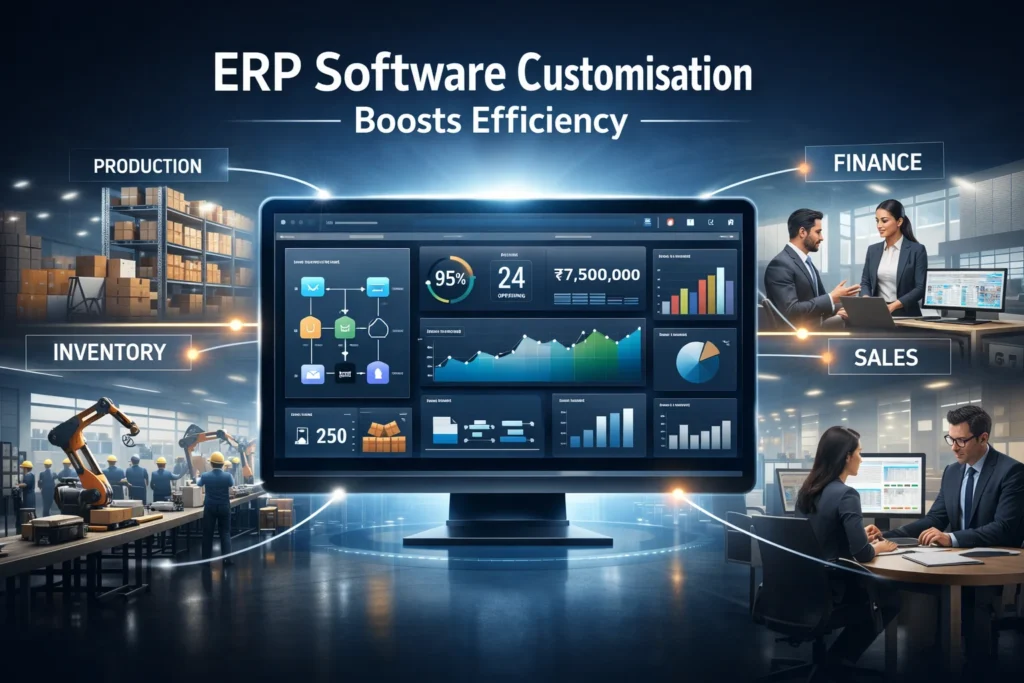
In today’s competitive business environment, efficiency is no longer a luxury—it’s a necessity. Companies are under constant pressure to reduce costs, improve productivity, and respond faster to market changes. While ERP systems are designed to streamline operations, many businesses discover that standard, off-the-shelf ERP software often falls short of their real operational needs.
This is where ERP Software Customisation becomes a game changer.
Instead of forcing your business to adapt to rigid software workflows, ERP software customisation allows the system to adapt to your processes. The result is faster operations, fewer errors, higher employee adoption, and significantly improved efficiency across departments.
In this blog, we’ll explore what ERP software customisation is, why standard ERP limits efficiency, and how customised ERP solutions help businesses unlock their true operational potential.
What Is ERP Software Customisation?
ERP Software Customisation refers to modifying or enhancing an ERP system so that it aligns perfectly with a company’s specific workflows, industry requirements, and business objectives. Unlike generic ERP solutions, customised ERP software is designed to support how your organization actually works.
Customisation may include:
- Custom modules and features
- Tailored workflows and approval processes
- Industry-specific logic
- Custom dashboards and reports
- Integrations with existing tools
Configuration vs Customisation in ERP
Many businesses confuse configuration with customisation, but they serve different purposes.
- ERP Configuration involves adjusting built-in settings such as user roles, permissions, tax rules, or basic workflows.
- ERP Software Customisation goes deeper—adding new functionalities, modifying logic, developing custom reports, or integrating third-party systems.
When your business processes are unique or industry-specific, configuration alone is not enough. That’s when ERP software customisation becomes essential.
Why Standard ERP Systems Limit Business Efficiency
Standard ERP systems are built to serve a broad audience. While this makes them versatile, it also means they often lack the flexibility needed for specialized operations.
Common Problems with Generic ERP Software
Without ERP software customisation, businesses frequently face:
- Manual workarounds and spreadsheets
- Duplicate data entry
- Process delays due to unnecessary steps
- Poor user adoption because the system feels complex
- Limited reporting and visibility
Instead of improving efficiency, a rigid ERP system can actually slow down operations and frustrate employees.
How ERP Software Customisation Boosts Efficiency
Customised ERP solutions remove bottlenecks by aligning software functionality with real business workflows. Here’s how ERP software customisation directly improves efficiency.
Workflow Automation Tailored to Your Business
With ERP software customisation, workflows are designed around your operations—not generic assumptions.
Benefits include:
- Automated approvals based on role, value, or department
- Elimination of redundant manual steps
- Faster task completion and reduced dependency on individuals
For example, a manufacturing company can automate production approvals based on machine capacity, raw material availability, and order priority—something standard ERP rarely handles well.
Faster Data Access and Real-Time Insights
One of the biggest advantages of ERP software customisation is custom dashboards and reports.
Instead of digging through irrelevant data:
- Managers see KPIs relevant to their role
- Teams access real-time operational insights
- Decision-making becomes faster and more accurate
Custom reports allow businesses to track exactly what matters—production efficiency, wastage, order fulfillment rates, or profit margins.
Reduced Operational Costs and Errors
ERP software customisation reduces inefficiencies that silently drain profits.
By:
- Eliminating duplicate data entry
- Reducing human errors
- Optimizing inventory and resource usage
Businesses experience lower operational costs and improved profitability over time.
Department-Wise Efficiency Gains with ERP Software Customisation
ERP software customisation doesn’t just improve efficiency at a high level—it transforms day-to-day operations across departments.
Production & Manufacturing
Manufacturing businesses benefit immensely from ERP software customisation.
Custom features include:
- Machine-wise production planning
- Custom Bills of Materials (BOMs)
- Real-time production tracking
- Wastage and consumption analysis
This leads to better capacity utilization, reduced downtime, and more accurate delivery timelines.
Inventory & Warehouse Management
Generic inventory modules often fail to handle real-world complexity. ERP software customisation solves this with:
- FIFO, batch, or serial tracking
- Location-based inventory control
- Custom stock valuation methods
- Automated reorder levels
The result is better stock visibility, reduced overstocking, and fewer stockouts.
Sales, CRM & Order Management
Customised ERP software streamlines the entire order lifecycle:
- Customized order approval workflows
- Customer-specific pricing and discounts
- Automated order-to-dispatch processes
- Sales performance dashboards
Sales teams spend less time on admin work and more time closing deals.
Finance & Accounting
Finance teams gain better control with ERP software customisation through:
- Custom tax structures
- Automated compliance reporting
- Tailored financial dashboards
- Department-wise cost tracking
This ensures accuracy, compliance, and faster financial closing.
Industry-Specific Benefits of ERP Software Customisation
Every industry has unique challenges, and ERP software customisation makes it possible to address them effectively.
Manufacturing & Engineering Companies
For engineering and manufacturing firms, ERP software customisation enables:
- Job-wise costing
- Production scheduling
- Material requirement planning (MRP)
- Quality checkpoints at every stage
This improves operational control and project profitability.
Automotive, Garment & Plastic Industries
Industries like automotive, garments, and plastics require process-specific ERP logic.
Custom ERP features include:
- Style-wise and size-wise tracking (garments)
- Batch and lot control (plastics)
- Vendor scheduling and dispatch automation (automotive)
ERP software customisation ensures compliance with industry standards while boosting efficiency.
ERP Software Customisation and Business Scalability
Efficiency today is important—but scalability tomorrow is critical.
A customised ERP system grows with your business by:
- Allowing new modules to be added easily
- Supporting multi-location and multi-branch operations
- Adapting to regulatory and market changes
Adapting ERP Software Customisation to Changing Needs
As your business evolves, ERP software customisation helps you:
- Launch new product lines
- Enter new markets
- Handle increased transaction volumes
This future-proofs your ERP investment.
Best Practices for Successful ERP Software Customisation
While ERP software customisation offers huge benefits, it must be done strategically.
Plan Before You Customise
- Document current workflows
- Identify inefficiencies and bottlenecks
- Define clear business objectives
Customisation should solve real problems—not just add features.
Avoid Over-Customisation
Over-customisation can increase complexity and maintenance costs.
Best practices include:
- Customise only what adds measurable value
- Ensure future upgrade compatibility
- Maintain system performance
A balanced approach ensures long-term success.
Cloud-Based ERP Software Customisation Advantages
Cloud ERP platforms make customisation faster, more flexible, and cost-effective.
Benefits include:
- Faster deployment
- Lower infrastructure costs
- Automatic updates
- Secure remote access
Cloud vs On-Premise ERP Customisation
| Factor | Cloud ERP | On-Premise ERP |
|---|---|---|
| Cost | Lower upfront | Higher upfront |
| Scalability | High | Limited |
| Maintenance | Vendor-managed | In-house |
| Customisation Speed | Faster | Slower |
For most growing businesses, cloud-based ERP software customisation offers better ROI.
Key Features to Look for in ERP Software Customisation
When choosing a customised ERP solution, ensure it offers:
- Modular architecture
- API and third-party integrations
- Role-based access control
- Custom report builders
- Mobile accessibility
These features ensure flexibility, security, and long-term usability.
Real-World Examples of ERP Software Customisation Improving Efficiency
Example 1: Manufacturing Unit
A mid-sized manufacturing company implemented ERP software customisation to automate production planning and inventory tracking. The result:
- 25% reduction in production delays
- 30% improvement in inventory accuracy
Example 2: Distribution Business
Custom order-to-dispatch workflows reduced manual errors and improved delivery timelines, leading to higher customer satisfaction.
How to Choose the Right ERP Software Customisation Partner
The success of ERP software customisation depends heavily on the implementation partner.
Look for:
- Industry experience
- Strong support and training
- Clear upgrade roadmap
- Proven customisation expertise
A reliable partner ensures your ERP system delivers consistent efficiency gains.
Conclusion: Why ERP Software Customisation Is a Smart Investment
ERP systems are meant to simplify operations—not complicate them. ERP Software Customisation ensures your ERP works the way your business works, not the other way around.
By automating workflows, improving visibility, reducing costs, and supporting scalability, customised ERP software delivers measurable efficiency gains across departments.
If your current ERP system feels restrictive, inefficient, or outdated, it may be time to invest in ERP software customisation—a strategic move that drives long-term growth and operational excellence.
Ready to boost efficiency with ERP software customisation?
Talk to an ERP expert today and transform the way your business operates.