
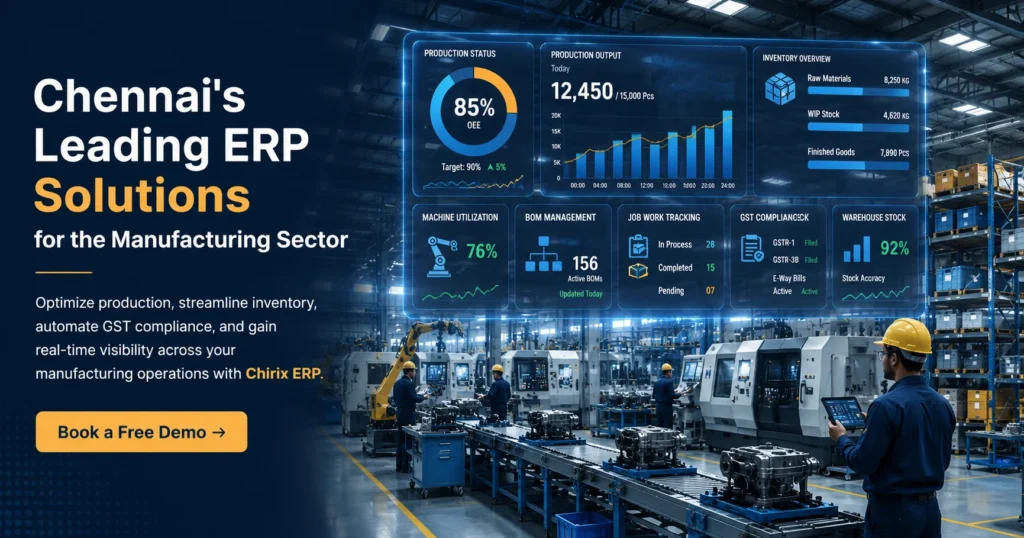
Chennai has long stood as one of India’s most important manufacturing corridors. From the automotive belt in Sriperumbudur and Oragadam to the auto-component ancillaries clustered around Ambattur and Guindy, the city’s factories run on tight production schedules, multi-tier supplier networks, and thin margins. Yet a surprising number of these manufacturers still track production, inventory, and compliance on spreadsheets and manual registers.
That gap is exactly where the right ERP system makes a difference. If you’re a Chennai-based manufacturer evaluating your options, this guide breaks down what to look for in Chennai’s leading ERP solutions for the manufacturing sector, the specific challenges local factories face, and how to choose a system that actually fits the way you operate — not a generic platform built for a different industry altogether.
Why Chennai’s Manufacturing Sector Needs Specialised ERP Solutions
Chennai’s Industrial Landscape
Chennai’s manufacturing base is unusually diverse for a single metro region. The automotive and auto-component cluster around Sriperumbudur and Oragadam sits alongside electronics manufacturing in the SIPCOT zones, heavy engineering units near Ambattur, and a dense network of job-work ancillaries that supply larger OEMs. Each of these segments has different production rhythms, but they share the same underlying problem: complex, multi-stage manufacturing processes that are hard to track without a purpose-built system.
Common Operational Bottlenecks
Talk to any mid-sized Chennai manufacturer, and the same complaints surface repeatedly:
- Bill of Materials (BOM) data scattered across Excel sheets that go out of date the moment a component substitution happens on the shop floor
- Stock reports that don’t match physical inventory because updates rely on someone remembering to log a transaction
- No real visibility into machine or line efficiency, so downtime and bottlenecks go unnoticed until they’ve already cost a delivery deadline.
- Manual data entry duplicated across production, inventory, and accounts — multiplying the chance of error at every handoff
Compliance and Regulatory Pressures
On top of operational challenges, Tamil Nadu manufacturers are also managing GST compliance, e-way bill generation, and job work documentation for subcontracted processes. When these are handled manually alongside production tracking, errors compound – a missed e-way bill or mismatched GST filing can hold up shipments or trigger penalties that a properly configured ERP would have caught automatically.
Key Features to Look for in ERP Solutions for Chennai Manufacturers
Not every ERP on the market is built with Indian manufacturing workflows in mind. Here’s what actually matters for a Chennai factory floor.
Real-Time Inventory and Stock Reporting Accuracy
Your ERP should reflect what’s physically on the shop floor and in the warehouse at any given moment, not what was true when someone last updated a spreadsheet. Real-time stock visibility prevents both overordering of raw materials and last-minute production stalls.
BOM and MRP Automation
Bill of Materials and Material Requirements Planning modules should update automatically as products are engineered or modified and should feed directly into procurement planning so a design change doesn’t mean manually rewriting five downstream documents.
OEE Tracking for Shop-Floor Visibility
Overall Equipment Effectiveness (OEE) tracking gives plant managers a clear read on machine uptime, performance, and quality rates, turning “the line felt slow today” into an actual number you can act on.
GST and Statutory Compliance Automation
Look for built-in GST invoicing, e-way bill generation, and return-ready reporting. This isn’t a nice-to-have; for Chennai manufacturers dealing with interstate shipments and multiple supplier tiers, it’s often the single biggest source of manual work an ERP can eliminate.
Job Work Order and Subcontracting Management
Many Chennai auto-component units operate as job-work ancillaries – sending semi-finished goods out for processes like plating, heat treatment, or machining before they come back for final assembly. An ERP built for this needs dedicated job work order tracking, not a workaround bolted onto a generic module.
How Chirix ERP Addresses Chennai’s Manufacturing Challenges
Chirix ERP was built specifically around manufacturing and packaging workflows, which means the features above aren’t add-ons; they’re the core of the system.
Eliminating Manual Data Entry
Production, inventory, and accounting data flow through a single system, so information entered once on the shop floor updates everywhere it’s needed – no re-keying data between departments.
End-to-End BOM and Job Work Order Tracking
Chirix tracks materials from raw input through job work stages to finished goods, giving Chennai ancillary units full visibility into where a batch is at any point in the subcontracting chain.
Scalable Architecture for SMEs to Mid-Sized Manufacturers
Whether you’re running a single production line or coordinating across multiple facilities, the system scales without requiring a full re-implementation.
ERP Implementation Roadmap for Chennai-Based Factories
Rolling out an ERP doesn’t need to disrupt production if it’s phased correctly.
1. Assessment and Process Mapping
Document current workflows, pain points, and compliance requirements before any configuration begins.
2. Data Migration and System Setup
Existing BOM, inventory, and vendor data are migrated and validated against the new system before go-live.
3. Staff Training and Change Management
Shop-floor staff and office teams are trained separately, since their touchpoints with the system differ significantly.
4. Go-Live and Post-Implementation Support
compliance and reporting reduce disruption to ongoing production.
Chirix ERP vs. Traditional/Legacy Systems: A Comparison
| Factor | Legacy/Manual Systems | Chirix ERP |
|---|---|---|
| Data entry | Manual, duplicated across departments | Single entry, system-wide sync |
| Stock accuracy | Dependent on manual updates | Real-time |
| GST/compliance | Manual filing, high error risk | Automated invoicing and e-way bills |
| Job work tracking | Spreadsheet-based, error-prone | Dedicated job work order module |
| Implementation time | Varies widely | Phased rollout, minimal production disruption |
Choosing the Right ERP Partner in Chennai
Questions to Ask ERP Vendors Before Signing
- Does the system support job work order tracking natively, or is it a workaround?
- How is GST and e-way bill compliance handled – automated or still requiring manual entry?
- What does a typical implementation timeline look like for a factory our size?
- What ongoing support is available after go-live?
Why Local Industry Context Matters
An ERP vendor familiar with Tamil Nadu’s manufacturing clusters – the ancillary structure around Chennai’s auto sector and the compliance patterns local units already navigate – will configure a system that fits from day one rather than one that needs months of customisation to become usable.
Conclusion
Chennai’s manufacturers don’t need a generic, one-size-fits-all ERP; they need a system built around BOM complexity, job work tracking, and GST compliance from the ground up. Chirix ERP is designed around exactly these requirements, giving Chennai-based factories a path away from manual spreadsheets and toward real-time, accurate operations.
Ready to see how Chirix ERP fits your production floor?
Frequently Asked Questions
The right choice depends on your specific production model. A system with strong BOM management, real-time inventory, and GST compliance built in, like Chirix ERP, is well suited to Chennai’s auto component and ancillary manufacturing base.
Costs vary based on the number of users, modules required, and data migration complexity. Most manufacturing ERP implementations for mid-sized Chennai units fall within a phased pricing model. Request a quote based on your specific setup.
Yes, a properly configured manufacturing ERP tracks materials sent out for job work processes (like plating or heat treatment) and back into finished goods, maintaining full traceability throughout.
Implementation timelines depend on scope, but a phased rollout – starting with inventory and BOM before adding compliance and reporting modules – typically minimises disruption to ongoing production.