
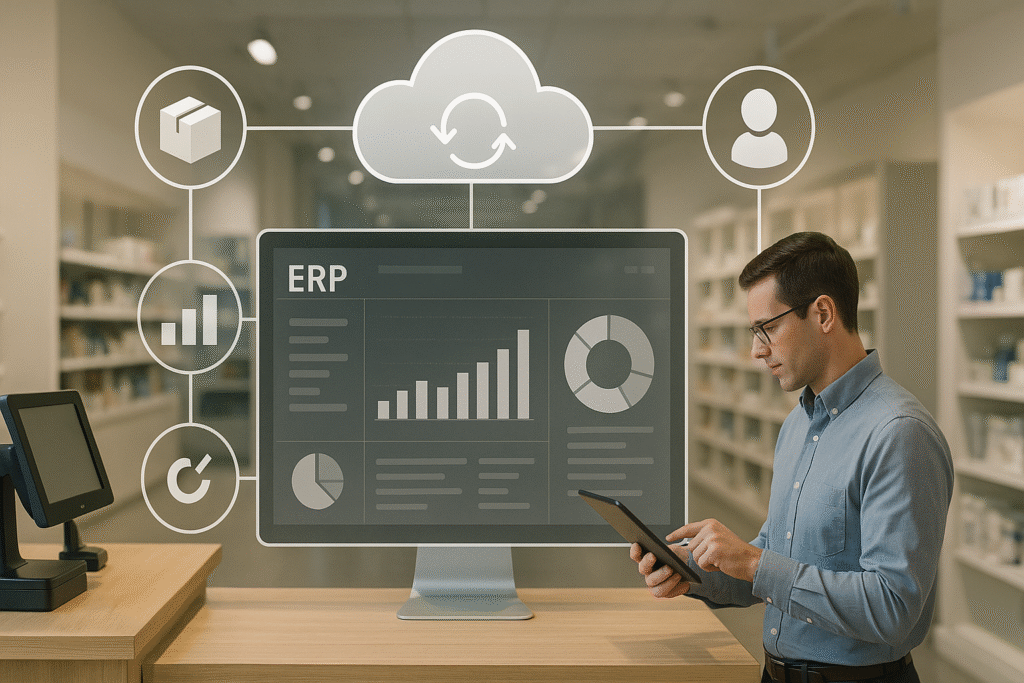
The retail industry is evolving at lightning speed. With rising customer expectations, complex supply chains, and the need for real-time inventory tracking, retailers can no longer rely on outdated, on-premise ERP systems. Instead, forward-thinking businesses are turning to Cloud-Based ERP Solutions to streamline operations, cut costs, and enhance agility.
But what’s driving this shift? From scalability and cost savings to AI-powered analytics, cloud ERP is transforming retail operations. In this blog, we’ll explore why more retailers are making the switch and how it can benefit your business.
What Are Cloud-Based ERP Solutions?
Enterprise Resource Planning (ERP) systems help retailers manage core operations—inventory, sales, procurement, and customer relationships. Traditional ERP systems run on local servers, requiring heavy IT maintenance and upfront costs.
Cloud-Based ERP Solutions, on the other hand, are hosted on remote servers and accessed via the internet. They offer:
- Remote accessibility – Manage your business from anywhere.
- Automatic updates – No need for manual software upgrades.
- AI-driven insights – Predictive analytics for smarter decision-making.
With cloud ERP, retailers gain a flexible, future-proof system that grows with their business.
Why Retailers Are Adopting Cloud-Based ERP Solutions
1. Cost Efficiency & Lower Upfront Investment
On-premise ERP systems require expensive hardware, licenses, and IT staff. Cloud-Based ERP Solutions operate on a subscription model, eliminating hefty upfront costs. Benefits include:
- Pay-as-you-go pricing – Scale up or down as needed.
- Reduced IT overhead – No need for in-house server maintenance.
- Faster ROI – Lower initial investment means quicker returns.
2. Scalability for Growing Retail Businesses
Whether you’re expanding to new locations or launching an eCommerce store, cloud ERP scales effortlessly. Key advantages:
- Add users, stores, or features with just a few clicks.
- Handle seasonal demand spikes (e.g., Black Friday sales) without slowdowns.
- Integrate new sales channels (Amazon, Shopify) seamlessly.
3. Real-Time Data & Improved Decision-Making
Retail success depends on accurate, up-to-date insights. Cloud ERP provides:
- Unified dashboards – Track sales, inventory, and supply chain in real time.
- AI-powered forecasting – Predict demand and optimize stock levels.
- Faster reporting – Make data-driven decisions without delays.
4. Enhanced Mobility & Remote Access
Modern retail isn’t confined to a physical store. Cloud ERP enables:
- Multi-location management – Oversee stores, warehouses, and online sales from one platform.
- Mobile access – Check inventory, approve orders, and analyze sales on the go.
- Hybrid workforce support – Empower remote teams with instant data access.
5. Seamless Integration with Retail Ecosystems
A disconnected tech stack leads to inefficiencies. Cloud ERP solves this by:
- Connecting POS, CRM, and eCommerce platforms (e.g., Shopify, WooCommerce).
- Automating workflows – From purchase orders to invoicing.
- Reducing manual errors – Sync data across all systems automatically.
6. Better Security & Compliance
Data breaches can cripple a retail business. Cloud ERP offers:
- Enterprise-grade encryption – Protect customer and financial data.
- Automatic backups – Prevent data loss from system failures.
- Compliance with retail standards – PCI-DSS, GDPR, and more.
Key Considerations When Choosing a Cloud-Based ERP Solution
Not all cloud ERP systems are created equal. When evaluating options, consider:
✔ Must-have features – Inventory tracking, omnichannel support, AI analytics.
✔ Vendor reputation – Look for proven retail ERP providers.
✔ Customization vs. out-of-the-box solutions – Does it fit your unique needs?
✔ Future-proofing – Can it integrate with AI, IoT, and blockchain?
Success Stories: Retailers Thriving with Cloud ERP
Case Study 1: Fashion Retailer Cuts Costs by 30%
A mid-sized apparel brand switched to a cloud ERP and reduced operational costs by 30% through automated inventory and procurement.
Case Study 2: Omnichannel Retailer Boosts Fulfillment Speed
By integrating their online and in-store systems, a home goods retailer improved order fulfillment speed by 40%.
Industry Stats:
- 65% of retailers plan to adopt cloud ERP within two years (Gartner).
- Businesses using cloud ERP see 25% faster decision-making (Forbes).
Future Trends in Cloud-Based ERP for Retail
The next wave of retail ERP innovation includes:
🔹 AI & Machine Learning – Smarter demand forecasting and dynamic pricing.
🔹 IoT Integration – Real-time tracking of inventory via smart sensors.
🔹 Blockchain for Supply Chains – Transparent, fraud-proof logistics.
Conclusion
The shift to Cloud-Based ERP Solutions is no longer optional—it’s a competitive necessity. Retailers that embrace cloud ERP gain cost savings, scalability, real-time insights, and security, positioning themselves for long-term success.
Is your retail business ready for the cloud ERP advantage? Explore the best solutions today and future-proof your operations!