
Why Job Costing Is the Biggest Profit Risk in Construction
Most construction companies don’t lose money because projects stop—they lose cash because cost overruns go unnoticed until it’s too late.
Materials are overused. Labour hours exceed estimates. Equipment sits idle. By the time management reviews monthly reports, margins are already gone.
This is why construction job costing is one of the most critical success factors in the industry—and why spreadsheets are no longer enough.
A construction ERP system with real-time job costing helps contractors track every rupee, every hour, and every material movement as the project progresses.
What Is Construction Job Costing?
Construction job costing is the process of tracking all costs associated with a specific project or job, including:
- Material consumption
- Labour wages and overtime
- Equipment and machinery usage
- Subcontractor payments
- Overheads and indirect expenses
The goal is simple: know exactly how much a project is costing at every stage and compare it against the estimated budget.
Without accurate job costing, profitability becomes guesswork.
Why Job Costing Fails in Most Construction Companies
Despite its importance, job costing often breaks down due to:
- Manual data entry from multiple sites
- Delayed updates from site teams
- Inaccurate material issue tracking
- Disconnected accounting and project data
- Lack of real-time visibility
The Spreadsheet Problem
Spreadsheets cannot update automatically across locations. They:
- Depend on manual inputs
- Create data silos
- Introduce errors
- Show problems only after costs are incurred
This reactive approach leads directly to cost overruns and shrinking margins.
How ERP Transforms Construction Job Costing
A construction-focused ERP system automates and integrates job costing across your entire operation.
Real-Time Cost Tracking
Every transaction—material issue, labour attendance, subcontractor bill, or equipment usage—is recorded against the project instantly.
This gives management live visibility into:
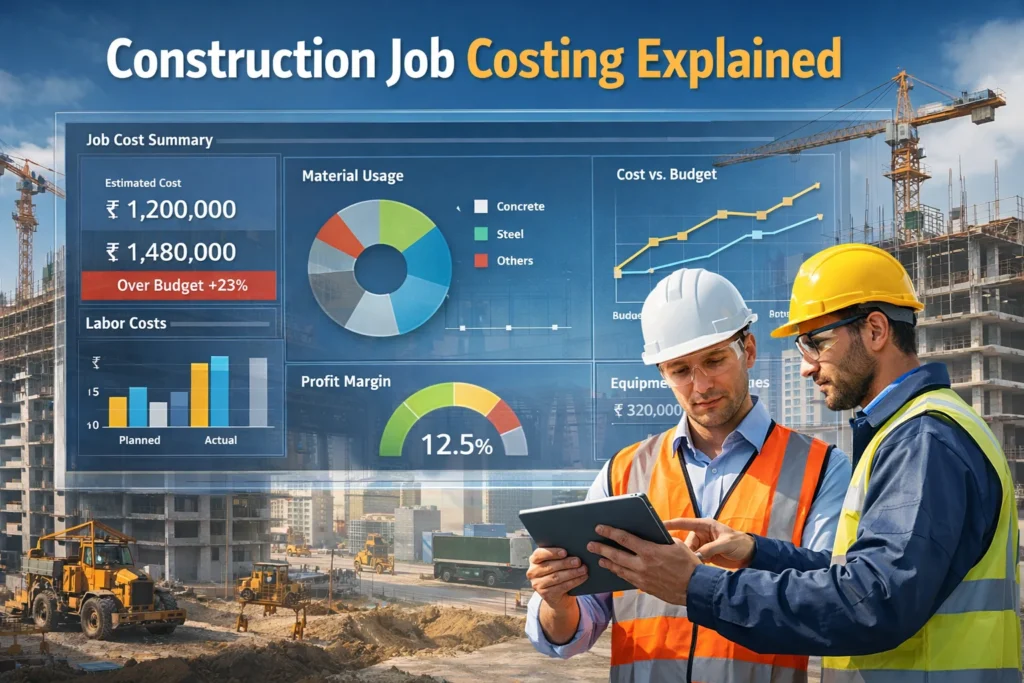
- Actual cost vs estimated cost
- Cost overruns by category
- Site-wise expense trends
Automated Cost Allocation
ERP automatically allocates:
- Labour costs based on attendance
- Material costs based on site usage
- Equipment costs based on runtime
- Overheads across projects
No manual calculations. No guesswork.
Real-World Scenario: Job Costing Before vs After ERP
Before ERP:
A contractor managing 6 residential projects relied on Excel for job costing. Material overuse and untracked labour overtime caused frequent overruns, discovered only during final billing.
After ERP:
With ERP-based job costing, site expenses were tracked daily. Cost deviations were flagged early, helping the company reduce cost leakage by 18% within one year.
Key Benefits of ERP-Based Job Costing in Construction
- Live project profitability visibility
- Early detection of cost overruns
- Accurate project-wise P&L
- Better budgeting for future projects
- Improved accountability at site level
Job Costing Across Different Construction Costs
Material Cost Control
ERP tracks:
- Material receipt
- Site-wise issues
- Consumption vs estimate
This prevents theft, wastage, and over-ordering.
Labour Cost Tracking
With attendance and payroll integration:
- Labour hours are recorded per project.
- Overtime is tracked accurately.
- Productivity gaps become visible
Equipment & Machinery Costing
ERP captures:
- Equipment utilisation
- Idle time
- Maintenance costs
This ensures equipment costs are correctly absorbed into project expenses.
Why Job Costing Accuracy Impacts Cash Flow
Poor job costing leads to:
- Incorrect progress billing
- Disputes with clients
- Delayed payments
- Cash flow stress
ERP ensures billing is backed by accurate, real-time cost data, improving collections and financial stability.
Who Needs ERP-Based Job Costing the Most?
- Contractors handling multiple projects
- EPC and infrastructure companies
- Real estate developers
- Firms struggling with margin control
If project profitability isn’t visible weekly—or daily—ERP-based job costing is no longer optional.
How Job Costing Fits into a Construction ERP System
Job costing works best when integrated with:
- Project management
- Inventory and procurement
- Accounting and finance
- Payroll and subcontractor billing
This is exactly what a construction ERP system delivers.
👉 Learn more about ERP Software for Construction Industry and how integrated job costing improves overall project control.
How Chirix ERP Software Simplifies Construction Job Costing
Chirix ERP Software is designed specifically for construction workflows.
What Makes Chirix ERP Different?
- Real-time project-wise job costing
- Automatic cost allocation across sites
- Integrated inventory, payroll, and finance
- Intuitive dashboards for management
Results You Can Expect
- Fewer cost overruns
- Higher project margins
- Faster, more accurate billing
- Better control across all sites
Take Control of Your Project Costs Before They Control You
Construction profitability is decided during execution, not at project completion.
With ERP-based job costing, you gain the visibility and control needed to protect margins and scale confidently.
Ready to See Real-Time Job Costing in Action?
✔ Track costs as they happen
✔ Identify overruns early
✔ Improve project profitability
👉 Request a Free Demo of Chirix ERP Software
👉 Talk to Our Construction ERP Experts Today