
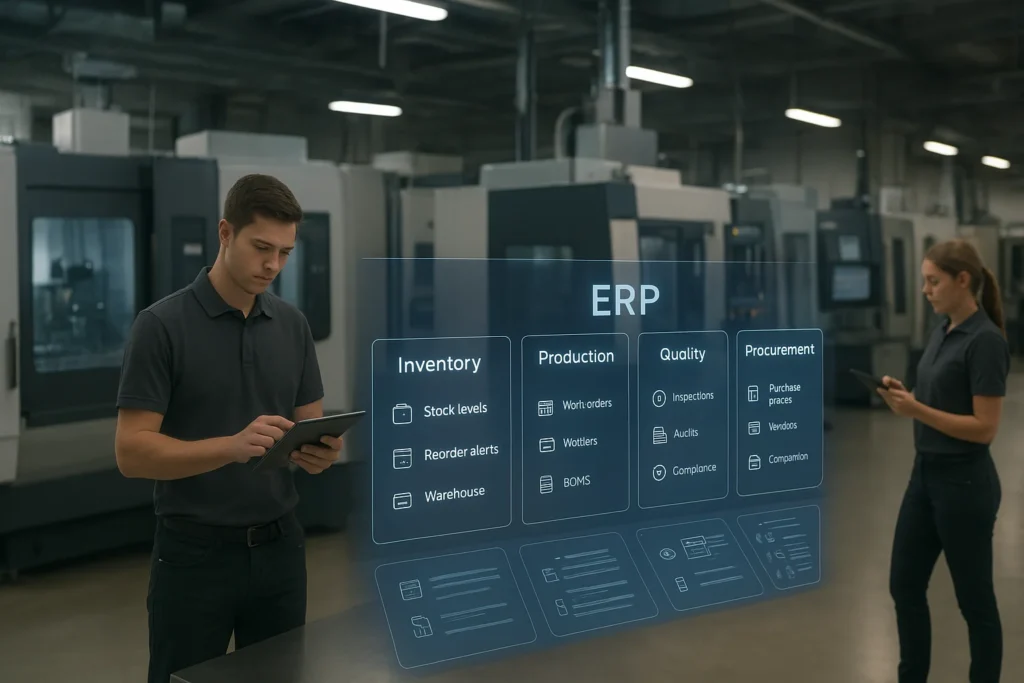
Small manufacturers today operate with tighter margins, higher customer expectations, and increasing competition. Manual spreadsheets, disconnected tools, and guesswork often lead to delays, stock issues, and costly errors.
This is where ERP software becomes essential.
A modern ERP for manufacturing industry helps small factories streamline operations, track inventory in real time, automate production planning, and run every department from a single dashboard. But with so many ERP systems available, choosing the right one can feel overwhelming.
This guide breaks down everything small manufacturers need to know before selecting an ERP — features, costs, benefits, and evaluation tips — so you can make an informed and confident decision.
Why Small Manufacturers Need an ERP System
Challenges Faced by Small Manufacturing Units
Small manufacturers often struggle with:
- Poor visibility into raw materials and finished goods
- Manual data entry and scattered spreadsheets
- Unpredictable production schedules
- Frequent stockouts or overstocking
- Inability to maintain consistent quality
- Late deliveries due to lack of planning
These inefficiencies directly affect profitability and customer trust.
How ERP for Manufacturing Industry Solves These Problems
A manufacturing-focused ERP can transform operations by offering:
- Real-time inventory tracking
- Automated material planning (MRP)
- Intelligent production scheduling
- Inbuilt quality checks throughout the workflow
- Centralised data for faster decision-making
- Seamless communication across departments
By integrating all processes, an ERP enables small manufacturing units to operate more efficiently and competitively.
Key Benefits of ERP for Small Manufacturers
End-to-End Operational Visibility
With a single source of truth, manufacturers gain a complete view of stock levels, work orders, machine capacity, and delivery schedules — reducing confusion and delays.
Cost Reduction & Better Resource Utilisation
ERP eliminates unnecessary expenses by:
- Reducing material wastage
- Improving manpower management
- Minimising rework and production bottlenecks
Faster, More Accurate Decision-Making
With real-time dashboards and analytics, manufacturers can proactively make decisions about production, costing, and demand forecasting.
Improved Customer Satisfaction
Better planning and execution lead to:
- On-time delivery
- Accurate order status updates
- Higher product quality
Result: stronger customer relationships and more repeat business.
Essential ERP Features Small Manufacturers Should Look For
Inventory & Material Management
A strong ERP must include:
- Real-time stock visibility
- Batch/lot tracking
- Minimum & maximum stock alerts
- Material issue and return tracking
Production Planning & Scheduling
The core of the manufacturing ERP includes:
- Detailed Bill of Materials (BOM)
- Material Requirements Planning (MRP)
- Work order management
- Production scheduling and capacity planning
- Machine & workforce allocation
Quality Management
Quality issues create losses. Look for:
- QC checkpoints
- Inspection templates
- Non-conformance tracking
- CAPA (Corrective and Preventive Actions)
Procurement & Vendor Management
A good ERP streamlines purchasing with:
- Automated purchase orders
- Vendor rating and comparison
- Price tracking
- Delivery monitoring
Finance & Accounting
Integrated accounting ensures accuracy:
- GST-ready invoicing
- Expense tracking
- Costing & profitability analysis
- Automatic financial reports
Sales & Order Management
To ensure fast and error-free deliveries:
- Order creation and tracking
- Dispatch planning
- CRM integration for lead and customer management
Mobile Accessibility
On-the-go access helps small manufacturing teams:
- Approve requests
- Track production updates
- Receive alerts instantly
How to Choose the Right ERP for Small Manufacturing Businesses
Understand Your Current Pain Points
Start by identifying your biggest challenges — inventory issues, production delays, or quality problems. Your ERP should directly address these pain points.
Prioritise Must-Have vs Nice-to-Have Features
Create a list of essential modules (inventory, production, purchase) and optional features depending on your industry (label printing, batch scanning, machine integration).
Evaluate Deployment Models: Cloud vs On-Premise
Compare both:
Cloud ERP
- Lower upfront cost
- Faster implementation
- Accessible from anywhere
- Automatic updates
On-Premise ERP
- Higher control
- Higher cost
- Requires IT team
For most small manufacturers, cloud ERP is more affordable and scalable.
Check Industry Fit
Make sure the ERP is specifically designed for the manufacturing industry, not a generic ERP modified later. Industry-ready ERPs reduce implementation time and customisation costs.
Consider Scalability
Choose an ERP that grows with your business — more users, additional machines, or a second plant should be easy to support.
Assess Vendor Support
Implementation and support are critical. Evaluate:
- Training quality
- Response time
- After-sales service
- Availability of updates
A powerful ERP with poor support can still fail.
Cost of ERP for Small Manufacturers
One-Time vs Ongoing Costs
Your ERP budget may include:
- Setup and implementation
- Data migration
- Customisation
- Training
- Monthly or annual subscription fees
Factors That Influence Pricing
- Number of users
- Modules required
- Cloud or on-premise deployment
- Customisations
- Machine integrations
- Support and AMC costs
Cloud-based solutions are typically more affordable for small businesses due to predictable monthly pricing.
Common Mistakes to Avoid When Selecting an ERP
Avoid these costly mistakes:
- Choosing the cheapest ERP instead of the right ERP
- Not involving your team during the selection process
- Ignoring integration needs (Tally, barcode scanners, CRM, machines)
- Skipping a live demo or trial
- Selecting a generic ERP not built for manufacturing
Top Questions to Ask ERP Vendors
Before finalising an ERP, ask:
- How long will the implementation take?
- Is your solution specifically built for the manufacturing industry?
- What level of customisation do you offer?
- Which integrations are available?
- What is the estimated ROI timeline?
- What type of support do you provide after implementation?
Conclusion
The right ERP for manufacturing industry can help small manufacturers run smarter, reduce costs, improve quality, and deliver products on time. As competition grows, investing in a manufacturing-focused ERP is no longer optional — it’s essential.
If you’re looking for a modern, scalable, and easy-to-use ERP built specifically for small factories, Chirix ERP is a strong option worth exploring.