
If your factory still runs on spreadsheets, disconnected tools, and manual inventory tracking, you’re leaving money on the table.
Production delays. Inventory mismatches. Missed deadlines. Communication breakdowns between teams.
These aren’t just operational headaches — they’re profit killers. And the frustrating part? Most of them are completely preventable.
That’s why manufacturers across industries are moving to ERP software not just to automate tasks but to build a workflow that actually scales.
But here’s the problem: choosing the wrong ERP creates bigger problems than the ones you started with, like expensive implementation failures, employee resistance, data migration nightmares, and systems you’ll outgrow in two years.
This guide gives you a clear, practical framework for choosing the right ERP for your manufacturing workflow without the guesswork.
What Is ERP for Manufacturing?
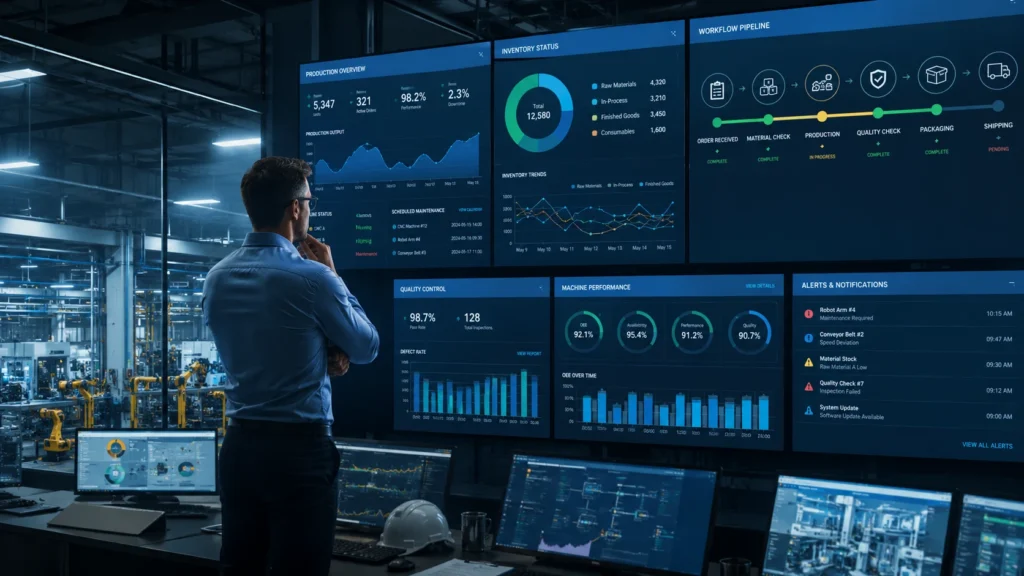
An ERP (Enterprise Resource Planning) system for manufacturing is a centralized software platform that connects production, inventory, procurement, finance, warehouse operations, and sales into one real-time system.
Instead of switching between five disconnected tools and making internal phone calls to track an order, everything lives in one place, updating in real time.
Think of it as the operational control center of your factory.
A manufacturing ERP system helps you:
- Track raw materials from procurement to production
- Monitor and schedule production runs
- Manage inventory levels across warehouses
- Automate purchase orders and supplier communication
- Reduce manual errors and duplicate data entry
- Generate real-time reports for faster decisions
The goal: faster production, fewer errors, lower costs, and complete operational visibility.
Why Are Manufacturers Switching to ERP Right Now?
Here’s a scenario that plays out in factories every week:
Your sales team confirms a large customer order. Production starts building the schedule. Then the warehouse discovers the raw materials are short, procurement was never notified, and the inventory records haven’t been updated in three days. Now your delivery deadline is at risk, and your customer is calling for updates.
This happens when departments operate in silos. And it keeps happening until something connects them.
When you implement an ERP system:
- Inventory changes update production automatically; no more surprise shortages
- Procurement orders trigger finance cost tracking — no more end-of-month reconciliation chaos
- Confirmed sales orders adjust production planning instantly; no more manual handoffs
That level of visibility doesn’t just reduce errors. It changes how your entire business operates.
5 Signs Your Manufacturing Business Needs an ERP Now
Many manufacturers wait too long before upgrading their systems. Here are the warning signs that your current setup is holding you back:
1. Your team depends on spreadsheets, WhatsApp updates, or manual approvals. Manual workflows create human errors, duplicate data, and communication delays, and they get exponentially worse as you grow.
2. Inventory problems keep surprising you. Unexpected stock-outs, over-purchases, or inventory mismatches that only get discovered during production are classic signs your inventory management needs an upgrade.
3. Production scheduling is becoming impossible. If you’re experiencing machine downtime, missed deadlines, or overloaded production floors, you likely don’t have the right planning tools.
4. You can’t get accurate reports without hours of manual data pulling. Real-time visibility should never require a full day of manual data consolidation.
5. Your teams operate like separate businesses. When sales, production, procurement, and finance aren’t working from the same data, costly miscommunications become routine.
If three or more of these sound familiar, it’s time to evaluate ERP options.
What to Look for in Manufacturing ERP Software
Not every ERP system is built for manufacturing. Many generic platforms lack the tools manufacturers actually need. Here’s what to evaluate before making a decision.
Does It Match Your Workflow?
This is the most important question and the one most buyers skip.
A textile manufacturer has fundamentally different operational needs than an automotive parts supplier, a food processor, or a pharmaceutical manufacturer.
Before you evaluate any ERP software, map your workflow first:
- Where are your biggest bottlenecks?
- Which processes still run manually?
- Which departments lose the most time?
- What data do you need to see every day?
The best ERP system is the one that fits your workflow, not the one with the longest feature list.
Cloud ERP vs. On-Premise ERP: Which Is Right for Manufacturers?
Cloud ERP On-Premise ERP Upfront cost Lower/Higher Implementation time Weeks to months Months to years Scalability Easy Complex Remote access Yes Limited IT maintenance Handled by vendor Your team Data control Shared infrastructure Full local ownership Best for Growing manufacturers Enterprise with strict compliance needs
The verdict for most manufacturers: Cloud ERP wins on speed, flexibility, and total cost of ownership — especially for businesses scaling production or adding locations.
The 5 ERP Features Every Manufacturer Needs
1. Production Planning and Scheduling Your ERP should help you build and optimize production schedules, allocate machines and labor properly, and reduce downtime. Without this, bottlenecks become recurring.
2. Inventory and Warehouse Management Look for real-time stock tracking, barcode management, batch and lot tracking, automated low-stock alerts, and inventory forecasting. Poor inventory management is one of the top profit killers in manufacturing.
3. Bill of Materials (BOM) Management For complex products, you need multi-level BOM structures, revision tracking, material planning, and production cost analysis. This directly impacts manufacturing accuracy and waste reduction.
4. Quality Control Management Your ERP should enable you to track inspections, monitor defect rates, maintain compliance documentation, and catch issues before they reach customers.
5. Supply Chain and Procurement Management Manage vendor relationships, automate purchase orders, track supplier performance, and monitor delivery timelines — all from one platform. A reliable supply chain starts with reliable software.
How to Evaluate and Choose an ERP Vendor
Choosing the right software is important. Choosing the right vendor is equally important.
Questions to Ask Every Vendor
“Do you have experience in my specific industry?” Some ERP platforms are built specifically for garment manufacturing, food processing, automotive production, pharmaceuticals, or process manufacturing. Industry-specific solutions typically require far less customization — which means faster implementation and lower costs.
“What is the total cost of ownership over 3 years?” Don’t only look at licensing fees. Factor in implementation costs, training, customization, integrations, maintenance, and future upgrades. Many manufacturers are surprised by what comes after the purchase.
“What does implementation actually look like, and how long does it take?” Ask for realistic timelines. Ask about data migration, employee training, and post-launch support. A vendor who can’t answer these questions clearly is a red flag.
“What does your support and onboarding process look like?” Even the best ERP fails if employees don’t adopt it. Strong vendors provide structured onboarding, role-based training, and ongoing technical support — not just a user manual.
Common Mistakes Manufacturers Make When Choosing ERP
Mistake 1: Choosing based only on price Cheap ERP systems often become expensive through missing features, poor scalability, hidden customization costs, and eventual replacement. Evaluate based on operational value, not just upfront price.
Mistake 2: Ignoring the people who’ll use it every day Your production team, warehouse staff, and floor managers will live inside this software. If the UI is clunky or the workflows don’t match how they actually work, adoption will suffer. Include them in demos.
Mistake 3: Choosing software that can’t scale with you Some ERP systems work fine for 20 employees and one warehouse but struggle at 100 employees and three locations. Choose a platform that can support your 3-year growth plan — not just where you are today.
Mistake 4: Skipping the demo or trial Never purchase ERP software without seeing it in action on your actual workflow. Request live demonstrations, trial environments, and real-use-case simulations.
How to Successfully Implement a Manufacturing ERP
ERP implementation isn’t just an IT project. It’s an operational transformation, and it needs to be treated like one.
Build a cross-functional implementation team Include people from production, finance, inventory, procurement, warehouse operations, and management. Top-down IT implementations without floor-level input consistently underperform.
Clean your data before migration. Duplicate records, outdated inventory data, and disorganized customer information will poison your new system from day one. Invest time in data cleanup before going live.
Train employees properly and don’t rush it. ERP adoption improves dramatically when employees understand why the system helps them, not just how to click through it. Role-specific, hands-on training is non-negotiable.
Monitor performance after launch. ERP optimization doesn’t end at go-live. Track production efficiency, inventory accuracy, reporting speed, and downtime reduction in the first 90 days. Use the data to continuously improve.
What Results Can You Expect From Manufacturing ERP Software?
Manufacturers who implement the right ERP system typically experience:
- Faster production cycle times
- Reduced inventory carrying costs
- Fewer production delays and missed deadlines
- Improved supplier and procurement management
- Real-time reporting that actually drives decisions
- Higher customer satisfaction and on-time delivery rates
More importantly, you gain complete operational visibility. And in manufacturing, visibility is everything. You can’t improve what you can’t see.
The Future of Manufacturing ERP: What’s Coming
Modern ERP platforms are evolving fast. The features becoming standard in 2025 and beyond include:
- AI-powered demand forecasting predicts stock needs before shortages occur
- Predictive maintenance — reduce unplanned machine downtime
- IoT integration — connect machines directly to your ERP for real-time production data
- Mobile accessibility — manage operations from anywhere, not just the office
- Smart factory connectivity — integrate ERP with automation, sensors, and robotics
Manufacturers who adopt modern ERP technology today are building the infrastructure to compete at scale tomorrow.
Frequently Asked Questions About ERP for Manufacturing
ERP stands for Enterprise Resource Planning. In manufacturing, it refers to integrated software that manages production, inventory, procurement, finance, and operations from a single platform.
Implementation timelines vary widely from a few weeks for cloud-based systems with standard configurations to 6–18 months for complex, heavily customized on-premise deployments. Your vendor should provide a realistic project timeline upfront.
ERP costs range significantly based on company size, number of users, deployment type, and customization requirements. Cloud ERP subscriptions for mid-sized manufacturers typically range from a few hundred to several thousand dollars per month. Always calculate the total cost of ownership, not just licensing.
MRP (Material Requirements Planning) focuses specifically on production scheduling and raw material planning. ERP is broader — it includes MRP functionality but also covers finance, HR, sales, procurement, and reporting across the entire business.
Yes. Many cloud ERP vendors offer scalable pricing specifically designed for small and mid-sized manufacturers. The operational benefits — reduced manual errors, better inventory visibility, faster reporting — apply at any production scale.
Is It Time to Invest in Manufacturing ERP?
If your business is struggling with inventory surprises, production delays, disconnected systems, or manual workflows that don’t scale, the answer is probably yes.
The right ERP for manufacturing isn’t just software. It’s the foundation for running a faster, smarter, more profitable operation.
The right system will:
- Fit your specific manufacturing workflow
- Solve the operational problems costing you the most right now
- Scale with you as production grows
- Help every team from the floor to finance work from the same real-time data.
In modern manufacturing, operational efficiency is no longer a nice-to-have. It’s your competitive advantage.
Ready to find the right ERP for your manufacturing workflow? Start by mapping your current bottlenecks, and look for a platform built to solve them.