
Tamil Nadu has long been one of India’s strongest manufacturing hubs, home to thousands of small and mid-size manufacturers across engineering, textiles, automotive, leather, food processing, chemicals, plastics, printing, and electronics. Cities like Chennai, Coimbatore, Tiruppur, Hosur, Salem, Erode, Madurai, and Sivakasi are driving industrial growth and contributing significantly to the state’s economy.
However, as competition increases and customer expectations evolve, many manufacturers still rely on spreadsheets, manual records, or disconnected software to manage production, inventory, purchasing, and finance. These outdated systems often lead to delays, inventory mismatches, higher operational costs, and limited visibility into business performance.
This is where ERP for Small & Mid-Size Manufacturers in Tamil Nadu becomes a game-changer. A modern Enterprise Resource Planning (ERP) system connects every department—from purchasing and inventory to production, sales, finance, and quality control—on a single platform. With real-time data and automated workflows, manufacturers can streamline operations, reduce costs, and make faster, data-driven decisions.
In this guide, we’ll explore why ERP is essential for manufacturers in Tamil Nadu, the key features to look for, the benefits it offers, and how to choose the right solution for your business.
Why Small & Mid-Size Manufacturers in Tamil Nadu Need ERP Software
Small and medium-sized manufacturing businesses are under constant pressure to produce more, reduce costs, and meet customer deadlines. While large enterprises often have dedicated systems to manage operations, many SMEs still depend on manual processes that limit efficiency and growth.
An ERP system provides a centralised platform that integrates every business function, helping manufacturers operate with greater accuracy and control.
Growing Competition Requires Smarter Operations
Manufacturers in Tamil Nadu compete not only within India but also in global markets. Customers expect faster deliveries, consistent product quality, and competitive pricing. Businesses that rely on manual processes often struggle to keep pace with these demands.
ERP enables manufacturers to optimise production planning, monitor inventory in real time, and improve overall operational efficiency.
Manual Processes Create Daily Challenges
Common issues faced by manufacturers include:
- Inventory discrepancies
- Delayed purchase orders
- Production scheduling conflicts
- Duplicate data entry
- Difficulty tracking work-in-progress
- Limited reporting capabilities
These challenges consume valuable time and increase operational costs.
Digital Manufacturing Is the Future
With the rise of Industry 4.0 and digital transformation, manufacturers are increasingly adopting technologies that improve visibility and automation. A cloud-based ERP system provides the foundation for a smarter, more connected manufacturing operation.
Common Challenges Faced by Manufacturers in Tamil Nadu
Every manufacturing business faces unique operational challenges, but many SMEs experience similar issues that affect productivity and profitability.
Inventory Mismanagement
Without accurate inventory tracking, businesses often experience the following:
- Overstocking of slow-moving materials
- Shortages of critical raw materials
- Increased storage costs
- Production delays due to stock-outs
ERP provides real-time inventory visibility, ensuring the right materials are available when needed.
Production Planning Issues
Manual production planning can result in the following:
- Machine idle time
- Inefficient scheduling
- Missed delivery deadlines
- Poor resource utilisation
ERP helps optimise production schedules based on machine capacity, workforce availability, and material readiness.
Purchasing Inefficiencies
A lack of visibility into procurement often leads to the following:
- Late purchase orders
- Vendor delays
- Emergency purchases at higher costs
- Inconsistent supplier performance
ERP automates procurement workflows and improves supplier management.
Limited Business Visibility
Business owners often struggle to answer questions like the following:
- Which products are most profitable?
- What is today’s production output?
- Which orders are delayed?
- What inventory needs replenishment?
ERP dashboards provide instant access to critical business information.
What Is ERP for Small & Mid-Size Manufacturers in Tamil Nadu?
Enterprise Resource Planning (ERP) is business management software that integrates multiple departments into a single, unified system. Instead of using separate applications for inventory, accounting, production, and sales, manufacturers can manage all operations from one platform.
An ERP system eliminates data silos, reduces manual work, and ensures that every department works with accurate, real-time information.
How ERP Connects Your Business
A manufacturing ERP typically integrates:
- Sales and customer management
- Purchase management
- Inventory management
- Production planning
- Warehouse operations
- Quality control
- Finance and accounting
- Human resource management
This integration improves communication, enhances productivity, and supports better decision-making.
Cloud ERP vs Traditional ERP
Cloud ERP offers several advantages over traditional on-premise systems:
| Cloud ERP | Traditional ERP |
|---|---|
| Lower upfront investment | High infrastructure costs |
| Accessible from anywhere | Limited to office network |
| Automatic updates | Manual upgrades |
| Easy scalability | Costly expansion |
| Faster implementation | Longer deployment time |
For most SMEs, cloud ERP is a more flexible and cost-effective choice.
Key Features Every Manufacturing ERP Should Have
Choosing the right ERP starts with understanding the features that matter most for manufacturing businesses.
Production Planning and Scheduling
Efficient production scheduling ensures machines, labour, and materials are used effectively, reducing downtime and improving delivery performance.
Inventory Management
Real-time inventory tracking helps businesses maintain optimal stock levels, reduce waste, and improve order fulfilment.
Purchase Management
Automated purchase requisitions, supplier management, and approval workflows simplify procurement and reduce delays.
Sales and Order Management
Track customer enquiries, quotations, sales orders, and deliveries from a single system.
Warehouse Management
Manage multiple warehouses, bin locations, stock transfers, and inventory movements with greater accuracy.
Quality Control
Monitor product quality at every stage of production to reduce defects and improve customer satisfaction.
Barcode and Batch Tracking
Barcode scanning and batch traceability improve inventory accuracy and product tracking.
Financial Accounting
Integrated accounting modules provide real-time financial reports, GST compliance, and cash flow visibility.
Real-Time Dashboards
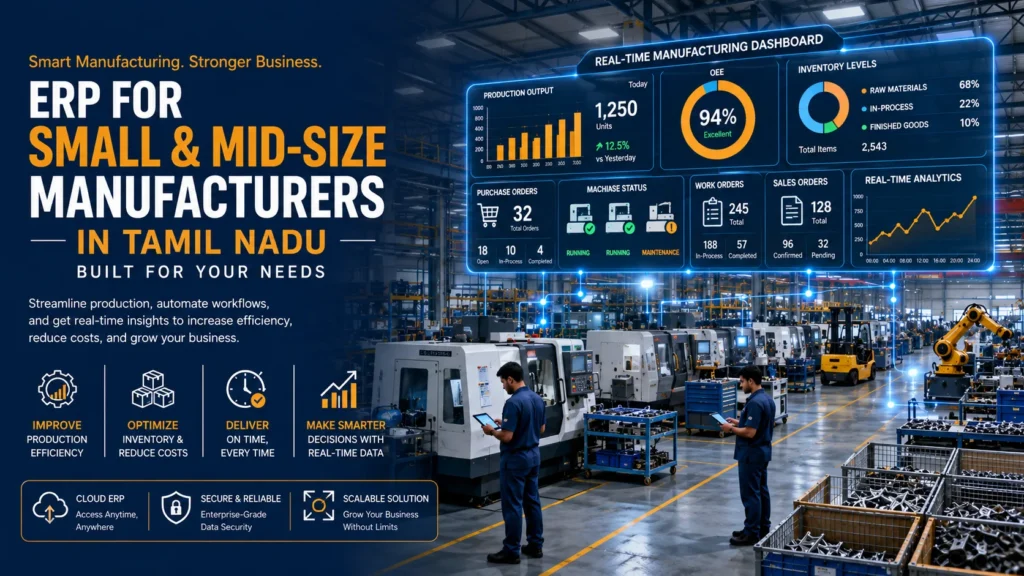
Interactive dashboards display production output, inventory status, purchase orders, sales performance, and financial metrics in one place.
Benefits of ERP for Small & Mid-Size Manufacturers in Tamil Nadu
Implementing an ERP system offers significant operational and financial benefits.
Increase Productivity
Automation reduces repetitive tasks, allowing employees to focus on higher-value activities.
Reduce Manufacturing Costs
Better planning minimises waste, reduces inventory carrying costs, and improves resource utilisation.
Improve Inventory Accuracy
Real-time inventory updates reduce stock discrepancies and improve material availability.
Faster Decision-Making
Live dashboards provide managers with accurate information for quicker and better decisions.
Better Customer Satisfaction
Improved planning and order tracking lead to on-time deliveries and higher customer confidence.
Scalable Growth
ERP grows with your business, supporting new products, locations, and production lines without disrupting operations.
Industries in Tamil Nadu That Benefit Most from ERP
Manufacturing ERP solutions are suitable for a wide range of industries, including:
- Engineering and fabrication
- Textile and garment manufacturing
- Auto components
- Food processing
- Printing and packaging
- Chemical manufacturing
- Plastic and rubber products
- Leather manufacturing
- Electrical and electronics
- Furniture manufacturing
- Paper and board industries
- Fireworks manufacturing
- Fishnet manufacturing
Each industry can customise ERP modules to match its production processes and business requirements.
How to Choose the Right ERP Solution
Not every ERP system is designed for manufacturing SMEs. Consider the following factors before making a decision:
- Industry-specific functionality
- Easy implementation and user-friendly interface
- Cloud accessibility
- Mobile support
- Customisation capabilities
- Local implementation and support
- Affordable pricing
- Scalability for future growth
Selecting an ERP vendor with manufacturing expertise ensures a smoother implementation and better long-term value.
Best Practices for ERP Implementation
A successful ERP implementation requires careful planning.
- Define clear business objectives.
- Map existing business processes.
- Clean and organise data before migration.
- Train employees thoroughly.
- Start with essential modules and expand gradually.
- Monitor key performance indicators after implementation.
With the right approach, businesses can achieve faster adoption and maximise their return on investment.
Frequently Asked Questions
ERP is an integrated software solution that helps manufacturers manage production, inventory, purchasing, sales, finance, and other business operations from a single platform.
Yes. Cloud-based ERP solutions offer flexible pricing models, making them accessible to small and medium-sized businesses without requiring significant upfront investments.
Implementation timelines vary depending on business size and complexity. Many SMEs can complete implementation within a few weeks to a few months.
Yes. Most modern ERP systems include GST-compliant invoicing, tax calculations, and financial reporting features.
Engineering, textiles, automotive, chemicals, plastics, printing, food processing, leather, furniture, and many other manufacturing sectors benefit from ERP solutions.
Conclusion
For small and mid-size manufacturers in Tamil Nadu, staying competitive requires more than hard work—it requires smarter processes, real-time visibility, and efficient resource management. Manual systems and disconnected software can no longer keep pace with the demands of modern manufacturing.
ERP for Small & Mid-Size Manufacturers in Tamil Nadu provides an integrated platform that streamlines production, inventory, purchasing, sales, finance, and quality management. By automating routine tasks, reducing errors, and delivering real-time insights, ERP empowers manufacturers to improve productivity, control costs, and make informed business decisions.
Whether you’re an engineering company in Coimbatore, a garment manufacturer in Tiruppur, an automotive supplier in Chennai, or a food processing business in Madurai, implementing the right ERP solution can lay the foundation for sustainable growth and long-term success.
If you’re ready to modernise your operations and build a more efficient manufacturing business, now is the time to explore an ERP solution tailored to your industry’s unique needs. A well-implemented ERP system isn’t just software—it’s a strategic investment in the future of your business.