
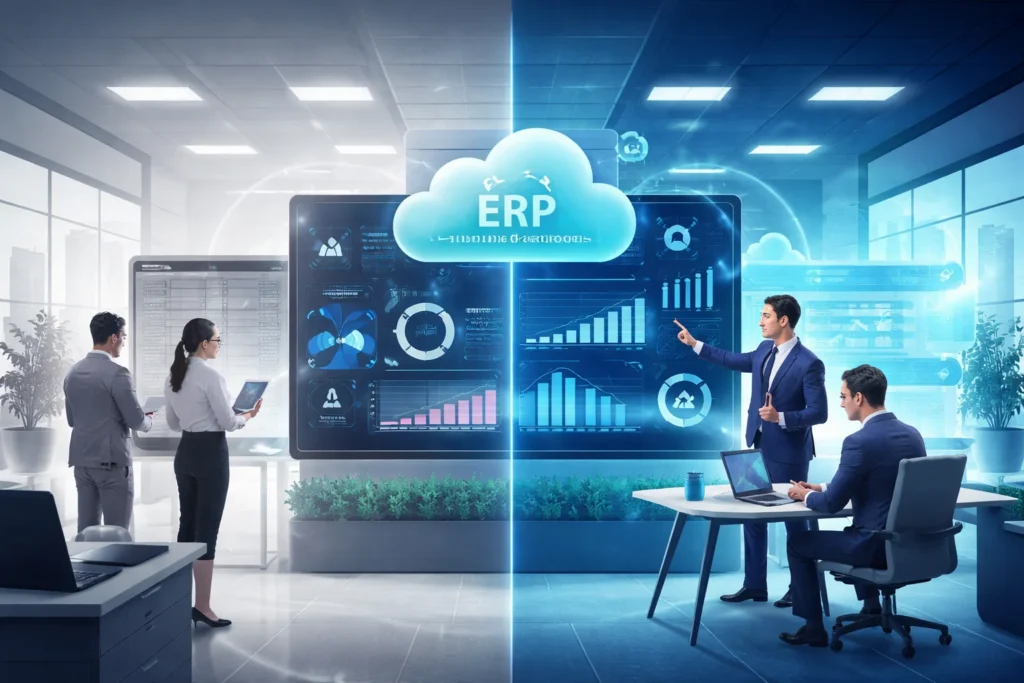
The Silent Cost of Staying Outdated
What if your business is losing money every single day… and you don’t even realise it?
In 2026, this is the reality for companies still relying on outdated systems. While competitors are leveraging automation, AI, and real-time insights, many businesses are stuck with slow processes, disconnected data, and costly inefficiencies.
According to industry reports, over 70% of growing businesses are shifting to cloud-based ERP systems to stay competitive.
These evolving ERP Trends are not just upgrades—they are complete business transformations.
👉 The question is no longer “Should you upgrade?”
👉 It’s “How much longer can you afford not to?”
In this guide, you’ll discover:
- The top ERP trends in 2026
- Real signs your system is holding you back
- How upgrading can unlock growth, efficiency, and profit
What Are ERP Trends and Why Do They Matter in 2026?
ERP Trends refer to the latest innovations shaping how businesses manage operations, data, and decision-making.
But here’s the shift:
👉 ERP is no longer just software.
👉 It’s now your business intelligence engine.
Why ERP Is Evolving Faster Than Ever
- Digital Transformation is accelerating across industries
- AI & Automation are replacing manual processes
- Remote Work demands cloud accessibility
- Data Overload requires real-time insights
Simple truth:
Businesses that adapt to ERP trends grow faster. Those that don’t… struggle to survive.
Top ERP Trends Transforming Businesses in 2026
1. Cloud-First ERP Adoption
Imagine accessing your entire business—from sales to inventory—on your phone.
That’s the power of cloud ERP.
- No expensive infrastructure
- Real-time access anywhere
- Easy scalability as you grow
Stat Insight: Businesses using cloud ERP report 20–30% lower IT costs.
2. AI-Powered ERP Systems
AI is turning ERP into a decision-making powerhouse.
- Predict demand before it happens
- Automate repetitive tasks
- Detect risks early
Instead of reacting, you start anticipating.
3. Industry-Specific ERP Solutions
Generic ERP systems are fading.
Modern ERP is tailored for:
- Manufacturing
- Retail
- Distribution
- Healthcare
Result: Faster implementation + higher ROI
4. Mobile ERP & Remote Control
What if you could:
- Approve orders instantly
- Track performance live
- Manage teams remotely
That’s why mobile ERP adoption is exploding in 2026.
5. Seamless Integration with Smart Technologies
ERP is no longer standalone.
It now connects with:
- CRM systems
- HR software
- IoT devices
- Analytics tools
Creating a fully connected business ecosystem
6. User-Friendly Dashboards (No More Complexity)
Old ERP systems were complicated.
Now?
- Clean interfaces
- Easy navigation
- Minimal training
Your team actually wants to use it.
7. Advanced Security & Compliance
With cyber threats rising, security is critical.
Modern ERP offers:
- End-to-end encryption
- Role-based access
- Compliance-ready frameworks
Protecting your business as it grows.
Signs Your Business Needs to Upgrade Your ERP (Right Now)
Be honest—how many of these apply to you?
- You still depend on Excel or manual work
- Reports take hours (or days)
- Your systems don’t “talk” to each other
- You face frequent errors or delays
- Your business is growing… but your system isn’t
If you said yes to even 2–3, your ERP is already slowing you down.
The Hidden Costs You’re Not Seeing
Outdated ERP systems quietly drain your business:
- Lost productivity
- Missed opportunities
- Poor decision-making
- Increased security risks
Reality check:
Staying outdated is often more expensive than upgrading.
Real Business Impact of ERP Trends
A mid-sized retail company struggled with:
- Inventory mismatches
- Delayed reporting
- Poor customer experience
After upgrading to a modern ERP system:
- Inventory errors dropped by 35%
- Reporting time reduced by 60%
- Sales increased due to better insights
👉 This is what happens when you align with modern ERP trends.
Benefits of Upgrading to a Modern ERP System
Upgrading isn’t just a tech move—it’s a growth strategy.
What You Gain:
- Faster operations with automation
- Real-time data for smarter decisions
- Reduced operational costs
- Better customer satisfaction
- Unlimited scalability
👉 In short: More control, less chaos.
How to Choose the Right ERP System in 2026
Choosing the wrong ERP can cost you time and money.
What to Look For:
- Industry-specific features
- Customisation options
- Integration capabilities
- Strong vendor support
Cloud vs On-Premise ERP: Quick Decision Guide
| Feature | Cloud ERP | On-Premise ERP |
|---|---|---|
| Cost | Lower upfront | High upfront |
| Flexibility | High | Limited |
| Access | Anywhere | Office-only |
| Maintenance | Vendor-managed | Manual |
Verdict: Cloud ERP is the future.
ERP Implementation Best Practices (Avoid Costly Mistakes)
A successful upgrade depends on execution.
✅ Do This:
- Set clear goals
- Train your team
- Plan data migration carefully
- Choose the right partner
❌ Avoid This:
- Rushing implementation
- Ignoring user adoption
- Underestimating costs
Future of ERP: What Comes After 2026?
The evolution doesn’t stop here.
Next wave of ERP innovation:
- AI-driven autonomous systems
- Hyperautomation across departments
- Personalised dashboards
- Sustainability-focused ERP
Soon, ERP won’t just support decisions—it will make them for you.
The Cost of Waiting Is Higher Than Upgrading
Every day you delay upgrading, you risk:
- Falling behind competitors
- Losing efficiency
- Missing growth opportunities
Meanwhile, smart businesses are already leveraging ERP Trends to scale faster and operate smarter.
Ready to upgrade your business for 2026?
Don’t wait until inefficiencies become losses.
Take the next step today:
- Evaluate your current system
- Identify gaps
- Move to a smarter ERP solution
💬 Want expert help? Start with a free ERP consultation and discover how your business can scale faster with the right system.
Great insights on the evolving ERP landscape—especially the shift toward AI-driven automation, cloud-first architectures, and composable ERP systems. The upgrade guidance is particularly valuable for organizations planning modernization, as 2026 clearly marks a transition from traditional systems to intelligent, real-time decision platforms.