
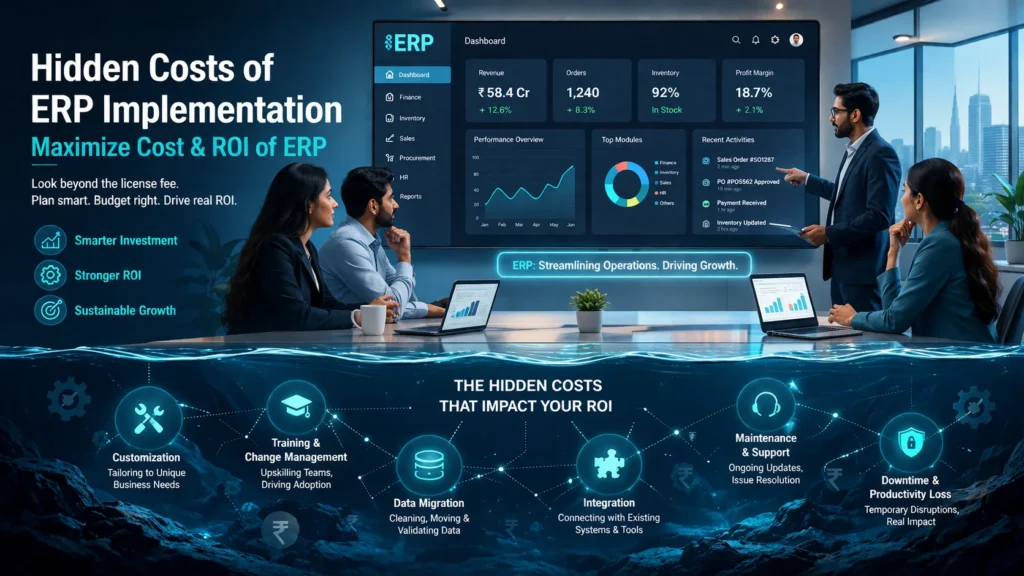
The Real Price of ERP Isn’t What You Think
ERP systems are often seen as a powerful solution to streamline operations, improve efficiency, and boost profitability. But here’s the reality—many businesses underestimate the true Cost & ROI of ERP, leading to budget overruns and delayed returns.
While vendors highlight attractive pricing, the hidden costs of ERP implementation can quietly drain your resources if not planned properly.
In this guide, you’ll discover:
- The real (often overlooked) costs of ERP
- How these impact your ROI
- Practical strategies to budget smartly and avoid surprises
What is ERP Implementation Cost?
ERP implementation cost is more than just buying software—it’s the total investment required to deploy, customise, and maintain the system.
Direct vs. Indirect Costs
Direct Costs:
- Software licences or subscription fees
- Hardware and infrastructure
- Implementation partner charges
Indirect Costs:
- Employee training
- Productivity loss during transition
- Ongoing maintenance
Why Businesses Underestimate ERP Costs
Many companies focus only on initial pricing and ignore long-term expenses. This leads to:
- Budget overruns
- Delayed implementation
- Lower-than-expected ROI
Understanding the full Cost & ROI of ERP helps avoid these pitfalls.
Hidden Costs of ERP Implementation
These are the expenses that most businesses don’t plan for—but should.
1. Customisation Costs
Every business has unique workflows, and customising ERP to fit them can be expensive.
- Over-customisation increases complexity
- Higher development and maintenance costs
- Longer implementation timelines
2. Data Migration Expenses
Migrating data from legacy systems is rarely simple.
- Data cleaning and formatting
- Risk of data duplication or loss
- Additional tools or consultants required
3. Employee Training & Change Management
Your team needs time and training to adapt.
- Training sessions and workshops
- Temporary drop in productivity
- Resistance to change
4. Integration with Existing Systems
ERP often needs to connect with:
- CRM tools
- Accounting software
- Third-party applications
Integration can significantly increase costs.
5. Ongoing Maintenance & Support
ERP is not a one-time investment.
- Annual maintenance fees
- Software updates
- Technical support
6. Downtime & Productivity Loss
During implementation:
- Operations may slow down
- Employees take time to adjust
- Revenue can be temporarily impacted
7. Vendor Lock-in Costs
Switching ERP vendors later can be costly and complex.
- Data migration challenges
- Contractual limitations
- Retraining employees
How Hidden Costs Affect the Cost & ROI of ERP
Hidden costs directly impact your return on investment.
Reduced ROI
Unexpected expenses increase total cost, lowering profitability.
Delayed ROI
Longer implementation timelines delay benefits.
Higher Total Cost of Ownership (TCO)
The actual cost becomes much higher than planned.
How to Measure ERP ROI Accurately
To calculate ROI effectively, consider:
- Increased operational efficiency
- Reduced manual work
- Better decision-making through real-time data
- Improved customer satisfaction
Common ROI Mistakes
- Ignoring hidden costs
- Focusing only on short-term gains
- Not tracking performance metrics
How to Budget for ERP Implementation
Smart budgeting is key to maximising the Cost & ROI of ERP.
1. Create a Realistic Budget
- Include all direct and indirect costs
- Add a contingency buffer (10–20%)
2. Choose the Right ERP Model
Cloud ERP:
- Lower upfront cost
- Subscription-based
On-Premise ERP:
- Higher initial investment
- Greater control
3. Work with Experienced Implementation Partners
An experienced partner can:
- Reduce costly mistakes
- Speed up implementation
- Improve ROI
4. Avoid Over-Customisation
- Focus on essential features first
- Scale gradually
5. Plan Training & Change Management
- Invest in employee training
- Ensure smooth adoption
Cost Optimisation Strategies
Phased Implementation
Implement ERP in stages to reduce financial pressure.
Leverage Cloud Solutions
Cloud ERP reduces:
- Infrastructure costs
- Maintenance expenses
Monitor Performance Regularly
Track KPIs to:
- Measure ROI
- Identify cost inefficiencies
ERP Cost Breakdown Example
Here’s a typical cost distribution:
- Software: 30%
- Implementation: 25%
- Training: 15%
- Maintenance: 20%
- Miscellaneous: 10%
Estimated ROI Timeline
- Short-term (6–12 months): Efficiency improvements
- Long-term (1–3 years): Full ROI realisation
Key Takeaways
- Hidden costs can significantly impact ERP budgets.
- Understanding the full Cost & ROI of ERP is essential
- Smart planning leads to better financial outcomes.
FAQs
It varies widely depending on business size, features, and deployment model—but hidden costs can add 30–50% more to initial estimates.
Typically between 1 and 3 years, depending on implementation efficiency and adoption.
Customisation, training, integration, and maintenance are the most overlooked.
Yes, for most businesses, cloud ERP reduces upfront investment and ongoing infrastructure costs.
Start small
Use cloud ERP
Avoid unnecessary customisation
Plan Smart, Maximise ROI
ERP can transform your business—but only if you understand the hidden costs involved.
By planning ahead, budgeting realistically, and focusing on long-term value, you can maximise the Cost & ROI of ERP and ensure a successful implementation.
Looking to implement ERP without unexpected costs?
Get a free consultation and discover the right ERP solution for your business today.
Very insightful breakdown of ERP cost vs ROI—especially the often-overlooked hidden costs like customization, integration, training, and long-term maintenance. A practical reminder that ERP success is not just about upfront investment but total lifecycle value and measurable business outcomes.