
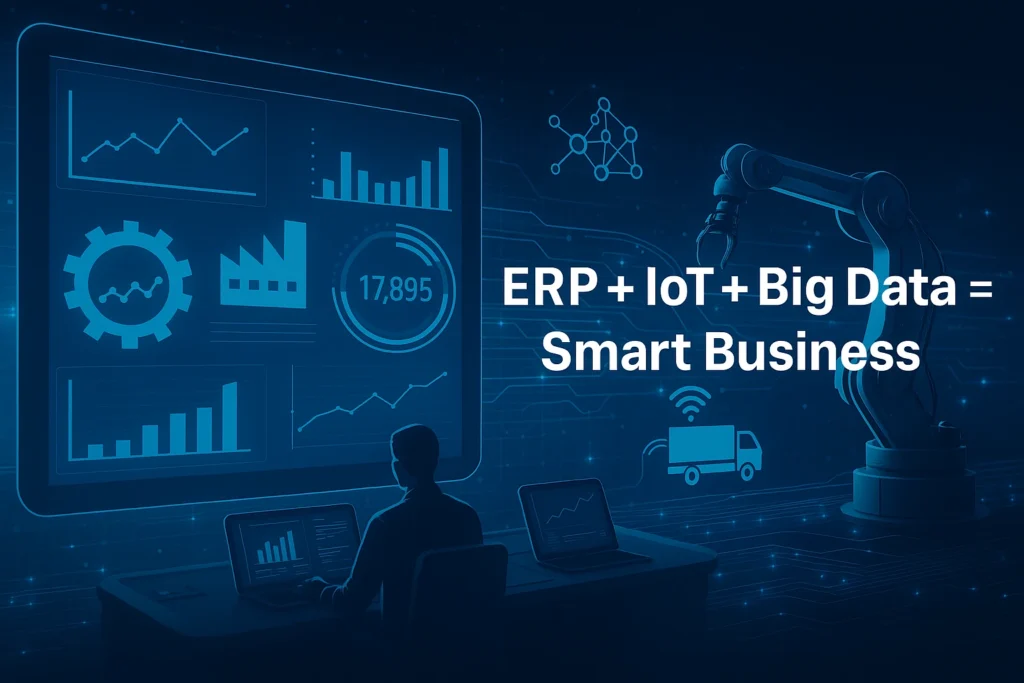
In today’s digitally connected world, data is more than a resource—it’s a strategic asset. As businesses navigate Industry 4.0, the integration of Enterprise Resource Planning (ERP) with the Internet of Things (IoT) and Big Data has become a game-changer. This convergence is unlocking real-time insights, improving operational efficiency, and enabling intelligent decision-making like never before.
Integrating ERP with IoT & Big Data is no longer a futuristic concept—it’s the cornerstone of smart business. In this blog, we’ll explore how this integration works, its benefits, real-world use cases, and what the future holds.
Understanding the Building Blocks
What is ERP?
Enterprise Resource Planning (ERP) is a software solution that centralises and manages core business processes—like finance, HR, procurement, inventory, and customer relationships—in one unified platform. By streamlining operations and providing data visibility, ERP empowers businesses to work more efficiently.
What is IoT (Internet of Things)?
IoT refers to a network of interconnected devices that collect and share data over the internet. In the industrial landscape, IoT includes sensors, machines, and systems that communicate real-time data—such as temperature, pressure, or equipment status—without human intervention.
What is Big Data?
Big Data describes the massive volume of structured and unstructured data generated daily. Its value lies not in its size but in how organisations analyse and interpret it to gain actionable insights. Characteristics of Big Data include high volume, velocity, variety, and veracity.
Why Integrating ERP with IoT & Big Data Matters
Breaking Down Data Silos
Traditional ERP systems operate in isolation. IoT and Big Data integration breaks down silos, enabling a continuous flow of information across departments and devices. This leads to greater transparency and collaboration.
Enhancing Operational Efficiency
IoT devices generate real-time data that feeds directly into ERP systems, triggering automated workflows and alerts. This synergy helps optimise maintenance schedules, reduce waste, and streamline production.
Enabling Data-Driven Decision Making
Big Data analytics within ERP systems enables businesses to make faster, smarter decisions. Whether it’s forecasting inventory needs or predicting machine failure, data-backed decisions reduce risks and improve outcomes.
Key Business Benefits of ERP, IoT & Big Data Integration
Improved Asset and Inventory Management
IoT-enabled sensors track inventory and equipment status in real time. ERP systems use this data to automatically reorder supplies, monitor usage patterns, and reduce overstocking or shortages.
Predictive Maintenance and Reduced Downtime
By analysing IoT data, businesses can detect anomalies and predict equipment failures before they occur. ERP platforms can then schedule maintenance proactively—minimising downtime and repair costs.
Smart Manufacturing and Industry 4.0
Integrated systems create smart factories where production processes are self-optimised. Machines communicate directly with ERP systems, improving agility, quality control, and responsiveness to market demands.
Enhanced Customer Experience
Access to real-time data enables personalised customer service, faster delivery times, and better product traceability. ERP-integrated data from IoT devices can alert support teams before issues arise, improving satisfaction.
Real-World Use Cases
Manufacturing
A smart factory integrates machine sensors with ERP to track performance and output in real time. When a machine shows signs of wear, the ERP system triggers maintenance requests—preventing costly breakdowns.
Logistics & Supply Chain
IoT devices track shipment location and condition. ERP systems use this data to update delivery timelines, adjust routing, and automate restocking—ensuring a more resilient supply chain.
Retail
Smart shelves with IoT sensors track product movement. Combined with Big Data analytics, ERP systems can predict demand patterns, optimise stocking, and create personalised marketing campaigns.
Challenges in Integration
Data Security and Privacy
With vast amounts of data flowing from IoT devices into ERP systems, cybersecurity becomes critical. Companies must adopt strict data governance and comply with regulations like GDPR.
System Compatibility
Legacy ERP systems often lack the flexibility to integrate with IoT platforms or handle large datasets. Modern cloud-based ERP solutions with open APIs are better suited for integration.
Cost and ROI Considerations
Implementing IoT and Big Data tools alongside ERP systems can require a significant investment. However, long-term benefits like reduced downtime, better forecasting, and increased agility often justify the cost.
Steps to Successfully Integrate ERP with IoT & Big Data
1. Choose the Right ERP Platform
Look for ERP solutions that are cloud-based, modular, and integration-ready. Support for APIs and data analytics tools is essential.
2. Define a Clear Data Strategy
Identify what data you need, where it comes from, and how it will be used. Ensure data quality and consistency from the start.
3. Foster Cross-Functional Collaboration
Successful integration requires collaboration between IT, operations, data science, and executive leadership teams.
4. Leverage AI and Machine Learning
AI can uncover hidden patterns and automate decision-making. Integrating AI with ERP, IoT, and Big Data takes predictive capabilities to the next level.
Future Trends to Watch
Edge Computing and Real-Time Insights
Edge computing allows data processing at or near the source, reducing latency and enabling faster ERP responses.
AI-Powered ERP Platforms
Next-gen ERP systems will come with built-in AI to automate complex business scenarios and enhance forecasting.
Digital Twins and 5G Connectivity
The rise of digital twins—virtual replicas of physical assets—and 5G will enable more accurate simulations and faster data transmission across systems.
Conclusion
The future of smart business lies in integrating ERP with IoT & Big Data. This powerful trio delivers real-time visibility, predictive power, and operational agility. By breaking down silos, automating processes, and unlocking deep insights, businesses can make smarter decisions, reduce risks, and stay competitive in a rapidly evolving digital landscape.
Ready to make your business smarter?
👉 Schedule a free ERP consultation to explore how IoT and Big Data integration can transform your operations.