
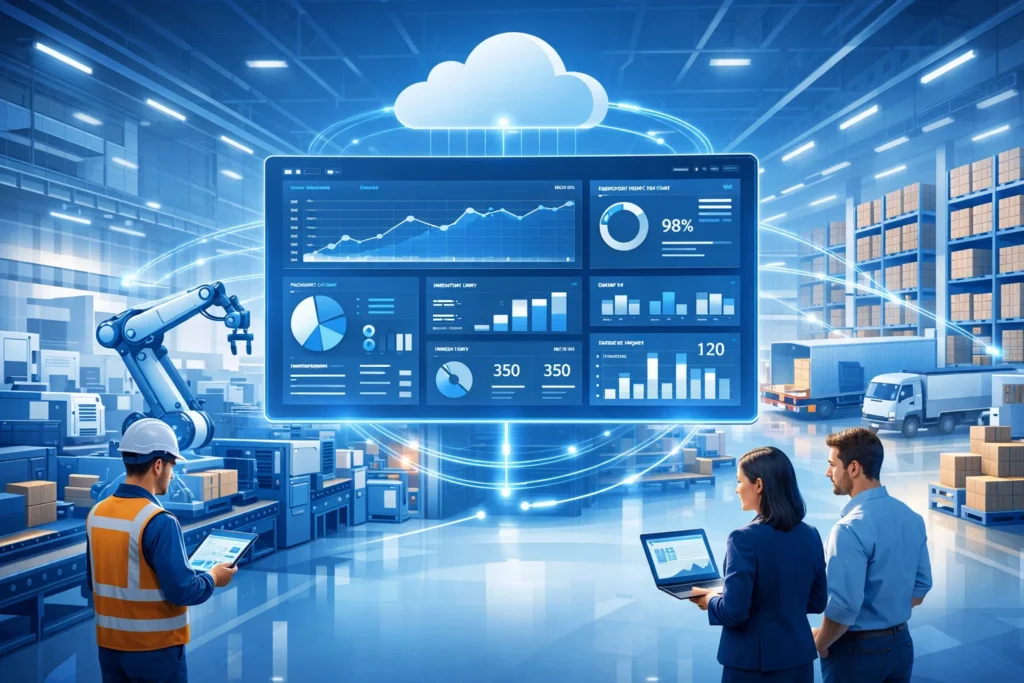
Manufacturing companies must manage complex operations such as production planning, inventory control, procurement, finance, and supply chain management. Handling these processes manually or using disconnected systems can lead to delays, inefficiencies, and costly errors.
This is why many manufacturers rely on ERP software for manufacturing companies. ERP systems integrate all business operations into one centralised platform, allowing manufacturers to streamline processes, improve productivity, and make data-driven decisions.
In this guide, we explore the top ERP software solutions for manufacturing companies, including their key features and how they support modern manufacturing operations.
What Is ERP Software for Manufacturing?
ERP (Enterprise Resource Planning) software for manufacturing is designed to integrate critical business functions into a single system. These platforms help manufacturers manage everything from raw material procurement to finished product delivery.
Key modules typically include the following:
- Production planning and scheduling
- Inventory and warehouse management
- Procurement and supplier management
- Quality control
- Finance and accounting
- Sales and order management
- Supply chain coordination
By centralising data across departments, ERP systems help manufacturers operate more efficiently and respond quickly to changing market demands.
Key Benefits of ERP Software for Manufacturers
Improved Production Planning
Manufacturing ERP systems provide real-time insights into machine capacity, labour availability, and material requirements. This helps businesses optimise production schedules and reduce downtime.
Better Inventory Management
ERP platforms track raw materials, work-in-progress, and finished goods in real time, preventing stock shortages and excess inventory.
Streamlined Supply Chain Operations
ERP integrates procurement, suppliers, and logistics into one system, improving coordination and reducing delays.
Real-Time Business Insights
Modern ERP dashboards provide analytics and reports that help managers monitor performance and make better strategic decisions.
Enhanced Quality Control
Manufacturers can track quality metrics, identify defects early, and maintain consistent product standards.
Top ERP Software for Manufacturing Companies
Here are some widely used ERP solutions that help manufacturing businesses manage production and operations efficiently.
1. Chirix ERP
Chirix ERP is a business management platform designed to help companies streamline operations across production, inventory, finance, and supply chain management.
Key Features
- Production and manufacturing management
- Inventory tracking and control
- Financial and accounting modules
- Integrated reporting and analytics
Best for: Small and medium manufacturing businesses seeking an integrated ERP platform
2. Oracle NetSuite ERP
Oracle NetSuite is a cloud-based ERP solution that helps manufacturers manage operations, finance, inventory, and customer relationships in one unified platform.
Key Features
- Cloud-based architecture
- Inventory and order management
- Financial automation
- Real-time dashboards and analytics
Best for: Growing and mid-sized manufacturing companies
3. Microsoft Dynamics 365
Microsoft Dynamics 365 offers flexible ERP capabilities integrated with tools like Power BI and Office 365, making it a popular option for businesses already using the Microsoft ecosystem.
Key Features
- Manufacturing resource planning
- AI-driven insights
- Supply chain optimisation
- Seamless Microsoft integrations
Best for: Manufacturers using Microsoft technologies
4. Epicor Software ERP
Epicor ERP is specifically designed for manufacturing industries, including automotive, aerospace, and industrial machinery.
Key Features
- Shop floor control
- Production scheduling
- Quality management
- Industry-specific manufacturing modules
Best for: Mid-sized manufacturers with complex production environments
5. Odoo Manufacturing ERP
Odoo is a modular ERP platform with a manufacturing module suitable for small and medium-sized businesses looking for a flexible and customisable solution.
Key Features
- Modular ERP system
- Production and inventory management
- CRM and accounting integration
- Highly customisable workflows
Best for: Small to mid-sized manufacturers
6. SAP S/4HANA
SAP S/4HANA is one of the most advanced ERP platforms used by large manufacturing enterprises worldwide. It provides deep integration across finance, production, and supply chain operations.
Key Features
- Advanced production planning
- Supply chain optimisation
- Real-time analytics
- Industry-specific manufacturing modules
Best for: Large manufacturing enterprises
ERP Software Comparison for Manufacturing
| ERP Software | Best For | Deployment | Key Strength |
|---|---|---|---|
| Chirix ERP | Small and mid-sized businesses | Cloud | Integrated business management |
| Oracle NetSuite | Growing businesses | Cloud | Integrated finance and operations |
| Microsoft Dynamics 365 | Microsoft ecosystem users | Cloud | AI and analytics integration |
| Epicor ERP | Manufacturing industries | Cloud / On-premise | Shop floor management |
| Odoo ERP | SMEs | Cloud / On-premise | Modular and customizable |
| SAP S/4HANA | Large enterprises | Cloud / On-premise | Advanced manufacturing analytics |
How to Choose the Right ERP for Your Manufacturing Business
Selecting the best ERP system depends on several important factors.
Business Size
Large manufacturers typically require enterprise-level ERP systems, while small and mid-sized businesses may prefer cloud-based solutions.
Industry Requirements
Some manufacturing sectors require specialised ERP modules such as batch production, quality tracking, or compliance management.
Integration Capabilities
The ERP system should integrate with your existing tools such as CRM software, accounting systems, and supply chain platforms.
Scalability
Choose an ERP solution that can grow with your business as production volumes increase.
Future Trends in Manufacturing ERP
Manufacturing ERP systems continue to evolve with new technologies shaping the future of smart factories.
Some key trends include the following:
- AI-powered production forecasting
- IoT integration with connected machines
- Real-time production analytics
- Cloud-based ERP adoption
- Automated workflow management
These innovations support the growth of Industry 4.0, enabling manufacturers to build smarter and more efficient operations.
Frequently Asked Questions
ERP software helps manufacturers manage production, inventory, procurement, finance, and supply chain processes within one integrated system.
Solutions like Odoo, Chirix ERP, and other cloud-based systems are often suitable for small to medium-sized manufacturers due to their flexibility and affordability.
The cost varies depending on the features, deployment model, and number of users. Cloud ERP solutions typically offer subscription-based pricing.
Key features include production planning, inventory management, supply chain tracking, quality control, financial management, and analytics.