
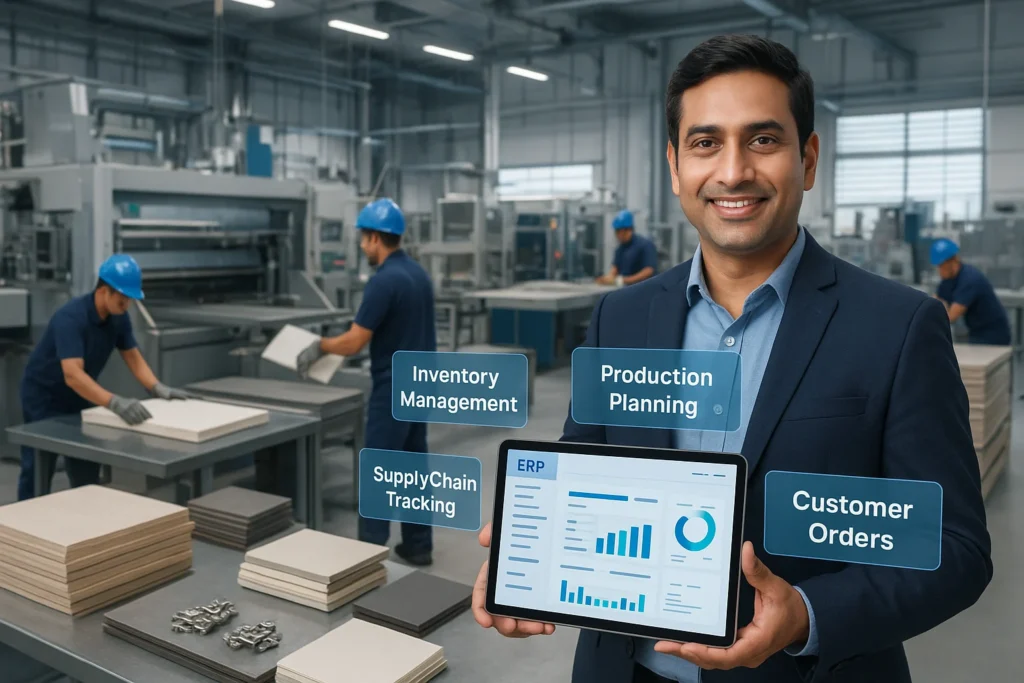
The modular kitchen industry is booming, driven by rising urbanisation, evolving lifestyles, and customer demand for modern, customised home solutions. But behind the sleek cabinets and stylish finishes lies a highly complex process—managing raw materials, multiple vendors, production schedules, and customer expectations.
For modular kitchen manufacturers, these challenges can lead to delayed orders, higher costs, and unhappy customers if not handled efficiently. This is where Enterprise Resource Planning (ERP) software comes in. By centralising operations, automating workflows, and improving visibility across departments, ERP helps modular kitchen businesses scale with confidence.
In this blog, we’ll explore why ERP is essential for modular kitchen manufacturers, the key features to look for, and the top ERP vendors in the market today.
Why Modular Kitchen Manufacturers Need ERP
Challenges in the Modular Kitchen Industry
Running a modular kitchen manufacturing business comes with unique operational challenges:
- Customisation overload – Customers demand different designs, colours, and finishes, leading to thousands of SKU variations.
- Inventory complexity – Tracking raw materials like plywood, laminates, hinges, and handles can become overwhelming.
- Supply chain dependency – Delays from vendors can halt production.
- Manual errors – Traditional processes often result in order mismatches and missed deadlines.
- Lack of visibility – Without real-time data, it’s difficult to forecast demand or monitor profitability.
How ERP Solves These Challenges
ERP software addresses these problems by:
- Offering centralised data management across departments.
- Providing real-time tracking of materials, production, and orders.
- Automating the order-to-delivery cycle for smoother operations.
- Helping manufacturers reduce costs with better planning and forecasting.
Key ERP Features for Modular Kitchen Manufacturers
Inventory & Material Management
- Track stock levels of wood, laminates, hardware, and accessories.
- Prevent over-purchasing and stockouts.
- Automate reordering based on demand.
Production Planning & Scheduling
- Streamline job orders with custom design variations.
- Optimise machine and workforce utilisation.
- Ensure on-time project delivery.
Supply Chain & Vendor Management
- Manage multiple suppliers with ease.
- Track purchase orders, deliveries, and supplier performance.
- Improve collaboration with vendors.
Sales & Customer Relationship Management (CRM)
- Capture customer requirements and design preferences digitally.
- Provide real-time updates on production and delivery.
- Build stronger customer relationships with timely communication.
Finance & Cost Control
- Monitor project-wise costs and profitability.
- Automate billing, GST compliance, and financial reporting.
- Gain a clear picture of cash flow and margins.
Business Intelligence & Reporting
- Custom dashboards to analyse production efficiency, sales trends, and inventory health.
- Data-driven insights to support better decision-making.
Benefits of ERP for Modular Kitchen Manufacturers
Implementing ERP can deliver measurable business advantages:
- Reduced delays by streamlining production workflows.
- Improved customer satisfaction through timely deliveries and transparency.
- Higher profitability with better cost tracking and control.
- Scalability to support franchise models or multi-location expansion.
Top ERP Vendors for Modular Kitchen Manufacturers
Chirix ERP
- Specially designed for manufacturing industries, including modular kitchens.
- Cloud-based, scalable, and user-friendly.
- Offers integration across inventory, production, sales, and finance.
SAP Business One
- Trusted ERP system with strong customisation options.
- Ideal for mid-sized to large manufacturers.
- Provides robust reporting and compliance tools.
Oracle NetSuite
- Cloud-first ERP with advanced supply chain and inventory management.
- Suitable for fast-growing modular kitchen businesses.
- Scalable and flexible with global reach.
Microsoft Dynamics 365
- Combines ERP and CRM in one solution.
- Best for businesses with multiple outlets or franchises.
- Strong analytics and AI capabilities.
Odoo ERP
- Open-source, modular, and highly customisable.
- Affordable option for small to medium modular kitchen businesses.
- Wide range of apps to cover every business function.
How to Choose the Right ERP for Your Modular Kitchen Business
Selecting an ERP solution depends on:
- Business size & complexity – Small businesses may opt for Odoo, while larger ones may need SAP or Microsoft Dynamics.
- Industry-specific features – Look for solutions that support modular kitchen workflows like production scheduling and material tracking.
- Integration & scalability – Ensure it integrates with existing tools and can scale with your business.
- Vendor support & pricing – Evaluate after-sales service, training, and overall cost.
Conclusion
For modular kitchen manufacturers, ERP is not just a tool—it’s a strategic investment for growth and efficiency. By centralising operations, cutting down delays, and providing real-time insights, ERP ensures your business delivers high-quality kitchens on time and within budget.
If you’re looking for an ERP that fits your manufacturing needs, Chirix ERP is tailored to help businesses like yours achieve scalability and long-term success.
ERP helps modular kitchen manufacturers manage inventory, streamline production, reduce delays, and improve customer satisfaction by centralizing all operations.
Important features include inventory management, production planning, vendor management, CRM, financial tracking, and real-time reporting.
Top ERPs include Chirix ERP, SAP Business One, Oracle NetSuite, Microsoft Dynamics 365, and Odoo—each catering to different business sizes and needs.
ERP ensures timely deliveries, transparency in order tracking, and accurate customization, resulting in better customer experiences.
Yes. Cost-effective solutions like Odoo or Chirix ERP offer scalable plans for small to mid-sized manufacturers.