
Introduction
The introduction of the Goods and Services Tax (GST) transformed the way businesses in India manage taxation. For small and medium-sized enterprises (SMEs), adapting to GST was not just a regulatory requirement but also a challenge in terms of accuracy, compliance, and efficiency.
This is where GST-compliant ERP software for Indian SMEs becomes essential. Unlike traditional accounting tools, ERP integrates all business functions—finance, sales, inventory, supply chain, and HR—while ensuring seamless GST compliance. For SMEs with limited resources, the right ERP solution not only simplifies tax processes but also fuels long-term business growth.
In this blog, we’ll explore why SMEs need GST-ready ERP systems, the features to look for, benefits across industries, and how to choose the best ERP vendor in India.
Why Indian SMEs Need GST – Compliant ERP
Simplifying Tax Compliance
Manual GST calculations are time-consuming and prone to errors. A GST-compliant ERP automates invoice generation, reconciles transactions, and ensures that returns (GSTR-1, GSTR-3B, etc.) are filed accurately and on time. This reduces the administrative burden for SMEs.
Avoiding Penalties & Errors
Late filings, incorrect tax input, or misclassified invoices can lead to penalties. With real-time invoice validation and automated updates on GST law changes, ERP helps SMEs stay compliant.
Supporting Business Scalability
As SMEs expand across states or add new branches, GST compliance becomes complex. ERP ensures compliance with state-specific GST rules and enables centralised management of tax processes, making it easier to scale operations.
Key Features to Look for in a GST-Compliant ERP
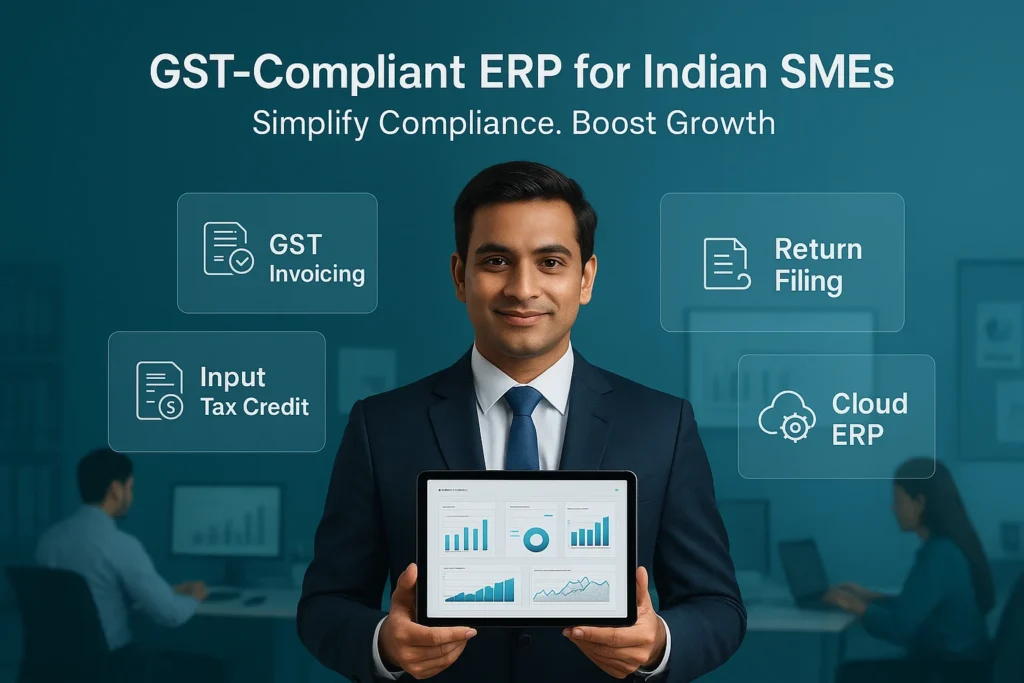
GST-Integrated Billing & Invoicing
ERP automatically generates GST-compliant invoices, complete with HSN/SAC codes, GSTIN, and tax breakdowns. This ensures legal compliance and smooth audits.
Input Tax Credit (ITC) Management
Tracking ITC across multiple vendors and purchases is crucial. A robust ERP helps SMEs manage ITC claims, avoid mismatches, and maximise tax benefits.
Automated GST Return Filing
Top ERP systems support one-click GST return filing, directly integrating with the GSTN portal. This ensures timely submission without manual intervention.
Real-Time Data Synchronisation
By syncing financial and transactional data, ERP eliminates duplication and errors. Real-time reporting gives SMEs clarity on tax liabilities.
Cloud-Based Deployments for SMEs
Cloud-based ERP reduces IT infrastructure costs and offers SMEs scalability, security, and anywhere access. It’s especially useful for remote teams and multi-location businesses.
Benefits of Using GST-Compliant ERP for Indian SMEs
Streamlined Financial Management
All financial data is stored in one place, making audits faster and reducing the risk of discrepancies.
Reduced Manual Workload
Automation minimises paperwork and manual reconciliations, allowing teams to focus on core business activities.
Improved Decision-Making
GST-ready ERP provides insights into profitability, tax liabilities, and sales trends, enabling SMEs to take smarter business decisions.
Compliance Confidence
SMEs can confidently operate knowing their ERP automatically updates with GST law changes, reducing legal risks.
How to Choose the Right GST – Compliant ERP for Your Business
Define Your Business Requirements
Every SME is different. Manufacturing companies may need strong inventory tracking, while service providers might prioritise billing and invoicing. Please identify your key needs before shortlisting ERP solutions.
Evaluate Ease of Use & Training Support
Many SMEs have limited IT staff. Choose an ERP with a simple, user-friendly interface and training support for employees.
Check Integration Capabilities
The best ERP integrates with accounting tools, HRMS, CRM, and third-party apps. This ensures smooth operations without needing multiple disconnected software.
Look for Fast ERP Implementation in India.
Time is money for SMEs. Opt for ERP vendors who offer fast implementation, data migration support, and minimal downtime.
Assess Vendor Reputation & Support
Choosing a trusted ERP vendor in India is crucial. Look for a provider with proven industry experience, local support, and strong post-implementation service.
Consider Pricing & ROI
ERP should not be viewed as a cost but an investment. Evaluate pricing models, subscription plans, and the long-term ROI it brings to your SME.
Top Industries Benefiting from GST-Compliant ERP in India
- Manufacturing – Manage raw materials, production, and GST filing seamlessly.
- Retail & Trading – Automate billing, stock movement, and GST invoice generation.
- Textiles & Garments – Track multi-location inventories and handle GST returns easily.
- Pharmaceuticals & Chemicals – Ensure compliance with complex tax rules and regulatory requirements.
- Engineering & Fabrication – Handle purchase orders, vendor invoices, and GST across multiple projects.
- Food & Beverage – Manage fast-moving stock, vendor payments, and GST on sales.
Common Mistakes SMEs Make While Choosing ERP
- Ignoring GST-specific compliance features.
- Overlooking future scalability needs.
- Choosing ERP purely based on price, not value.
- Not evaluating the ERP vendor’s after-sales service and support.
Final Checklist Before Choosing Your ERP
✅ GST compliance features (invoicing, ITC, return filing)
✅ Cloud-based deployment option for flexibility
✅ Integration with purchase orders & inventory
✅ One-click GST return filing
✅ Trusted ERP vendor with SME experience in India
✅ Fast ERP implementation with training & supp ort
Conclusion
In today’s regulatory environment, GST-compliant ERP for SMEs in India is no longer a luxury—it’s a necessity. From ensuring accurate tax compliance to streamlining overall operations, ERP empowers businesses to grow confidently and avoid costly errors.
By selecting the right ERP vendor and focusing on features like cloud-based deployments, fast ERP implementation in India, and seamless integration, SMEs can achieve both compliance and efficiency.
Ready to transform your SME with GST-compliant ERP? Partner with a reliable ERP vendor who understands the Indian business landscape and can deliver tailored solutions for your growth journey.
Because it simplifies tax filing, reduces errors, ensures compliance, and saves time for growing businesses.
GST-compliant invoicing, ITC management, automated GST return filing, and real-time data integration.
Manufacturing, retail, garments, pharmaceuticals, engineering, and food industries.
By automating tax processes, validating invoices, and staying updated with GST law changes.
Evaluate vendor experience, support, industry expertise, implementation speed, and pricing before finalizing.