
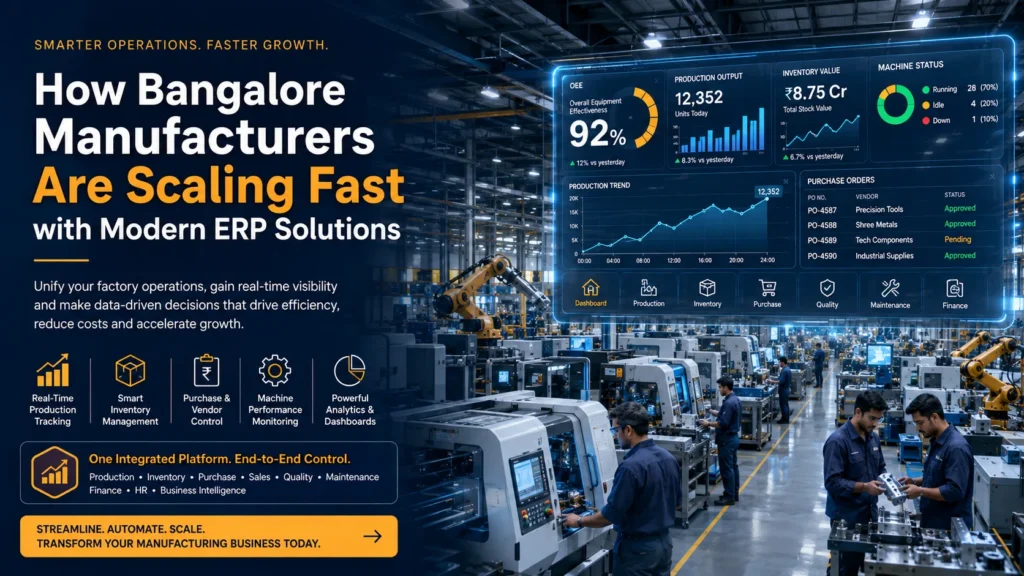
Bangalore has long been recognised as India’s technology capital, but it is also one of the country’s fastest-growing manufacturing hubs. From automotive components and aerospace engineering to electronics, pharmaceuticals, industrial machinery, and precision engineering, manufacturers across Bangalore are embracing digital transformation to stay competitive.
As businesses expand, managing production, inventory, procurement, finance, and customer orders using spreadsheets or disconnected software becomes increasingly difficult. Manual processes often lead to production delays, inventory shortages, rising operational costs, and poor decision-making.
This is where modern ERP (Enterprise Resource Planning) solutions are making a significant impact. By integrating every business function into a single platform, ERP software provides manufacturers with real-time visibility, automated workflows, and data-driven insights that help them scale efficiently.
In this article, we’ll explore how Bangalore manufacturers are scaling fast with modern ERP solutions, the benefits they deliver, and why investing in the right ERP system is becoming essential for sustainable growth.
Why Bangalore Is a Manufacturing Powerhouse
Bangalore has evolved into one of India’s most dynamic industrial ecosystems. Its strong infrastructure, skilled workforce, access to technology, and proximity to major suppliers have attracted manufacturers from a wide range of industries.
Some of the key sectors driving Bangalore’s manufacturing growth include:
- Automotive Components
- Aerospace & Defence
- Industrial Machinery
- Electronics Manufacturing
- Pharmaceutical Production
- Medical Devices
- Plastic & Packaging
- Engineering Equipment
With growing domestic and international demand, manufacturers are under increasing pressure to improve efficiency while maintaining quality and controlling costs.
The Challenges Facing Growing Manufacturers
As production volumes increase, manufacturers often encounter operational bottlenecks that limit scalability.
1. Inventory Management Issues
Many businesses struggle with:
- Overstocking
- Stock shortages
- Inaccurate inventory records
- Manual stock reconciliation
Without real-time inventory visibility, production schedules are frequently disrupted.
2. Production Delays
Production planning becomes increasingly complex when:
- Raw materials arrive late
- Machines remain idle
- Work orders are not tracked effectively
- Departments operate independently
These delays directly affect customer satisfaction and profitability.
3. Disconnected Business Processes
Many manufacturers still rely on separate software for:
- Finance
- Inventory
- Sales
- Purchase
- Production
Because these systems don’t communicate with one another, employees spend valuable time manually entering the same data multiple times.
4. Limited Business Visibility
Management teams often struggle to answer questions such as:
- Which production line is performing best?
- What is today’s production output?
- Which customer orders are delayed?
- How much inventory is available?
- What is the current production cost?
Without accurate real-time data, strategic decisions become slower and less reliable.
What Is a Modern ERP Solution?
A modern ERP solution is an integrated software platform that connects every department within a manufacturing organisation.
Instead of managing multiple standalone applications, manufacturers can monitor all operations from a single dashboard.
A manufacturing ERP typically includes:
- Production Planning
- Inventory Management
- Purchase Management
- Sales Management
- Warehouse Management
- Finance & Accounting
- Human Resources
- Quality Control
- Maintenance Management
- Business Intelligence Dashboards
Cloud-based ERP solutions also enable users to access business information securely from anywhere, supporting remote management and multi-location operations.
How Modern ERP Solutions Help Bangalore Manufacturers Scale
Streamlined Production Planning
Efficient production planning is essential for meeting customer demand while minimising downtime.
ERP software automates production scheduling by considering:
- Machine availability
- Material availability
- Production capacity
- Delivery deadlines
This reduces manual planning effort and helps manufacturers optimise machine utilisation.
Real-Time Inventory Management
Inventory is one of the largest investments for any manufacturer.
Modern ERP systems provide the following:
- Live stock updates
- Barcode integration
- Batch and lot tracking
- Warehouse visibility
- Automated stock alerts
With accurate inventory data, businesses can reduce excess stock, avoid shortages, and improve cash flow.
Better Purchase Management
ERP solutions simplify procurement by automating:
- Purchase requisitions
- Purchase orders
- Vendor management
- Approval workflows
- Material requirement planning (MRP)
This ensures that production always has the right materials at the right time.
Improved Production Monitoring
Manufacturers can monitor production progress in real time through dashboards displaying the following:
- Production targets
- Actual output
- Machine utilisation
- Downtime
- Operator performance
- Rejection rates
Managers can quickly identify bottlenecks and take corrective action before delays impact delivery schedules.
Faster Decision-Making
Modern ERP dashboards consolidate data from across the business into actionable insights.
Executives can track:
- Sales performance
- Production efficiency
- Inventory value
- Profit margins
- Pending orders
- Cash flow
With instant access to reliable information, decision-making becomes faster and more accurate.
Key Benefits of ERP for Bangalore Manufacturers
Implementing an ERP system offers measurable advantages across the organisation.
Increased Productivity
Automation reduces repetitive manual work, allowing employees to focus on value-added activities.
Reduced Operational Costs
Better inventory control, optimised production schedules, and efficient resource utilisation help lower operating expenses.
Enhanced Product Quality
Integrated quality management ensures inspections are performed consistently throughout the production process.
Better Customer Satisfaction
Accurate production planning and order tracking improve on-time deliveries and strengthen customer relationships.
Improved Financial Control
ERP software provides real-time visibility into costs, revenues, receivables, and profitability, enabling better financial planning.
Business Scalability
As manufacturers expand to new plants or markets, ERP systems can support higher transaction volumes and more complex operations without major process changes.
Essential ERP Features for Manufacturers
When selecting an ERP solution, manufacturers should prioritise features such as the following:
- Production Planning & Scheduling
- Material Requirement Planning (MRP)
- Inventory Management
- Warehouse Management
- Barcode Integration
- Batch & Lot Traceability
- Purchase Management
- Sales & Order Processing
- Quality Control
- Preventive Maintenance
- Financial Accounting
- GST Compliance
- Mobile Accessibility
- Business Intelligence Dashboards
These capabilities enable manufacturers to streamline operations and respond quickly to changing market demands.
Best Practices for ERP Implementation
Successful ERP adoption depends on careful planning and execution.
Define Clear Objectives
Identify the specific business challenges the ERP system should address, such as reducing inventory costs or improving production efficiency.
Standardise Processes
Review and optimise existing workflows before implementing the ERP system to maximise its effectiveness.
Train Employees
Comprehensive training helps users understand the new system and encourages organisation-wide adoption.
Start with high-priority modules.
Begin with critical areas like inventory, production, and finance, then expand to additional modules over time.
Monitor Performance
Track key performance indicators (KPIs) after implementation to measure improvements and identify opportunities for further optimisation.
The Future of Manufacturing in Bangalore
As Industry 4.0 technologies continue to evolve, manufacturers are increasingly integrating ERP systems with the following:
- Artificial Intelligence (AI)
- Internet of Things (IoT)
- Predictive Analytics
- Machine Monitoring
- Cloud Computing
- Business Intelligence Platforms
These technologies enable predictive maintenance, smarter production planning, improved resource utilisation, and enhanced operational visibility.
Manufacturers that embrace digital transformation today will be better positioned to compete in an increasingly data-driven and global marketplace.
Frequently Asked Questions
ERP software integrates business processes into a single platform, improving efficiency, reducing manual work, and providing real-time operational visibility.
Yes. Modern cloud ERP solutions are scalable and affordable, making them suitable for businesses of all sizes.
ERP provides real-time stock tracking, automated replenishment, barcode integration, and accurate inventory reporting, helping reduce both excess inventory and stock shortages.
Implementation timelines vary based on business size and complexity but typically range from a few weeks to several months.
Cloud ERP offers advantages such as lower infrastructure costs, remote accessibility, automatic updates, and easier scalability, making it a preferred choice for many growing manufacturers.
Conclusion
Bangalore’s manufacturing sector is expanding rapidly, and companies that rely on outdated systems risk falling behind. Modern ERP solutions empower manufacturers with real-time visibility, automated workflows, accurate inventory control, and intelligent production planning, enabling them to operate more efficiently and scale with confidence.
Whether you’re a small manufacturer aiming to streamline daily operations or a large enterprise managing multiple facilities, implementing the right ERP system can transform the way your business operates. By investing in a modern ERP platform, Bangalore manufacturers can reduce costs, improve productivity, enhance customer satisfaction, and build a strong foundation for long-term growth in an increasingly competitive market.
Ready to accelerate your manufacturing growth? Explore a modern ERP solution that aligns with your business goals and take the next step toward smarter, more efficient operations.