
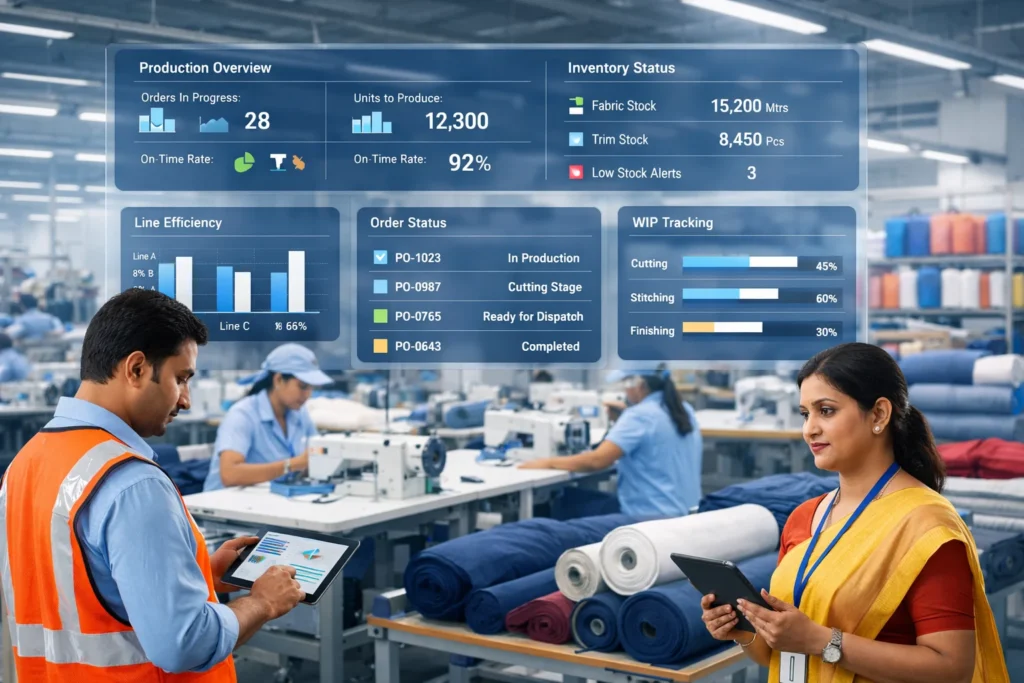
The Indian garment manufacturing industry operates on thin margins, tight delivery schedules, and constant pressure from buyers for quality, compliance, and cost efficiency. Managing fabric inventory, tracking production, calculating piece-rate wages, and meeting dispatch deadlines using spreadsheets or disconnected software often leads to errors, delays, and revenue leakage.
This is where a garment manufacturing ERP becomes a game-changer.
A garment-specific ERP system integrates production planning, inventory, job work, quality, finance, and payroll into one centralised platform—giving factory owners real-time visibility and control. In this guide, we’ll explain how garment manufacturing ERP implementation works, its cost in India, the implementation timeline, and the ROI you can realistically expect.
What Is a Garment Manufacturing ERP?
A garment manufacturing ERP is an industry-specific enterprise resource planning system designed to manage end-to-end apparel production—from raw material procurement to finished goods dispatch.
Unlike generic ERP software, garment ERP systems are built to handle:
- Multiple styles, sizes, and colours
- Fabric and trim wastage tracking
- Line-wise production planning
- Job work and subcontracting
- Production-based wage calculations
This makes them ideal for Indian apparel manufacturers, exporters, and domestic garment units.
Why Garment Manufacturers in India Need ERP Implementation
Indian garment factories face unique operational challenges due to labour-intensive processes, fluctuating raw material prices, and buyer compliance requirements.
Common Problems Without a Garment Manufacturing ERP
- Fabric stock mismatches and excess wastage
- Manual production reporting and delayed MIS
- Inaccurate style costing and margin loss
- Delayed job work tracking and payments
- Difficulty scaling operations as order volume grows
A garment manufacturing ERP system eliminates these issues by digitising and automating daily operations.
Key Modules in a Garment Manufacturing ERP System
Production Planning & Control (PPC)
- Line-wise and operation-wise planning
- Real-time WIP tracking
- Bottleneck identification and efficiency monitoring
Inventory & Warehouse Management
- Fabric roll-wise, lot-wise tracking
- Trims and accessories management
- Shrinkage and wastage control
Job Work & Subcontractor Management
- Outsourced process tracking (cutting, embroidery, washing)
- Job work rate management
- Accurate reconciliation and payments
Quality Control & Compliance
- Inline and final inspection
- Rejection, rework, and alteration tracking
- Buyer compliance reporting
Finance, Costing & Payroll
- Style-wise and order-wise costing
- Production-based wage calculation
- Real-time profitability reports
Garment Manufacturing ERP Implementation Process (Step-by-Step)
Step 1: Business Requirement Analysis
The ERP vendor studies your current workflows—cutting, stitching, finishing, packing, and dispatch—to identify gaps and automation needs.
Step 2: ERP Vendor Selection
Choose a vendor with proven experience in Indian garment factories, not a generic ERP provider.
Step 3: System Configuration & Customisation
The ERP is configured to match:
- Your production flow
- Wage calculation logic
- Approval structures and reports
Step 4: Data Migration & Integration
- Masters setup (styles, BOMs, vendors, buyers)
- Integration with accounting or barcode systems if required
Step 5: User Training & Testing
- Role-based training for supervisors, merchandisers, and accountants
- Pilot runs to ensure accuracy
Step 6: Go-Live & Support
The ERP goes live with continuous monitoring, fine-tuning, and support.
Garment Manufacturing ERP Implementation Timeline
Typical Implementation Duration in India
- Small garment units: 4–8 weeks
- Medium-scale factories: 2–4 months
- Large or multi-location units: 4–6 months
Factors That Affect Timeline
- Number of ERP modules
- Level of customisation
- Availability of accurate data
- User adoption readiness
Cost of Implementing a Garment Manufacturing ERP in India
ERP Cost Components
- Software licence or cloud subscription
- Implementation and setup charges
- Training and annual support
Approximate Cost Range (India)
- Small units: ₹1.5 – ₹3 lakhs
- Medium factories: ₹3 – ₹8 lakhs
- Large enterprises: ₹10 lakhs and above
Cloud-based garment manufacturing ERP systems are increasingly preferred in India due to lower upfront cost and faster deployment.
ROI of Garment Manufacturing ERP Implementation
Tangible Benefits
- 5–15% reduction in fabric wastage
- 10–20% improvement in production efficiency
- Faster order execution and dispatch
Intangible & Strategic Benefits
- Real-time decision-making
- Improved buyer confidence
- Better compliance and audit readiness
Sample ROI Scenario
If a factory spends ₹5 lakhs on ERP implementation and saves ₹1–1.5 lakhs per month through reduced wastage, labour optimisation, and improved productivity, the payback period is just 4–6 months.
Common Challenges in Garment ERP Implementation (and Solutions)
- Resistance to change → Proper training and management involvement
- Poor data accuracy → Clean masters before migration
- Over-customisation → Follow standard garment ERP best practices
Best Practices for Successful Garment Manufacturing ERP Implementation
- Strong top-management involvement
- Clear KPIs and reporting goals
- Phased module implementation
- Continuous feedback from production teams
How to Choose the Right Garment Manufacturing ERP Vendor
Look for:
- Apparel industry specialisation
- Indian factory implementation experience
- Strong post-implementation support
- Scalable cloud-based architecture
Is Garment Manufacturing ERP Worth the Investment?
For Indian garment manufacturers, ERP is no longer optional—it’s a strategic necessity. With better control over inventory, production, costs, and compliance, a garment manufacturing ERP delivers rapid ROI and long-term growth.
Investing in the right ERP today prepares your factory for higher volumes, better buyers, and sustainable profitability.